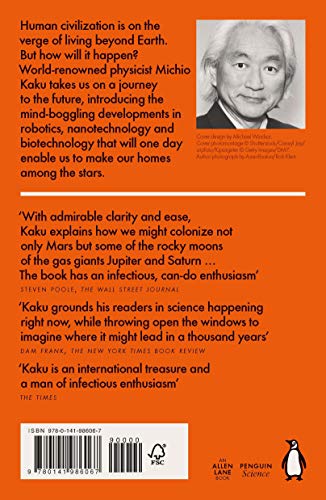


desertcart.in - Buy The Future of Humanity book online at best prices in India on desertcart.in. Read The Future of Humanity book reviews & author details and more at desertcart.in. Free delivery on qualified orders. Review: Landmark - This is an exploration of the topics at the frontier of human endeavour. It might well serve as a laundry list of future careers and fields of enquiry, for those interested. Future herein refers to near term to practically forever . A one of a kind work Review: Just perfect! - Got a damaged piece at first, replaced it with a pristine copy.. The book is indeed exceptional. I already enjoyed reading the Parallel Worlds by the same author, loving this one too. Easy 5 stars!
| Best Sellers Rank | #17,504 in Books ( See Top 100 in Books ) #25 in Astronomy (Books) #383 in Society & Culture (Books) #399 in Crafts, Hobbies & Home |
| Country of Origin | United Kingdom |
| Customer Reviews | 4.6 4.6 out of 5 stars (2,605) |
| Dimensions | 13 x 2.3 x 19.7 cm |
| Generic Name | BOOK |
| ISBN-10 | 0141986069 |
| ISBN-13 | 978-0141986067 |
| Importer | Penguin Random House India Pvt Ltd |
| Item Weight | 273 g |
| Language | English |
| Net Quantity | 750.00 Grams |
| Packer | Penguin Random House India Pvt Ltd |
| Paperback | 368 pages |
| Publisher | Penguin (1 January 2019); Penguin Random House Ireland Limited; [email protected] |
P**B
Landmark
This is an exploration of the topics at the frontier of human endeavour. It might well serve as a laundry list of future careers and fields of enquiry, for those interested. Future herein refers to near term to practically forever . A one of a kind work
P**D
Just perfect!
Got a damaged piece at first, replaced it with a pristine copy.. The book is indeed exceptional. I already enjoyed reading the Parallel Worlds by the same author, loving this one too. Easy 5 stars!
A**L
Speed Of Light
Wormholes, to another dimension, this is an interesting book which squeezes the essence of time and space. The book end notes on the fate of universe and sheds light on type I,II, III, IV type of civilisations which is classified on the basis of energy consumption. This book encapsulates the idea of transforming vacant lifeless planets into a habitable ones, and discusses the mode of establishing human settlement’s in the distant future. It’s a book which ignites wonder and mysteries of time, space, universe, energy and life.
A**R
Awesome book
Must read
V**R
Very interesting book
This book is very interesting and useful. Highly recommend to read for all age groups.
L**️
A very good book on future science and humanity's destiny among the stars
Love this type of books which try to look into our future based on what we are today. Some countries of Earth are on the verge of interplanetary travel and even settling on other worlds. It is becoming a necessity. Climate change, resource depletion and future catastrophes will compel us to abandon Earth, one day we will make our homes among the stars. Physicist Michio Kaku discussed in detail how humanity might gradually develop a sustainable civilization in outer space and build habitable cities on Mars. Kaku also explores alternative paths to ensure the survival of humanity, including the possibility of genetic engineering and transferring human consciousness into non-biological machines and transcend our physical bodies entirely. Click on the 'Helpful' button if you liked this review. Uploading some pics for your benefit. Thanks for reading.
H**A
Simple yet compelling,mind opener
A highly recommended book!Mr.Kaku gives a futuristic insight to humanity and lists down numerous ways in which we could become an interplanetary species. A must read for space enthusiasts!
A**R
Nice book to read
Book is nice to read has collection of ideas already floating around. Good for non science people. What it lacks is it describes mostly already known things could happen in future for more than last 20 years. It is a book and latest so new ideas imagination gone wild thing that one expects is not there. Many things described may not be implemented as described. Albert Einstein said imagination is more important than knowledge. This book is good for someone looking into future of humanity for the first time. But if you are already think about it and intouch with lastest reasearch going on. You will be disappointed.
T**H
Ein Wunderschönes Buch !!!
K**Y
I've read several of Professor Kaku's books, and there are two things I can say about all of them: (1) they are extremely well written and (2) they will expand your mind. When it comes to the genre of physics books for laypersons, Kaku is as good as it gets. Indeed, his book "Hyperspace" was one of the first books of this genre that I read many years ago, and thanks to Professor Kaku, this one-time English major has become very interested in physics. "The Future of Humanity" is a fun book. This is one of Kaku's gifts--making science fun. Any layperson of average intelligence can (with a little determination) understand Professor Kaku's discussions of quantum physics, relativity, string theory, and related matters. In this book, Kaku covers not only the short-term future, which involves colonization of Mars, and exploration of earth-like planets in our galactic neighborhood. He also takes a look into the very distant future of humanity, when we might well have achieved immortality, and have advanced from our current Type 0 civilization into a Type 3 civilization, which has harnessed the power of galaxies, to explore the entire universe. Along the way, one learns quite a bit about quantum physics, including string theory, and also quite a bit about science fiction, which has inspired Professor Kaku's mind throughout his life. (Kaku's references to science fiction are a great deal of fun and quite interesting). I was most interested in the short-term future and how we solve our problems regarding clean and abundant energy and how we begin to colonize nearby planets. On these issues, Kaku is an optimist, and his optimism is well grounded in science. It is clear that if our species is to survive, we must eventually find ways to leave Earth and colonize Mars and earth-like planets in nearby solar systems. Even overcoming the many challenges of traveling to and eventually colonizing Mars presents daunting obstacles. Professor Kaku discusses these obstacles in great depth and suggests ways that future generations will eventually be able to overcome them. Kaku's discussion of the short-term future (through the end of this century) is quite convincing because there are already many ideas as to how humanity could terraform Mars and eventually travel to nearby earth-like planets. Professor Kaku makes a convincing case that if humanity can avoid self-destruction, we can and will be able to colonize nearby habitable planets, which is absolutely essential to our species' survival. By the end of this century we will probably have colonies on Mars and perhaps on some of the many earth-like planets that have been discovered orbiting nearby stars. The most speculative--and most entertaining--part of this book (for me) was when Professor Kaku looks into the distant future and begins to speculate what humanity could achieve thousands of years from now. This part of the book discusses concepts such as navigating wormholes to explore the vast distances of our universe and the use of AI and robotics to greatly expand our life expectancy to the point where we could realistically hope to explore the known universe and to travel well beyond the limits of our home. This section of the book also raises a number of philosophical questions (e.g., is immortality actually desirable? how will our conception of what it means to be human change when we encounter other civilizations?, will we even recognize our species as human thousands of years from now?), and Kaku's thoughts on these matters are thought-provoking and challenging. I particularly enjoyed Kaku's discussion of Type 1, Type 2, and Type 3 civilizations. We are currently not quite Type 1; our ability to generate the energy that's necessary to travel beyond our planet and to spread humanity throughout the galaxy is still quite primitive, but we are making great progress. We will eventually become proficient at using atomic and solar power in ways that will provide the necessary clean and abundant energy that we need to venture to Mars and beyond. Kaku's discussion of what we might be thousands of years from now when we become a Type 3 species and can harness the power of entire galaxies to explore the entire universe is speculative, but a treat for the imagination--science at its best, inspiring and hopeful. Above all, I think that this is a hopeful book. If humanity can avoid self-destruction, then our future is very bright indeed. Earth will always be home, but to survive as a species we must journey from home to the ends of the universe, and we can do so. This is a very enjoyable and inspiring book by a very talented writer and scientist. Mind-blowing and entertaining.
C**H
Amazing author and communicator...I never thought I would understand physics but it proves that we can all learn new and amazing things with the right teachers
R**E
Just wow. What a beautiful way of explaining the universe to someone who has absolutely NO IDEA of physics, math or anything related. Absolutely recommended.
R**A
This is smart funny and gives an interesting outlook on our next future possibilities.I advice it to anyone willing to understand science basics explained in a really clear and not boring way
Trustpilot
1 week ago
1 month ago