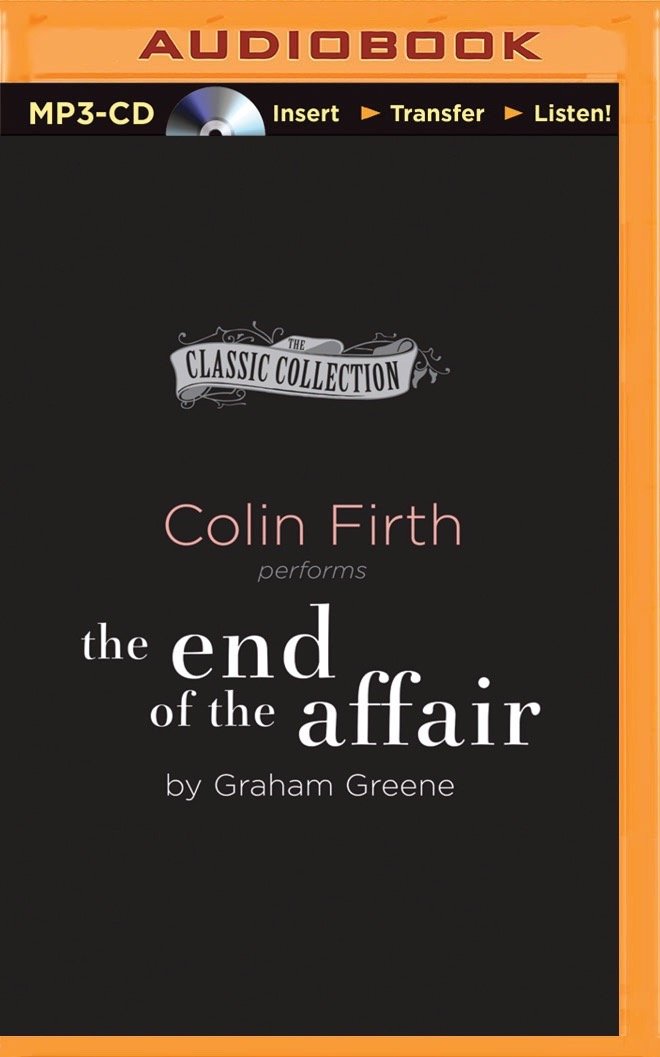
End of the Affair, The (The Classic Collection) [Graham Greene, Colin Firth] on desertcart.com. *FREE* shipping on qualifying offers. End of the Affair, The (The Classic Collection) Review: Of love and hate - I wish it were possible to read certain books for the first time without knowing how they will turn out. But publishers seem to imagine that once a book becomes a classic (and this is one of Greene's masterpieces) the plot becomes common property. I read this in the Penguin Centennial edition, lovely to the eye and soft to the touch, yet the inside-cover blurb manages to reveal in two short paragraphs all the plot twists that Greene, as a master thriller writer, does not disclose until well into the second half of the book. You can see some reviewers on this site trying gamely not to let the cat out of the bag, but others (including the editorial reviews at the top) don't even try. So, if by some miracle you don't know how the novel turns out, stop reading NOW, buy the book, turn straight to page 1 without looking at the cover material, and enjoy. But fortunately, even if you do know the general outline, it is a finely written work of art which will give great pleasure anyhow. The title is unusually apt. How daring to start a novel, literally, with the END of an affair! From this point where a novel might normally finish, Greene's character Maurice Bendrix begins not only to recall the course of his affair with Sarah Miles, the wife of a dull neighbor in the civil service, but also to gnaw on that word "end." Fueled by what he calls hate, but which we come to recognize as the obverse of his passion, he obsesses about how it ended, why it ended, and what happens after the end. Convinced that Sarah has left him for another man, he hires a private detective (Parkis, a surprisingly touching character) to follow her. Those who know Greene well may not find it hard to guess what Bendrix ultimately discovers, or that a rather sordid book about adultery would be transformed into a grueling challenge to the existence of God. It may in fact be the most explicitly religious of Greene's so-called Catholic novels, and too much for some readers, especially at the end. But it is a beautifully crafted work which never loses touch with the realities of this world (the Blitz, social conventions, physical sex) in its ultimate convergence on the next. Review: Lots of depth here - It is written in a clever and interesting format, and is truly about the end of an affair and the aftermath of it. We read this for our book club, and I appreciated the insights of our friend who had read it before. She said that she found the spiritual aspects to be much deeper and had a greater impact on her by reading it a second time. I think it does help the reader to know that the author does believe in God, and this book is really designed to draw us closer to Him despite being largely made up of agnostic/atheist characters. The narrative is interesting and really shows how difficult it is to be happy when doing something wrong.
| Best Sellers Rank | #7,591,095 in Books ( See Top 100 in Books ) #598 in Classic Literature & Fiction #1,270 in Literary Fiction (Books) #26,552 in Books on CD |
| Customer Reviews | 3.9 out of 5 stars 3,752 Reviews |
R**E
Of love and hate
I wish it were possible to read certain books for the first time without knowing how they will turn out. But publishers seem to imagine that once a book becomes a classic (and this is one of Greene's masterpieces) the plot becomes common property. I read this in the Penguin Centennial edition, lovely to the eye and soft to the touch, yet the inside-cover blurb manages to reveal in two short paragraphs all the plot twists that Greene, as a master thriller writer, does not disclose until well into the second half of the book. You can see some reviewers on this site trying gamely not to let the cat out of the bag, but others (including the editorial reviews at the top) don't even try. So, if by some miracle you don't know how the novel turns out, stop reading NOW, buy the book, turn straight to page 1 without looking at the cover material, and enjoy. But fortunately, even if you do know the general outline, it is a finely written work of art which will give great pleasure anyhow. The title is unusually apt. How daring to start a novel, literally, with the END of an affair! From this point where a novel might normally finish, Greene's character Maurice Bendrix begins not only to recall the course of his affair with Sarah Miles, the wife of a dull neighbor in the civil service, but also to gnaw on that word "end." Fueled by what he calls hate, but which we come to recognize as the obverse of his passion, he obsesses about how it ended, why it ended, and what happens after the end. Convinced that Sarah has left him for another man, he hires a private detective (Parkis, a surprisingly touching character) to follow her. Those who know Greene well may not find it hard to guess what Bendrix ultimately discovers, or that a rather sordid book about adultery would be transformed into a grueling challenge to the existence of God. It may in fact be the most explicitly religious of Greene's so-called Catholic novels, and too much for some readers, especially at the end. But it is a beautifully crafted work which never loses touch with the realities of this world (the Blitz, social conventions, physical sex) in its ultimate convergence on the next.
B**R
Lots of depth here
It is written in a clever and interesting format, and is truly about the end of an affair and the aftermath of it. We read this for our book club, and I appreciated the insights of our friend who had read it before. She said that she found the spiritual aspects to be much deeper and had a greater impact on her by reading it a second time. I think it does help the reader to know that the author does believe in God, and this book is really designed to draw us closer to Him despite being largely made up of agnostic/atheist characters. The narrative is interesting and really shows how difficult it is to be happy when doing something wrong.
L**S
My least favorite of all his books.
The story reads like a blow by blow account of an actual, unfulfilling, extramarital affair. I found it self-absorbed, self-involved, and self-indulgent, which may or may not be the actual case. Who knows. And even more to the point, who cares? That's my primary criticism of this book. I didn't care a bit for any of the primary characters. They weren't interesting, weren't engaging. They whined for 275 pages. The second half of the book is an examination of religion and love of God. Once again, it wasn't interesting because I don't wrestle with these issues in my own life. If I struggled with religion I might have been more open to his struggle. But I don't, so I'm not. I don't think he could have gotten this thing published if it was his first or second novel. All that said, I am a huge fan. I love his direct, clean writing. I guess everybody has a low point in their chosen field. This is Greene's.
L**E
Where Has Graham Greene Been My Whole Life?
From the first time I discovered that Graham Greene was a Catholic author, I wanted to check out his work. This was years and years ago, but it wasn't until The End of the Affair was marked down on Audible.com that I finally took the plunge. What a waste of years! The End of the Affair is one of the best books I've ever read. The story of Bendrix's affair with Sarah and its aftermath are so perfect, so true. Bendrix is never quite certain if his story is about love or hate, despair or hope. It is always one extreme or the other. When he believes his competition for Sarah's love is her husband or another man, he hates Sarah in his despair and wants to destroy her. He cannot bare not knowing what took her away. It stifles his art and eats him alive. When he ultimately learns the truth about the ending of their relationship, he is elated and at once certain that he can overcome it all. Michael Kitchen narrated the audio version of this novel and he was no less than superb. This may sound odd (I think it's odd, but I'll share anyway), but the way Kitchen used his breath, particularly in exhaling, made it seem like Bendrix was in my car with me. We were having an intimate conversation. I could almost smell his tobacco. The effect was fantastic and could not have happened had Kitchen not been paired with such a gifted author. It was a wonderful way to first experience Graham Greene. If you've read The End of the Affair before and are hankering for a reread, I cannot recommend this audio version enough. Even though I loved the audio, I found that I had to possess the book as well. A Kindle version just wouldn't do. I immediately turned around and bought the Penguin Classics Deluxe edition of both The End of the Affair and, on Rebecca from The Book Lady's Blog's suggestion, The Quiet American. As soon as they arrived, I hugged them to my chest. It felt so good and was nearly impossible for me to not start rereading The End of the Affair. When I began reading The End of the Affair, I didn't know what to expect. What really surprised me was the ending would have a similar affect on me as Gone With the Wind. It was so open ended and I loved every possibility. I cannot rave about it enough. The End of the Affair has got to be the best book I've read since I started blogging. More Graham Greene, please. Wow!
E**H
Wonderful classic!
If only today’s books were written like this. It is smart, thought provoking and has clean language even with an adult theme. Bravo! I can see why the author is considered one of the best from the 20th century.
T**C
If You've Seen The Film
Be prepared for a completely different story. Oh, the same elements are there: the setting is London during and post World WarII, the characters are basically the same (though there was a merging of the Lancelot and rationalist "preacher" in the film), but the insight and heart of the story are quite distinct. I had seen the film and loved it so my mum (Irish Catholic one at that) bought me the book and it's easy to see why. This is not a love story (or triangle) between people; it's between human nature and God (specifically Catholicism). Sarah is married to a bland but wealthy man and has various affairs but never falls in love until she meets Maurice (an acquaintance of her husband). They have a passionate affair and then, right after Maurice has a near fatal experience, she breaks off the relationship without any explanation to him. Years later, he meets her again and becomes obsessed with discovering why she left. That's the end of the similarities. In the film, Sarah runs off with Maurice and breaks her promise to God only to find that she has an incurable illness. In the book (I hope I'm not giving anything away. This book is about the journey and not the destination), she keeps her promise to God but sacrifices herself. This is a beautiful book even if you are a Secularist like myself. One line will stay with you forever "I hate you, God. I hate you as if you existed". It sums up the book; the epic struggle between our human love and our duty to God; the pleasures of this life verses obeying the divine. You might not agree with Sarah's choice (I didn't), but there is a great nobility in her sacrifice that touches the very heart of even this skeptic. It is a beautiful classic that works both as a love story between Sarah and Maurice, and as a love story/struggle between humanity and God. Simply beautiful.
K**A
A mish mash of religion and obsessive love
There is a lot to like about this book. As usual, the mastery of phrasing and characterisation of Greene are in full display. It started , very promisingly for me, with a highly evocative scene of two men meeting with no apparent purpose in mind but both with heaps of baggage, emotional as well as ideological. Greene saves this novel from descending into another "Passion of Maurice Bendrix" by the astute observations on how the affair was conducted , with Parkis and his boy sad side actors in the play. Towards the end, the novel became unbearably infused with religiosity, all kinds of miracles being shown up to persuade us that we are fools not to believe in god. I am sure Greene can do better than this.
B**K
Leaves the reader with much to think on
I really enjoyed this book. The explorations of love vs hate, morality and faith, fidelity vs lust are thought-provoking well balanced throughout. Somewhat spoiler-y below - - - - - - I found myself strangely rooting for the narrator by the end. Hoping that his stubborn hate would sustain him, though doubting it would last, truly, at the end. For he was crumbling, wasn’t he? A fine story. Something refreshing and different from a lot of books.
Trustpilot
1 week ago
3 days ago