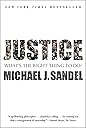


Justice: What's the Right Thing to Do? [Sandel, Michael J.] on desertcart.com. *FREE* shipping on qualifying offers. Justice: What's the Right Thing to Do? Review: Sandel's virtues - Justice: What's the Right Thing to Do? Michael Sandel teaches a Harvard course on moral reasoning and justice, so popular that the university has produced it as online video (which you can preview for free). Upon reading Justice: What's the Right Thing to Do you will quickly understand why Sandel's course draws rave reviews. The book is marvelously instructional, even for readers already well-educated in political philosophy. Sandel explores each of the principal aims of justice: maximizing welfare, respecting freedom, and promoting virtue. He delivers clear expositions and critiques of utilitarianism, libertarianism, Kantian ethics, and John Rawls' theory of justice, and then builds a case for the views of Aristotle. Sandel makes all of this easy to assimilate by framing the theoretical discussion in dozens of cases that lay out the issues. His typical approach is to describe a situation posing a moral dilemma, to ask (either explicitly or implicitly) for our reaction about what the right choice would be, and then to probe what moral principle might support that choice. A few of his cases are hypothetical (such as the notorious trolley cars headed toward people on the track) but most are drawn from history, the news, or popular culture, and many are quite contemporary. This may be the only book of serious political philosophy where some of the lessons appropriately rely on Winnie the Pooh, the Simpsons, Miss Manners, and Woody Allen. More typically, the illustrations resonate because they involve humans having to make tough decisions, choices that we ourselves would likely struggle with. No matter what your predispositions, you may find yourself thinking in new ways about such issues as immigration, affirmative action, abortion, stem cell research, assisted suicide, same-sex marriage, and voluntary cannibalism, for example. Sandel's principal criticism of modern theories of justice is that they try to separate questions of fairness and rights from arguments about honor, virtue, and moral desert, that they seek principles that are neutral among ends, enabling people to choose their own preferences. Following Aristotle, Sandel believes that separating arguments about justice from those about the good life is neither possible nor desirable, that the good is prior to the right. Our stance on same-sex marriage, for instance, requires us to take a position on the purpose of marriage, which is contested moral terrain. "A just society can't be achieved simply by maximizing utility or by securing freedom of choice. To achieve a just society we have to reason together about the meaning of the good life, and to create a public culture hospitable to the disagreements that will inevitably arise," he declares. For Sandel, as for Aristotle, the purpose of politics is to form good citizens and cultivate good character. A good philosophy teacher does not necessarily seek total agreement and may leave his or her students with further questions. Here are just a few that occur to me. Is justice a matter of principles guiding behavior or of physiologically instilled moral sentiments helping to shape principles, or both (Sandel's position is not fully elaborated)? If our cultural identities inevitably and desirably inform our moral choices (as he advocates), what principles prevent those communal encumbrances from becoming oppressive (as he warns is possible)? Even if we cannot set aside our cultural identity, why would it be undesirable to try to do so, to be as impartial as possible in questions of justice (think of the Sotomayor confirmation hearings)? Justice is the sort of book that may make you wish you could take Sandel's follow-up class. Review: a tough look at a complicated topic - I find thinking about basic concepts - those that form the essence of our society - can be very tough going. Basic concepts, when one thinks hard about them, become slippery. What, after all, is meant by the concept of "ethics" or "morality" or, for that matter, "justice"? These words are so frequently used that their precise meaning is assumed. They seem joined; their meaning seems a bit blurred. Are ethics the same concept as morals? Are ethics a way of living, a way of sorting out right from wrong, encompassing such concepts as fairness, honesty, compassion, a guidepost to finding the good life? Are morals something a bit more constrained? Are they concerned with doing the right thing, always with a view toward the impact of our actions on other human beings? If these distinctions are hard enough, "justice" is an even harder concept. We all know that a "just" society is vastly preferred over an "unjust" one. It offers a route to the diffusion of happiness throughout society. But is a just society compatible with gaping differences in the economic or social position of different people in the society? Does a just society require that most people enjoy similar benefits? Can a society be considered to be "just" if a few control the many? What exactly is "justice" and how is it measured? How is it created? How can we tell if a society is "just"? In the end, is a "just" society preferable to one that is less just? If so, how can we tell it is preferable? These are the tough concepts that Michael Sandel tackles in a very challenging, but ultimately deeply satisfying thought piece. His book, Justice, What's the Right Thing to Do?, takes three quite different cuts at surveying the field of justice. This is complicated stuff and I would advise any reader to take notes as the essay unfolds. It is easy to lose the thread, not because Sandel is not precise and not because he is boring. In fact, he is neither: he is very clear and demanding in his thinking and he illustrates different concepts of justice and fairness (not that these are necessarily identical concepts) with real-life examples that ask the reader to look at the same set of facts from different angles. Professor Sandel teaches at Harvard Law School and has the exemplary ability to argue two different points of view of an issue, each with great persuasive power. I thought I had a strong point of view about affirmative action, the sale of fresh human organs, the volunteer army, and the proper distribution of wealth in a society. These issues, and many more, are discussed in the context of some of the great thinkers about justice. More than anything, it leads this reader to a revised attitude towards the discussion of values, greater respect for the strength of different points of view. We first learn about Jeremy Bentham and his principle of utilitarianism. Is any particular solution to any problem just? His sole measuring stick is simple: determine what solution produces the highest level of happiness for the largest number of people. This seems simple, although the measurement of satisfaction is undoubtedly hard. But then, is this all there is to forming a "just" society? What about defending individual rights, which can be so easily ignored if the only measuring stick is the happiness of the community? Does utilitarianism weigh preferences with no judgment as to their worthiness? Ultimately, the respect for the individual becomes a more central idea in the pursuit of justice. John Stuart Mill, a generation younger than Bentham, erects a superb structure that argues the notion that respecting individual liberty is the essence of the just society. Character is what counts most to Mill. This is a seductive line of thought and, in fact, it was only short distance between Mill's thoughts and the idea that any interference with individual liberty is not only repugnant but leads eventually to an unjust society. This is the essence of libertarianism: reject all forms of restraint on the individual. Taxation is a form of theft. Free markets hold the answer to any tough issue. Why should there not be a market for human organs? What is wrong with consensual cannibalism? What is wrong with using economic inducements to citizens in order to persuade them to serve in the armed forces? The logic of this approach seems seductively attractive but somehow wrong. What about higher values? Is human life all about getting what we want? Is there a higher standard? This brings us to a discussion of Immanuel Kant, a philosopher who had always had a forbidding image to me. Kant's view is that one must look at the motive behind any action to determine its worth. He asks that all our actions be honest, all be held to the standard of a dedication to high morals. Is what I am doing fair and virtuous to myself? To society? What is the impact of my actions and behavior on others? So we travel and long, and sometimes hard, road in this book. But at the end, Professor Sandel asks us to think about the effects of what we do and the system that we create not only on ourselves but on the society as a whole. This is a very satisfying, if tough, book. It asks questions that are very hard to think about, let alone answer. But in asking the questions, it forces the reader to think about the logic and the eventual effect of all possible answers. It moves the debate from the talking heads of television and the extremism of today's political heat to a discussion of what really is a just society.


| Best Sellers Rank | #4,495 in Books ( See Top 100 in Books ) #11 in Political Philosophy (Books) #14 in History & Theory of Politics #20 in Philosophy of Ethics & Morality |
| Customer Reviews | 4.6 4.6 out of 5 stars (3,506) |
| Dimensions | 5.4 x 0.8 x 8.2 inches |
| Edition | Reprint |
| ISBN-10 | 0374532508 |
| ISBN-13 | 978-0374532505 |
| Item Weight | 2.31 pounds |
| Language | English |
| Print length | 320 pages |
| Publication date | August 17, 2010 |
| Publisher | Farrar, Straus and Giroux |
J**H
Sandel's virtues
Justice: What's the Right Thing to Do? Michael Sandel teaches a Harvard course on moral reasoning and justice, so popular that the university has produced it as online video (which you can preview for free). Upon reading Justice: What's the Right Thing to Do you will quickly understand why Sandel's course draws rave reviews. The book is marvelously instructional, even for readers already well-educated in political philosophy. Sandel explores each of the principal aims of justice: maximizing welfare, respecting freedom, and promoting virtue. He delivers clear expositions and critiques of utilitarianism, libertarianism, Kantian ethics, and John Rawls' theory of justice, and then builds a case for the views of Aristotle. Sandel makes all of this easy to assimilate by framing the theoretical discussion in dozens of cases that lay out the issues. His typical approach is to describe a situation posing a moral dilemma, to ask (either explicitly or implicitly) for our reaction about what the right choice would be, and then to probe what moral principle might support that choice. A few of his cases are hypothetical (such as the notorious trolley cars headed toward people on the track) but most are drawn from history, the news, or popular culture, and many are quite contemporary. This may be the only book of serious political philosophy where some of the lessons appropriately rely on Winnie the Pooh, the Simpsons, Miss Manners, and Woody Allen. More typically, the illustrations resonate because they involve humans having to make tough decisions, choices that we ourselves would likely struggle with. No matter what your predispositions, you may find yourself thinking in new ways about such issues as immigration, affirmative action, abortion, stem cell research, assisted suicide, same-sex marriage, and voluntary cannibalism, for example. Sandel's principal criticism of modern theories of justice is that they try to separate questions of fairness and rights from arguments about honor, virtue, and moral desert, that they seek principles that are neutral among ends, enabling people to choose their own preferences. Following Aristotle, Sandel believes that separating arguments about justice from those about the good life is neither possible nor desirable, that the good is prior to the right. Our stance on same-sex marriage, for instance, requires us to take a position on the purpose of marriage, which is contested moral terrain. "A just society can't be achieved simply by maximizing utility or by securing freedom of choice. To achieve a just society we have to reason together about the meaning of the good life, and to create a public culture hospitable to the disagreements that will inevitably arise," he declares. For Sandel, as for Aristotle, the purpose of politics is to form good citizens and cultivate good character. A good philosophy teacher does not necessarily seek total agreement and may leave his or her students with further questions. Here are just a few that occur to me. Is justice a matter of principles guiding behavior or of physiologically instilled moral sentiments helping to shape principles, or both (Sandel's position is not fully elaborated)? If our cultural identities inevitably and desirably inform our moral choices (as he advocates), what principles prevent those communal encumbrances from becoming oppressive (as he warns is possible)? Even if we cannot set aside our cultural identity, why would it be undesirable to try to do so, to be as impartial as possible in questions of justice (think of the Sotomayor confirmation hearings)? Justice is the sort of book that may make you wish you could take Sandel's follow-up class.
D**M
a tough look at a complicated topic
I find thinking about basic concepts - those that form the essence of our society - can be very tough going. Basic concepts, when one thinks hard about them, become slippery. What, after all, is meant by the concept of "ethics" or "morality" or, for that matter, "justice"? These words are so frequently used that their precise meaning is assumed. They seem joined; their meaning seems a bit blurred. Are ethics the same concept as morals? Are ethics a way of living, a way of sorting out right from wrong, encompassing such concepts as fairness, honesty, compassion, a guidepost to finding the good life? Are morals something a bit more constrained? Are they concerned with doing the right thing, always with a view toward the impact of our actions on other human beings? If these distinctions are hard enough, "justice" is an even harder concept. We all know that a "just" society is vastly preferred over an "unjust" one. It offers a route to the diffusion of happiness throughout society. But is a just society compatible with gaping differences in the economic or social position of different people in the society? Does a just society require that most people enjoy similar benefits? Can a society be considered to be "just" if a few control the many? What exactly is "justice" and how is it measured? How is it created? How can we tell if a society is "just"? In the end, is a "just" society preferable to one that is less just? If so, how can we tell it is preferable? These are the tough concepts that Michael Sandel tackles in a very challenging, but ultimately deeply satisfying thought piece. His book, Justice, What's the Right Thing to Do?, takes three quite different cuts at surveying the field of justice. This is complicated stuff and I would advise any reader to take notes as the essay unfolds. It is easy to lose the thread, not because Sandel is not precise and not because he is boring. In fact, he is neither: he is very clear and demanding in his thinking and he illustrates different concepts of justice and fairness (not that these are necessarily identical concepts) with real-life examples that ask the reader to look at the same set of facts from different angles. Professor Sandel teaches at Harvard Law School and has the exemplary ability to argue two different points of view of an issue, each with great persuasive power. I thought I had a strong point of view about affirmative action, the sale of fresh human organs, the volunteer army, and the proper distribution of wealth in a society. These issues, and many more, are discussed in the context of some of the great thinkers about justice. More than anything, it leads this reader to a revised attitude towards the discussion of values, greater respect for the strength of different points of view. We first learn about Jeremy Bentham and his principle of utilitarianism. Is any particular solution to any problem just? His sole measuring stick is simple: determine what solution produces the highest level of happiness for the largest number of people. This seems simple, although the measurement of satisfaction is undoubtedly hard. But then, is this all there is to forming a "just" society? What about defending individual rights, which can be so easily ignored if the only measuring stick is the happiness of the community? Does utilitarianism weigh preferences with no judgment as to their worthiness? Ultimately, the respect for the individual becomes a more central idea in the pursuit of justice. John Stuart Mill, a generation younger than Bentham, erects a superb structure that argues the notion that respecting individual liberty is the essence of the just society. Character is what counts most to Mill. This is a seductive line of thought and, in fact, it was only short distance between Mill's thoughts and the idea that any interference with individual liberty is not only repugnant but leads eventually to an unjust society. This is the essence of libertarianism: reject all forms of restraint on the individual. Taxation is a form of theft. Free markets hold the answer to any tough issue. Why should there not be a market for human organs? What is wrong with consensual cannibalism? What is wrong with using economic inducements to citizens in order to persuade them to serve in the armed forces? The logic of this approach seems seductively attractive but somehow wrong. What about higher values? Is human life all about getting what we want? Is there a higher standard? This brings us to a discussion of Immanuel Kant, a philosopher who had always had a forbidding image to me. Kant's view is that one must look at the motive behind any action to determine its worth. He asks that all our actions be honest, all be held to the standard of a dedication to high morals. Is what I am doing fair and virtuous to myself? To society? What is the impact of my actions and behavior on others? So we travel and long, and sometimes hard, road in this book. But at the end, Professor Sandel asks us to think about the effects of what we do and the system that we create not only on ourselves but on the society as a whole. This is a very satisfying, if tough, book. It asks questions that are very hard to think about, let alone answer. But in asking the questions, it forces the reader to think about the logic and the eventual effect of all possible answers. It moves the debate from the talking heads of television and the extremism of today's political heat to a discussion of what really is a just society.
J**O
O Professor Michael Sandel escreveu um clássico, de linguagem simples, direta, objetiva. O que dizer de um clássico? Bem, basta dizê-lo clássico, simples assim. De qualquer modo destaco uma passagem do livro. Diz ele: "A ganância é um vício, um mau jeito de ser, principalmente quando deixa as pessoas alheias ao sofrimento dos outros.. Mais do que um vício pessoal, está em desacordo com a virtude cívica. Em tempos de dificuldade, uma boa sociedade se une. Em vez de pressionar pela vantagem máxima, as pessoas cuidam umas das outras." Adiante ele acrescenta: "Uma sociedade em que as pessoas exploram seus vizinhos para obter ganhos financeiros em tempos de crise não é uma boa sociedade. A ganância excessiva é, portanto, um vício que uma boa sociedade deve desencorajar, se puder." De imediato me veio à memória um país de grande extensão e grande população localizado na Ásia. Um país em que não há respeito a Direitos Humanos, não há eleição, divisão de Poder e liberdade religiosa. Direitos trabalhistas nem pensar, e justamente porque eles não existem esse país se transformou na grande fábrica de tudo. Uma grande fábrica em que se pratica trabalho escravo ou similar à escravidão. É exemplo para o mundo? o que tem a ensinar? Reflexão que todos deveriam fazer. Quanto ao livro do ilustre Professor de Harvard ele é muito mais do que essa passagem reproduzida acima, sobre ganância e falta de virtude. Recomendo o livro. Boa leitura.
J**R
Exceptionally written by a leading intellectual on the matters of political philosophy and applied ethics. Everything is laid out well and real cases used to give practical examples of concepts discussed. One of those books you are disappointed to finish because it's just so good.
C**N
Fácil lectura para todo público aunque no se esté familiarizado con el tema, ejemplos claros, buena explicación, buen desarrollo de los temas, incluye ejemplos de autores importantes de cada corriente.
T**O
Dr. Sandel's excellent philosophy textbook explains three great moral philosophers, Bentham, Kant, and Rawls. Like his lecture for college students, readers are involved in discussions of controversial problems such as the Wall Street bailout, surrogate mothers, selling organs, Bill Clinton and Monica, affirmative actions, and so on. Utilitarianism is simple but problematic in ethics, defined categorically and imperatively according to Kant. Rawls emphasizes civic virtue and the common good to solve the matter of ethics. Audible was not suited for me because of the sophisticated sentences; Give me a little time to think.
W**R
This book is well written and the ideas are presented clearly. The importance of the topic discussed — i.e., justice — cannot be overstated given all the fighting, conflicts, and disagreements around the world today. According to Michael Sandel, there are three ways or lenses to think about justice: (1) maximization of welfare (i.e., utilitarianism), (2) respect for freedom and individual rights (there are two divisions here: the laissez-faire and fairness camps), and (3) cultivation of virtue. Many contentious topics such as bailouts of financial institutions, conscription, surrogate pregnancy, affirmative action, the extent of rights of an individual in society, and same-sex marriage are raised and discussed in a thoughtful manner. Moral and political philosophies such as those from Aristotle, Jeremy Bentham, Immanuel Kant, John Stuart Mill, and John Rawls among others are covered along the way. A clear understanding of these philosophies can certainly help to improve the clarity of our own thinking and decision making. However, as Mr. Sandel points out, these philosophies cannot solve all disagreements. He is right on this count. Firstly, what is justice? It is a mere mental construct or concept that we fabricate. Justice has no intrinsic value in and of itself. Our senses of “right or wrong” and “fair or unfair” with which we determine what is just are also constructs. Our beliefs and inclinations can change over time as well. All these have implications for the application of justice. It is also worthwhile to point out that none of the philosophies presented are infallible or perfect; they reflect in part the philosophers' own biases, beliefs, and perceptions. These raise problems too so far as justice is concerned. We can see the amount of subjectivity involved in determining justice. Fundamentally, we use one concept to justify another one! And whose basis for justice should be the correct one? Solutions to disagreements require disputing parties to see contentions from multiple perspectives — in other words, one must be able and willing to walk in the other’s shoes. Parties involved must also assess the situation in an open/unbiased manner. These are not easy to achieve in practice. With this in mind, it is easy to see that while Mr. Sandel’s book is illuminating in many ways, it is of limited utility to help resolve real-world disagreements. As such, I feel the book is aimed more for our own self-improvement than anything else. It forces us to think rationally and work through our decision making. In other words, read this book for one's own edification. For this alone, it is worth five stars.
Trustpilot
1 month ago
2 days ago