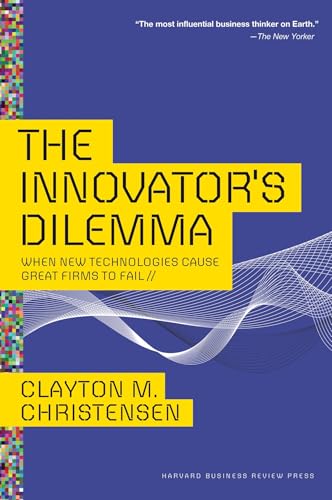


desertcart.com: The Innovator's Dilemma: When New Technologies Cause Great Firms to Fail (Management of Innovation and Change): 9781422196021: Christensen, Clayton M.: Books Review: View technology and business through a new lens - As some other reviewers stated: - A bit text book-like and academic in its format - It a bit dated in the industry studies However, after getting through the first chapter or two where he over-explains what he’s going to tell you in the book and how he’s going to tell it, it becomes much easier to read, and enjoyable, as he gets into the meat of it. Stick with it. I found it interesting to read about the older (mostly late 20th century) industries and disruptive innovations he studied. It was informative in a historical way as well as economic and business. Outside of the excavator industry, the author’s research was on relatively recent and modern technologies (disk drives, printers, computers, discount retail stores, etc). And I found the excavator research to be very illuminating due to the simplicity of the technology. While reading the book, I began viewing technology and projects at my work, in my industry, and in other industries with a new lens. I began thinking about what have been disruptive innovations over the past 20 years, and why they were disruptive and who were the companies led the way, and profited. And why they succeeded and others failed. What are the current and upcoming disruptive technologies? A new way for you to look at things, not just for management purposes but also for investment. Review: great reading - Very insightful and applicable to this very fast moving world. I would especially recommend it to technology enthusiasts and business strategists.


| Best Sellers Rank | #312,933 in Books ( See Top 100 in Books ) #22 in Strategic Business Planning #60 in Systems & Planning #184 in Leadership & Motivation |
| Customer Reviews | 4.5 4.5 out of 5 stars (4,029) |
| Dimensions | 6.5 x 1 x 9.75 inches |
| Edition | Reprint |
| ISBN-10 | 142219602X |
| ISBN-13 | 978-1422196021 |
| Item Weight | 2.31 pounds |
| Language | English |
| Part of series | The Innovator's Dilemma Series |
| Print length | 288 pages |
| Publication date | November 19, 2013 |
| Publisher | Harvard Business Review Press |
D**G
View technology and business through a new lens
As some other reviewers stated: - A bit text book-like and academic in its format - It a bit dated in the industry studies However, after getting through the first chapter or two where he over-explains what he’s going to tell you in the book and how he’s going to tell it, it becomes much easier to read, and enjoyable, as he gets into the meat of it. Stick with it. I found it interesting to read about the older (mostly late 20th century) industries and disruptive innovations he studied. It was informative in a historical way as well as economic and business. Outside of the excavator industry, the author’s research was on relatively recent and modern technologies (disk drives, printers, computers, discount retail stores, etc). And I found the excavator research to be very illuminating due to the simplicity of the technology. While reading the book, I began viewing technology and projects at my work, in my industry, and in other industries with a new lens. I began thinking about what have been disruptive innovations over the past 20 years, and why they were disruptive and who were the companies led the way, and profited. And why they succeeded and others failed. What are the current and upcoming disruptive technologies? A new way for you to look at things, not just for management purposes but also for investment.
B**E
great reading
Very insightful and applicable to this very fast moving world. I would especially recommend it to technology enthusiasts and business strategists.
A**R
despite having good managers, because they fail to find the new ...
The Innovator’s Dilemma is an interesting work written by Clayton M. Christensen in 1997. The book seeks to explain why certain businesses are successful in their ventures and why other firms fail in response to new technologies. Christensen tries to explain throughout the book why some firms, when new technologies enter the market, fail either because they adapt the new technology or not. The author initially believes that new technologies are constantly emerging and all businesses must continually adapt to stay relevant. However, this proves to be false as in his studies not all firms that ignored the new technology failed while not all firms that adapted the new technology succeeded. This is the fundamental dilemma in the book, and Christensen’s main purpose is to figure out a recipe for managers to follow to stay successful when disruptive technologies enter the market. Most of the book revolves around the study of the disk drive market since they were first developed in the 1950’s. The disk drive industry was important because technology was rapidly advancing and smaller drives were being released within a few years of each other. Many of the established firms often chose not to invest in the next smaller disk drive because they did not have enough memory to meet their standards. However, emerging firms would find new markets for the use of smaller drives and also find ways to make them more powerful, eventually drive the existing firms out of business. Christensen eventually concludes that successful businesses often collapse, despite having good managers, because they fail to find the new markets for disruptive technologies while instead supplying current customers with what they currently need. The goal of the book is to educate people in the business world about how new technologies affect firms and to provide a new way of thinking about disruptive technologies. The end of the piece brings the conclusion that leading firms almost always have set technologies that work well for their current customers, choosing not to invest in new technologies because what they are currently doing is working, current customers do not want change. That is, until new technologies grow to be superior than their predecessors. Christensen does a fantastic job in making his point clear as he provides a plethora of studies across different markets to support his claims. The first half of the book is essentially a detailed history of the disk drive industry that has multiple examples of different firms both choosing to invest in smaller drives and continuing to use their already established, larger drives. He uses this information to create hypothesis’ about why these firms made their decisions and whether it lead them to success or not. Essentially, the author’s process in writing the book is to look at different industries that had disruptive technologies and discover what trends lead to success and what trends lead to failure. He spends a lot of time focusing on a single industry, the disk drive. However, he does bring up several other markets including the mechanical excavator, steel, computer, and discount retailer industries. This variety of different scopes enhances his argument, especially since he sees similar trends across all of these different markets. Many of his examples include established firms choosing not to adopt new technologies because it does not fit their current business motives, but then later being replaced by firms that dared to find new markets for the new technology. His claims are definitely unbiased as all of his conclusions are drawn from the hard evidence that he compiles and delivers to the reader throughout the book about the different firms in those industries. It is almost impossible to disagree with his conclusion since all of his evidence accurately backs up his claims. Personally, I enjoyed reading the book but mostly because it appeals to my interests. As a young business major, the book is intended for me to read and may directly pertain to my own future. However, this book would be challenging to read for the average person that is not interested in business. The book is confusing at some times and is clearly designed for educated readers with a basic understanding of the business world. I would say that the book is a must-read for managers of a company that may be facing disruptive technologies in their industry as it does provide direct advice for people of that demographic. It is a book that I would certainly recommend to my peers within my major. Christensen does a decent job in making the book engaging. Some of the chapters where he is providing data are dry and confusing, but he does always provide a summary at the end of chapters to keep the reader focused. A lot of the book is also repetitive in regards to the disk drive industry and the author reiterating his claims about disruptive technologies. Nonetheless, the book is overall definitely a success for its purpose. There is plenty of evidence throughout the book that prove his claims in real-world situations. His main ideas about why firms choose to serve current customers with current technology rather than try to force new technologies on customers also makes logical sense, given the customer-centric market that is present in today’s society. His complex conclusion that disruptive technologies succeed only when they find a market that does not currently exist is confusing, but is definitely supported with his evidence. In conclusion, the book is a great read for those looking to advance their knowledge in the business world and think about topics that are not usually discussed. The author’s conclusions are creative and complex, but are backed up with hard evidence throughout the piece. The insights and advice brought up by Christensen are useful knowledge to any person studying business and the impact of emerging technologies. This is a book that I will definitely keep in mind in the future and I will recommend to others.
T**R
Must-Read
Clayton Christensen’s The Innovator’s Dilemma, while admittedly a bit dry, remains one of the most important business leadership books on the market. Christensen’s incredibly thorough research into industries like mechanical excavators, disk drives, and even retail is empirically supported throughout and provides abundant examples of the phenomenon of disruptive innovation and the context in which it can take industry leaders by surprise. Since the book was first written in the late 1990s, the environment has changed and the pace of technological innovation has increased drastically. These environmental factors, or contextual changes, may require adjustments to the recommendations in this book; however, the foundational principles remain the same—when companies are doing everything right, they can still lose their position of leadership in the market. Companies are incentivized to act in accordance with what their customers want, and if they are not careful, that mentality can preclude them from taking advantage of disruptive opportunities that their current customers are not yet interested in. Christensen’s warnings should be heeded by leaders and managers at all levels of the organization. As the pace of technological innovation continues to increase, leaders will be required to anticipate disruptive innovation to survive, and I look forward to reading about how the Innovator’s Dilemma can be addressed in this age of near-constant innovation and rapid technological advancement.
R**T
Great book worth the read
K**O
This is one of the true must reads for anybody working in the IT Industry. (or in any industry that might be under attack by an disruptive technology, ie. from taxis to hotels, video rentals to bookstores, computer makers or mobile phone manufacturers) This book is easily in the top 5 books you need to read, know and use if you want to survive in the long run.
S**N
I felt surprised for the quality of the book in terms of: - Many real-life examples from where conclusions are so easily derived (Honda motorcycles introduction in US is a very good one, also disk drive industry and others) - Additional references for those who want to dig more into some specific areas I like very much the overall message and how Clayton guides the reader into his simple logic: good management can lead to disaster (as proved by several real-life examples) so what we can do to harness the principles of disruptive innovation. In other reviews you have additional information into the book and the content , but all in all, I'd say this is a must for any marketer, strategist of professional working in fast-paced and dynamics business with great potential for disruption.
R**R
Depuis bientôt 20 ans, ce livre est devenu un classique et ses idées se sont assez bien diffusées... mais pas partout ! On voit encore des entreprises qui sombrent face à l’émergence d’une concurrence nouvelle, d’une technologie de rupture. Christensen expose, à travers une série d’exemples historiques issus de différents secteurs, les caractéristiques qui permettent de reconnaitre une véritable rupture et analyse l’impact qu’elles ont eu sur des leaders historiques. En seconde partie, il expose les stratégies que peut mettre une entreprise établie pour gérer ces ruptures et éviter de se faire emporter par l’émergence de concurrents inattendus. Lisez-le ! Cette vision est plus que jamais d’actualité dans notre monde piloté par l’innovation, peut-être même dans VOTRE entreprise.
M**E
Like it
Trustpilot
1 month ago
1 month ago