
DOWNLOAD THE APP


Customer Services
Copyright © 2025 Desertcart Holdings Limited
DOWNLOAD THE APP
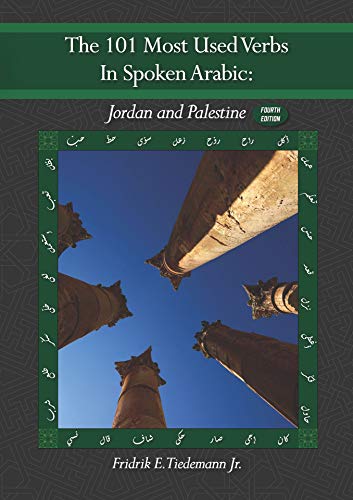
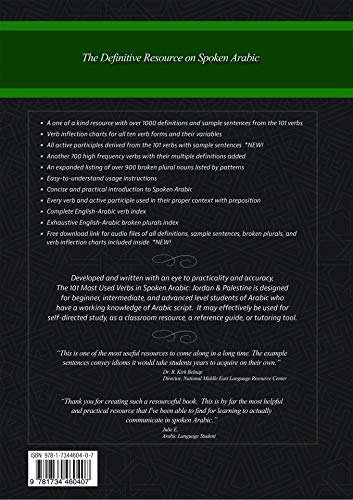


The 101 Most Used Verbs in Spoken Arabic: Jordan & Palestine (4th Edition, 2020) [Fridrik E. Tiedemann Jr.] on desertcart.com. *FREE* shipping on qualifying offers. The 101 Most Used Verbs in Spoken Arabic: Jordan & Palestine (4th Edition, 2020) Review: The most authoritative book on Spoken Arabic - I bought this book after owning the 3rd edition. I felt upgrading was worth it as there are hundreds of new example sentences and a section on ism il-faa'il (active participles) which are heavily used in spoken Arabic in place of verbs. If you're learning Jordanian or Palestinian Arabic, this book is simply not optional, it's required. The title may be misleading, it's not a book of just 101 verbs. It goes over all of the 101 verbs which all of their variant meanings, expressions, and so on. This is important because just knowing the base translation of a verb does not give you access to it's real meaning. The first in the book illustrates this well /ija/ (to come). This verb is used for many things, such as to receive a call, /ijaani [i]kteer telefonaat/, or to describe someone "coming at you," /inta [i]btiijii fiyye/. It is coupled with audio of every sentence or word in this book as well. This book is likely for intermediate and above because it assumes ability to read Arabic (no transliteration, which is a plus in my opinion), and assumes you can conjugate verbs and know basic grammatical syntax. The book is good for students who are in need of vocabulary and syntax (i.e., how sentences are actually said rather than word for word, clunky translations). What I really like about the book is how many dialectical Arabic words there are within example sentences. Practical, real world sentences. While it's titled 101 verbs, it actually contains thousands of useful verbs, nouns, adjectives. It has useful indices for broken plurals as well. Bottom line: Required reading for students of Southern Levant (Jordan and Palsetine) dialect. Highly encouraged for Northern Levant students. Review: A Masterclass in Colloquial Jordanian/Palestinian Dialect - This is an outstanding resource for students of the Arabic language who are looking to break into learning a dialect. It is probably best for an intermediate/advanced learner who already has a feel for the basics of the language, and its format lends itself to someone capable of dedicated self-study. This is not a dictionary, and it is not a textbook. It is somewhere in-between. The title is a bit misleading because, while it is organized around the 101 most-used verbs in Southern Levantine Arabic, it actually contains many hundreds beyond that, as well as a bounty of colloquial sayings/slang and phrases that don't often find their way into a formal textbook. Most verbs are not just one verb, but contain a variety of phrases that utilize that verb. For example: to take to take the initiative to take (a car) for a spin to take a tour to take a vacation ...etc. Each iteration of the various verbs and their sub-forms contains an example sentence that is written in both English and in Arabic. And, once you get the book you can reach out to CGE and get access to the audio files which contain recordings of every single verb and example sentence in the book. This is where the book truly shines--it is a dense and diverse collection of colloquial speech that you can only otherwise get by buying a plane ticket to Amman yourself. Even then, you'd be better served spending a few months poring through this book's expansive linguistic bounty in preparation for such a trip. Outstanding resource, and if you can only have one book on Jordanian dialect, this one would be it.
| Best Sellers Rank | #195,347 in Books ( See Top 100 in Books ) #904 in Language Study & Reference (Books) |
| Customer Reviews | 4.7 4.7 out of 5 stars (63) |
| Dimensions | 11.65 x 8.27 x 1.06 inches |
| Edition | 4th |
| ISBN-10 | 1734460407 |
| ISBN-13 | 978-1734460407 |
| Item Weight | 2 pounds |
| Language | English |
| Print length | 356 pages |
| Publication date | March 26, 2020 |
| Publisher | Great Arabic Publishing |
A**I
The most authoritative book on Spoken Arabic
I bought this book after owning the 3rd edition. I felt upgrading was worth it as there are hundreds of new example sentences and a section on ism il-faa'il (active participles) which are heavily used in spoken Arabic in place of verbs. If you're learning Jordanian or Palestinian Arabic, this book is simply not optional, it's required. The title may be misleading, it's not a book of just 101 verbs. It goes over all of the 101 verbs which all of their variant meanings, expressions, and so on. This is important because just knowing the base translation of a verb does not give you access to it's real meaning. The first in the book illustrates this well /ija/ (to come). This verb is used for many things, such as to receive a call, /ijaani [i]kteer telefonaat/, or to describe someone "coming at you," /inta [i]btiijii fiyye/. It is coupled with audio of every sentence or word in this book as well. This book is likely for intermediate and above because it assumes ability to read Arabic (no transliteration, which is a plus in my opinion), and assumes you can conjugate verbs and know basic grammatical syntax. The book is good for students who are in need of vocabulary and syntax (i.e., how sentences are actually said rather than word for word, clunky translations). What I really like about the book is how many dialectical Arabic words there are within example sentences. Practical, real world sentences. While it's titled 101 verbs, it actually contains thousands of useful verbs, nouns, adjectives. It has useful indices for broken plurals as well. Bottom line: Required reading for students of Southern Levant (Jordan and Palsetine) dialect. Highly encouraged for Northern Levant students.
D**S
A Masterclass in Colloquial Jordanian/Palestinian Dialect
This is an outstanding resource for students of the Arabic language who are looking to break into learning a dialect. It is probably best for an intermediate/advanced learner who already has a feel for the basics of the language, and its format lends itself to someone capable of dedicated self-study. This is not a dictionary, and it is not a textbook. It is somewhere in-between. The title is a bit misleading because, while it is organized around the 101 most-used verbs in Southern Levantine Arabic, it actually contains many hundreds beyond that, as well as a bounty of colloquial sayings/slang and phrases that don't often find their way into a formal textbook. Most verbs are not just one verb, but contain a variety of phrases that utilize that verb. For example: to take to take the initiative to take (a car) for a spin to take a tour to take a vacation ...etc. Each iteration of the various verbs and their sub-forms contains an example sentence that is written in both English and in Arabic. And, once you get the book you can reach out to CGE and get access to the audio files which contain recordings of every single verb and example sentence in the book. This is where the book truly shines--it is a dense and diverse collection of colloquial speech that you can only otherwise get by buying a plane ticket to Amman yourself. Even then, you'd be better served spending a few months poring through this book's expansive linguistic bounty in preparation for such a trip. Outstanding resource, and if you can only have one book on Jordanian dialect, this one would be it.
C**S
Great resource!
Very good resource! I will say though, I am a beginner and do have a bit of trouble reading the Arabic font that the book uses, but I may get used to it with time.
S**M
Good job****
I think the achievement of the book is its unique way of teaching and explaining the colloquial arabic of jordan and palestine. I think the audio files still need a lot of improvement in quality and structure. But the book is amazing and a great source if you have some basic knowledge and the necessary support to enter the endless world of coloquial arabic.
E**S
Indispensable resource for everyone interested in spoken Arabic (Jordan, Palestine, Israel))
As a Hebrew speaker, I have the privilege of using textbooks in perfect transliteration (although Arabic has a few more letters, there is virtually a 1:1 correspondence). It is a tested method for close to 1000 years (Maimonides frequently wrote Arabic using Hebrew letters). Hebrew speakers who learn Arabic also enjoy the advantage of the similarity of grammar: As in Arabic, Hebrew verbs are built on a trilateral root and conjugated in tenses, mood etc. in seven (rather than ten) forms, in an amazingly similar pattern. I was all the more surprised how insightful and valuable I found F.E. Tiedemann Jr.'s "The 101 Most used Verbs in Spoken Arabic". It already sets itself apart by its esthetically pleasing A4 format which is perfect to reproduce the information, which comes almost exclusively in generously spaced tables (crowded pages and busy text can be a deterrent) . The book dispenses with any transliteration (always problematic when using Latin letters/a European language), making it ultimately easier to train pronunciation and understand grammar. So, it requires knowing the Arabic alphabet, which can be learned in a fairly short period of time. Whether you use it as a standalone text - which you easily can (!) - or in addition to other textbooks, it will soon become indispensable to you. The book comes with a free audio download, a must for teaching a living language.
J**O
Best written resource
I've been studying Jordanian Arabic for 4 months now and this book has become an invaluable resource as it provides sample sentences with crisp audio recordings. I'm glad it doesn't provide transliterations below the Arabic script because it really makes me concentrate on the Arabic script. I transferred the audio files to my phone, so whenever I'm walking the dog, I make sure to get in some listening. I love the ample use of each verb along with prepositions - just like in English I can get to know the different uses of each verb and not be limited to its basic meaning. Shipping to Germany was really quick too. Thanks for this awesome resource, I'd buy it thousand times over! :)
L**A
After having owned this book for a year I am posting an edited review and adding one star. The reason for the edit is that I had the opportunity to find an amazing grammar teacher who gave me very solid foundations over the space of several months after which I could come back to this book. Even after re-watching the tutorial on how to utilise this book on the CGE Jordan channel, it still wasn't clear to me how to actually understand how to use this book. I later realised that I just didn't know enough grammar to understand how it all fit together. The director of CGE Jordan is the one who recorded a number of video lessons based on this book on YouTube, and I have to say that now that I do get how the book works, I can see its great potential. Perhaps it's just me, but I find Mr Tiedemann often unclear in his explanations in those YT videos. I would say that his lessons could be improved and be a bit less off the cuff and structured. Even if Levantine Arabic is grammatically simpler than Modern Standard Arabic, this is very much relative as it is still a challenging language, so explanations have to be very clear to be useful, as I found with Arabic attention to detail is critical. The premise of the patterns in the verb tables is how a verb is voweled in the past tense and then in the present tense. The approach is not entirely unique (Lingualism's Palestinian Arabic classifies verbs in a broadly similar manner), but I am not entirely sure the present tense conjugation for the third person masc and third person plural using a short vowel for the letter yaa (ي) after the ب is correct, based on what I have learned with a qualified teacher and professional mother tongues I asked. My favourite part is aimed at the mid-intermediate students , and is the meaty almost 150 pages of sentences where the 101 verbs are used in context in everyday speech and idioms. The audio is very clear, and the addition in the chart of a column combining the verb with affixed pronouns is very helpful and unique in verb books. Unfortunately, the treatment of the past, present and future in the future and perfect moods is absent and this is the major shortcoming of the book compared to its competitors. Personally I would have left out the broken plurals part and completed the verb part with the other tenses. Considering the very considerable pros, this a very valuable book for intermediate students as a companion, along with other texts.
Trustpilot
5 days ago
3 days ago