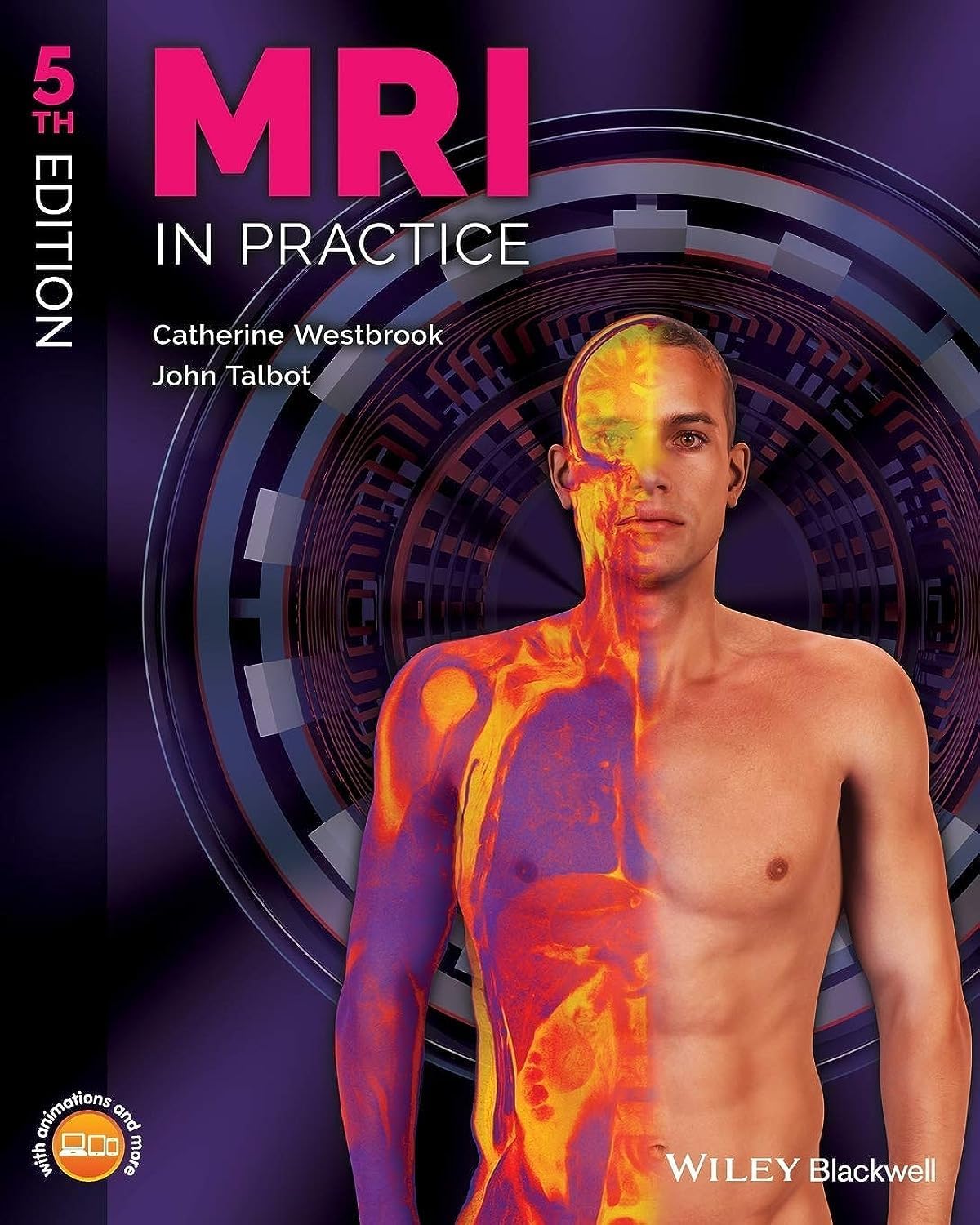


Buy MRI in Practice by Westbrook, Catherine, Talbot, John online on desertcart.ae at best prices. ✓ Fast and free shipping ✓ free returns ✓ cash on delivery available on eligible purchase. Review: For my daughter. Review: The book was in brand new condition and at a great price!! Very happy with this purchase!

| ASIN | 1119391962 |
| Best Sellers Rank | #133,997 in Books ( See Top 100 in Books ) #51 in Radiology #2,130 in Engineering #12,903 in Higher & Continuing Education Textbooks |
| Customer reviews | 4.8 4.8 out of 5 stars (685) |
| Dimensions | 20.32 x 2.29 x 25.15 cm |
| Edition | 5th |
| ISBN-10 | 9781119391968 |
| ISBN-13 | 978-1119391968 |
| Item weight | 1.05 Kilograms |
| Language | English |
| Print length | 416 pages |
| Publication date | 26 October 2018 |
| Publisher | Wiley-Blackwell |
P**N
For my daughter.
J**N
The book was in brand new condition and at a great price!! Very happy with this purchase!
K**A
Very informative and easy to understand
R**Y
En bra bok för att bli bekant med MR.
D**Y
MRI can be quite complicated, or simple, depending on what the individual brings to the study. I have been in and around MRI for over thirty years, and always want to find the five minute explanation. Never really did but in many ways this book comes close. My bias is that I have spent fifty plus years doing signal analyses and have been using Fast Fourier Transforms for an equal time. Thus knowing Fourier Transforms quite well, grasping the basic element of MRI, namely that location equals frequency, and sum of weighted frequencies equals something that can be inverse Fourier Transformed gives all one needs. Then understanding TE and TR, and then T1 and T2, one can readily understand the response of fat to water and any other mix thereof. Namely if one understood FFT then this book would be a great introduction. However not many have that background and the authors try to work around this. That is always a difficult and often confusing approach. But somehow it gets done in this book, without really ever discussing the FFT. Now there are two negatives. First there are figures with axes that have no definition. The figures thus are often more confusing than enlightening. If one uses a figure with a graph then one must explain both axes and from whence it come. The lack of these is pandemic across the book. Second, and perhaps a critique undeserved is a better explanation of DWI and DCE MRI. Concomitant with that is a door explanation of the various contrast media. Overall this a great first step to MRI. Wish I had it 30 years ago when I tried to explain MRI to some Internists.
Trustpilot
2 weeks ago
4 days ago