Desertcart purchases this item on your behalf and handles shipping, customs, and support to Philippines.
📡 Cut the static, keep the stream — never miss a moment!
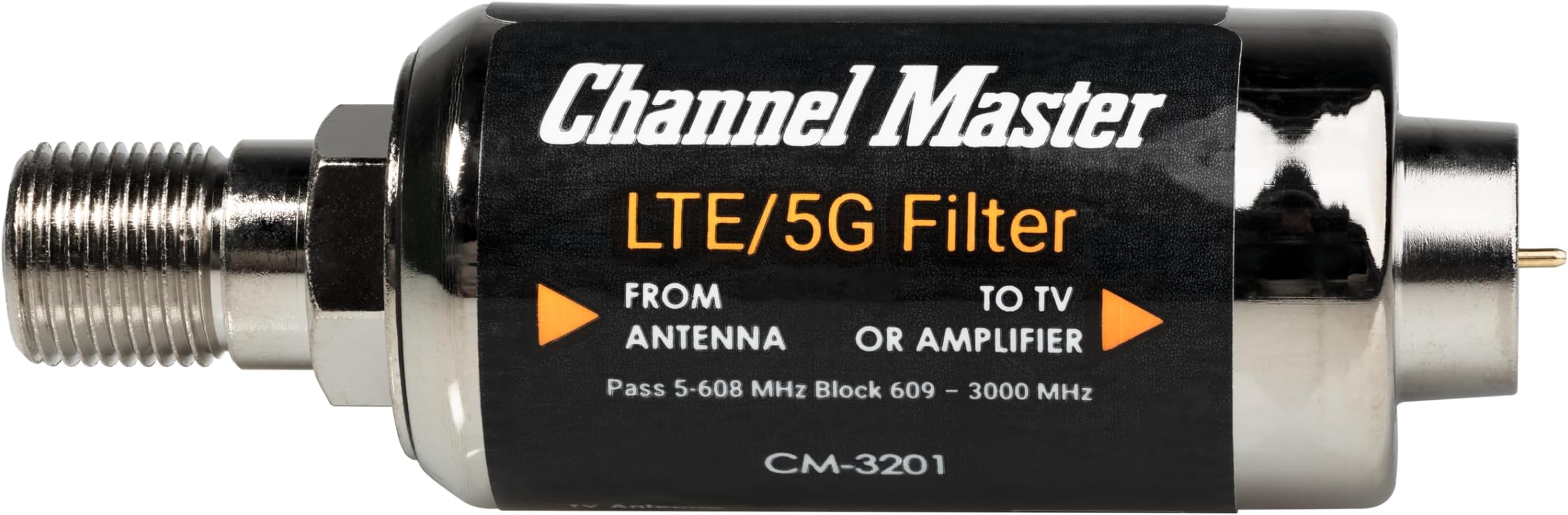
The Channel Master LTE/5G Filter is a premium inline device designed to block disruptive LTE, 4G, and 5G signals above 618MHz, preventing pixelation and signal loss on OTA HDTV broadcasts. Featuring a weatherproof O-ring for reliable indoor/outdoor use, it supports all US TV channels up to 608MHz and complies with ATSC 1.0 and 3.0 standards. With low insertion loss and class A RFI shielding, it ensures your digital TV signal remains strong and clear, making it an essential upgrade for cord-cutters seeking uninterrupted, high-quality reception.


| ASIN | B01JGSC5AO |
| Antenna | Television |
| AntennaDescription | Television |
| Best Sellers Rank | #73 in TV Antennas |
| Brand | Channel Master |
| Color | dark gray or black |
| Customer Reviews | 4.0 out of 5 stars 4,691 Reviews |
| Global Trade Identification Number | 00020572032018 |
| Impedance | 75 ohm |
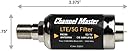
| Item Dimensions L x W x H | 2.4"L x 0.75"W x 0.75"H |
| Item Weight | 2 ounces |
| Manufacturer | Channel Master |
| Mfr Part Number | CM-3201 |
| Model Number | CM-3201 |
| Number of Items | 1 |
| Number of Packs | 1 |
| Product Dimensions | 2.4"L x 0.75"W x 0.75"H |
| UPC | 020572032018 |
| Unit Count | 1 Count |
| Warranty Description | 1-Year Limited Warranty |
T**D
Yes, it is more expensive but it is much better too!
For those who don't know what this product is about, a quick (simplified) summary of major changes to Over-the-Air Television in the United States. UHF TV reception in the US originally consisted of channels 14 to 83 (460 to 890 MHz) introduced through FCC regulation in 4/11/1952. The 800 MHz portion (channels 70 to 83) of the UHF TV band were reallocated already back in 1983 for other services (including but not exclusively to mobile telephone service). Effective 6/12/2010 (immediately following the Analog to Digital TV conversion) the 700 MHz portion of the UHF TV band (channels 52 to 69) were auctioned off by the FCC of which AT&T (band 12, 699 to 746 MHz) and Verizon (band 13, 746 to 787 MHz) were the major winners. Since then the FCC conducted a "repack" requiring TV broadcasters to move from upper UHF channels to lower UHF channels or back to VHF (were many stations were broadcasting prior to the Analog to Digital TV conversion), including to the low-VHF band that was originally deemed unsuitable for digital television. In 2017 the FCC then auctioned off the 600 MHz portion of the UHF TV band (channels 38 to 51) of which T-Mobile was a significant winner (band n71, 617 to 698 MHz). TV broadcasters had until June 2020 to complete their relocation and to free up the 600 MHz spectrum. TV channel 37 has been and continues to be a reserved channel for radio astronomy which means that the usable UHF TV band has shrunk to channels 14 to 36 (460 to 608 MHz). All of the above refers to the actual RF channels on which your local stations really transmit (which has absolutely nothing to do with the channel numbers your TV will display). Depending on how old your TV tuner is, it will be designed to receive signals from the 600, 700 and possibly (so less likely) 800 MHz ranges which no longer contain any TV programming. The mostly mobile phone transmissions on those bands can interfere with the TV programming you are actually interested in. To prevent nearby cell towers and even your own cellphones from interfering with your TV reception, a number of companies make filters to block the unwanted signals from getting into your TV. This product (ChannelMaster CM-3201) is one of those products. It was twice as expensive as a similar product sold under the Philips brand name (SDM1520/27 also here at Amazon) which I also purchased. Needless to say, I was curious whether or not the higher price of the CM-3201 was worth it and I wanted to rely on science instead of subjective testing (e.g. how many times a particular channel pixelates within an hour). I therefore used a NanoVNA-H4 to measure the filter characteristics. I'll state upfront that using test equipment for 50 Ohm impedance with 75 Ohm impedance filters does introduce some errors into the measurements, however since this is the same impedance mismatch in both cases it still results in a valid comparison. An ideal (impossible) filter would have no attenuation below the cut-off frequency and infinity attenuation for any frequency above it (meaning that there would be no transition band at all). Real filters reveal their quality by how much they attenuate unwanted signals and how wide the transition range is (the frequencies between start of attenuation and full attenuation). Both filters showed a start of attenuation at 606 MHz (first visible sign of attenuation in the LogMag trace, not the 3dB attenuation commonly used to characterize filters) which is still within the frequency range for TV channel 36 (I subsequently tested the filters on a local station that uses RF channel 36 and the reception was fine). Also both filters showed reasonably low figures for insertion loss (the attenuation of a good signal just because the filter is being added). The CM-3201 (this product) showed a transition band of 36 MHz (less is better) and attenuation of almost 60dB (more is better, but 60dB is already excellent). The SDM1520/27 showed a transition band of 72 MHz (a bit disappointing that it is so wide) and attenuation of about 30dB (good, but higher would be better). In-line filters are often symmetrical and can be used in either direction. Both the CM-3201 and the SDM1520/27 have explicit input and output markings but I did not test whether the filters behave any different when used backwards. The ChannelMaster CM-3201 is significantly larger in diameter which may be a problem on some TVs with recessed antenna connectors (it wasn't a problem for me, I connected it to the input of the antenna amplifier which is the recommended place). Bottom line, this filter does work and it is much better than the half price competition. Not everybody may need these filters and of those who do, some may get satisfactory results from the cheaper filter. That said, why settle for less when the better product is still affordably priced ? However beware of any filters that are still sold which are based on the 2010 elimination of the 700 MHz band since those are not blocking cell transmissions in the 600 MHz range (those older filters are useless, regardless of price).
T**Y
Great Product - Channels coming in better
Channel Master products, in my opinion, are top-of-the-line. I've owned several of their products and, so far, have not had any issues with them. As for this LTE filter, I will say I was a little skeptical about their claims, but was pleasantly surprised. I cut-the-cord to cable years ago and hav been using and external arial antenna for a long time. Although I was able to receive all the main broadcast channels plus a few extra (32), there were a few channels that struggled to come in, especially during bad weather. I had read about LTE filter recently and thought I'd give this one a try. It's a little more expensive that many you'll find on Amazon, but it's a Channel Master, so quality is a big draw here. I received the filter and it was super easy to install. Just screw it into the cable port on your TV, then screw your antenna cable into the filter. After doing so there was no immediate difference. All the same channels still came in. The beauty of this product really came to light when the first cloudy, raining day happened. Typically bad weather would cause the furthest TV stations from my home to disappear. I would get digital choppiness or no signal at all. Now, since I have the filter installed, I have not had a complete loss of signal. Broadcast TV stays connected even in bad weather. There is still occasional digitization, but, for the most part, the signal is much more stable. Keep in mind that this is not a "booster". It will not help you reach broadcast antennas that are too far away. What it does do is "clean up the signal". It filters out cellular phone broadcast so that TV broadcasts aren't fighting for bandwidth. If you are struggling with channel signals dropping out, this may be the solutions you are looking for.
M**I
Did did help with pixelation and flickering out
While Channel Master has been a industry standard for decades I knew I could trust it and it did work it helped some channels that are a weak signal stop pixelating and flickering out so much. Now this is simply a G5 LTE blocker it does not improve reception, it helps reduce interference from cell phones or if you have a G5 router in your home.
C**S
It might work for some situations; also check the specs
I purchased the CM-3201 LTE filter hoping that it would fix a problem I had with two channels pixelating, with the signal going up and down just enough (value of 59 - 87, with sometimes as low as 0, out of 100) to cause this. The LTE filter did not solve my problem. The problem exists exactly like it did before. These two troublesome channels are full power and their transmitting antennas are even mounted on the same tower and height as all the other channels that give no problem. However, one thing that should be noted is that although the filter I received states on its glued-on label that it passes the signals in the 5 - 599MHz range (only up to UHF channel 35), it actually passes as high as 609MHz, namely, up to channel 36. There is a channel 36 (not virtual, but actual transmission) in my area and it did not block it; the signal passed right through it. The worded specifications on the Channel Master website states that it passes signals in the 5 - 609MHz range (up to channel 36), this is even though the photo of the filter in the same webpage shows the filter's glued-on label as stating 5 - 599Mhz (as if it blocked channel 36). Channel Master has to fix this inconsistency in specs as well as Amazon. I wrote Channel Master about this and they responded to me that the LTE filter should pass the 5 - 609MHz signals, although they made no mention as to why the inconsistency in the filter's misleading glued-on label. On a separate matter, there is no specification as to any signal loss by attaching this filter, thus, I suppose that there is none. I experimented observing the signal range on my TV and antenna setup, both with and without the LTE filter and on every channel. There was no difference as to signal strength. In summary, I wasted my money, but there was only one way to find out if my problem had to do with the cell phone towers in my area.
D**N
Does exactly what it's supposed to do!
I had at least one digital channel that was dropping out. First audio, then the entire picture. Fortunately, that local station had a form on its website to fill out for technical support questions. They responded in less than 24 hours, and recommended this particular filter. I'm happy to say it solved my issue, and the station comes in without any drops in audio or video reception. My particular installation is on a television that is hooked up to a central OTA antenna in my attic, and we are only between 8 and 9 miles from the transmitter tower. Four other TVs in the house did not have this issue, but this one did. I'm betting it's because the coaxial cable goes through an exterior wall that faces in the direction of a LTE cellular tower that is about .7 miles away. Since all other TVs in the house received the channel just fine, I hooked the Channel Master filter up to the back of my problem TV. I had to put a 6-inch coax directly on the TV connector because the filter was too wide to fit directly onto the TV. All in all, this thing works great, and I'd recommend it to anyone having digital channel reception problems.
S**C
Channel Master Works in Reverse
The Channel Master LTE 5G feels solidly built and works in the reverse direction (according to Channel Master, see answers to questions). My TV is tight on spacing between the back and the input, so the piece does not fit in the usual place (see photo). That is not really the fault of Channel Master. Channel Master goes back a long way to the analog days, and their products have had a good reputation as far as I can recall. The filter can be screwed into my wall outlet in the reverse direction or at the antenna in the attic in the reverse direction. Inserting it into the line in the forward direction would require another piece of cable and a male-male connector, which would further attenuate the unamplified signal. I could insert it in the forward direction inside the wall box, where the screw post points toward the antenna like the post on back of the TV, but the space is not deep enough. However, these are moot points since CM stated reversing the direction works. I have about 50 ft of good quality RG6 coaxial cable with only 1 break (male-male connector integrated in the plastic cover in the usual way) at the wall box near the TV. Reception in Harford County is good for Baltimore stations 11-x, 13-x, 45-x, 67-x, and a little less stable for 2-x, moderately stable for Lancaster PA 8-x and Daystar Baltimore 24-x, and later at night WJLA Washington D.C. (7-x). A cloud deck or very late night times will help pull in D.C. channels 5-x, 9-x, 20-x, and a few others. I have not noticed any real differences yet inserting the LTE filter, so my pixelation may be signal strength and multi-path related. Further testing is needed. It will be interesting when we are able to buy new ATSC 3.0 Next Gen TV tuners at a reasonable price and approved by ATSC, there has been recent news on the standardization so we should be able to see tuners appear soon.
J**.
Amazing little device
Well, a short introduction is in order. I used to faithfully review every purchase I made with Amazon, and that number is ample, but after I gave one unnamed product a negative review because it was a total piece of junk, that review was removed by Amazon. There was no swearing or bad language in my review and I did not violate any of Amazon's rules with that review, but it was still removed, which, in my mind, it was removed because it was a negative review of a product sold by Amazon. Thus, no more reviews on any products were written by me. Why should I waste my time giving any reviews if the negative ones would be potentially deleted. I purchased this Channel Master LTE Filter and it's operation was so successful, my wife talked me into giving it a review. I have an old outside antenna on my roof that worked to receive all my local channels until a heavy wet snow storm damaged some of the wings on that antenna. A repair was made and reception was restored. I might add, getting to this roof antenna was a really big pain and very dangerous because it is mounted 32' above the ground and hanging out over the edge of the roof line. Any fall from this height would be life changing if not result in death. I do not wish to ever get back up on the roof to work on this antenna again. One local channel stated to be troublesome and eventually was impossible to view because of interruption of the 'over the air' signal. All other local channels were not interrupted. After trying an inline signal booster with no improvement, I reluctantly decided to buy a very expensive CM roof antenna. During my search for a replacement antenna, I came across this Channel Master (CM) LTE Filter and decided to give it a try before purchasing a new antenna and having to go through the major trouble of installing it onto my very high and dangerous roof. Amazon shipped my order which I received in a few days. The install took less than three minutes and that included reading the directions. To my surprise, all my local channels were perfectly clear, including the favorite channel that previous to the install of this device, I could no longer view. This filter is a 'magic' little device which solved my reception problems. I recommend the purchase of this filter if you are receiving intermittent signal over your roof antenna. Great product from a good company. Hopefully this review, in its entirety, will be posted. Sincerely, a happy customer.
D**K
Instead of better picture quality it caused more lag, buffering, and freezing for Tablo 4th Gen
This is supposed to filter out 4G LTE & 5G cell signals that can interfere with UHF ATSC 1.0/3.0 channels. My setup is as follows: 1. In my attic I have an Antennas Direct ClearStream 4 (UHF only). 2. I verified with the factory that from my location most of the broadcast towers are at a compass heading of 95 degrees and pointed the Antenna at this azimuth. As the crow flies the towers are only 35 mi. from my house and the ground is mostly flat between. 3. I have high quality RG6 Quad Shield 3Ghz cable from the Antenna to my basements, then a RG6 coupler to another cable (same specs) that runs from the basement to the wall outlet in the living room. There are No splitters and only 2 couplers, so I'm only losing 2db signal Gain at the most. 4. From the living room wall outlet another RG6 cable (same specs) to the Tablo 4th Gen 4 Tuner gateway. According to the Channel Master instructions this should go to the Splitter input or the TV input. For my setup this is going directly to the Tablo input. Before installing this filter, my weakest OTA channels were 2 PBS stations and one other that were weak and grainy, but could still watch without lag or buffering. After installing this filter they were worse with a lot of lag, buffering, and freezing. The Tablo settings has a built-in amplifier if the Antenna does not have one. I have the Tablo amplifier turned On since my antenna has none. Now these channels are unwatchable. I removed this filter and everything is better again. I guess it depends on your location and situation. It may or may not help improve your channel reception. For me it did not work well.
L**R
n'apporte rien bien au contraire le filtre diminue la reception du signal
diminution du signal antenne, de plus pour renvoyer cet article pas évident j'ai perdu 49€
G**C
This was the solution to my chanel pixelation
On my quest to get rid of channel pixelation even though my signal was strong, i tried several things. A new antenna (ClearStream 2V )... This did not help. A (Channel Plus 2512 DC + IR Passing 2-Way Splitter/Combiner)... Nope, but it did help me get more channels for the new antenna for some reason and a stronger signal. And i learned you can combine two antenna signals, but i think this is ideal if you have two of the same antennas. I recommend this. An amplifier for the new antenna(GE Outdoor TV Antenna Amplifier )... Nope... It made it worse. I do not recommend this amplifier. This filter was a god send, I'm in the city and it improved the signal for both of the antennas and got rid of the pixelation and got me a few more channels that i didn't have before. Try this before anything else if your in a busy city and have pixelation. DO IT!!!!!
P**┬
Funciona muy bien
Superó mis expectativas de hecho le dábamos poca credibilidad y vaya que demostró mejorar la calidad con que se recibe la señal 📶 ayudado del amplificador de TV 📺 ha dado un resultado que captamos más canales y con mayor intensidad y mejor respuesta al sintonizar los es un hecho que la imagen se ve mucho mejor gracias 👏
A**R
pas bon
pour moi ces un gros zéro très dessus de cette appareille la j avais des problème de perte de poste et des manque dans l écrans sur mon téléviseur quand je l ai connecter j ai perdu des poste j ai un graphique qui m indique a combien ca rentre la force du signal dépendamment des heures le signal varie pas mal j ai acheter ca pour le poste v car ou je suis il es très dure a capter puis mon antenne es dans mon grenier pour corriger mon problème a 99% j ai fabriquer une parabolique derrière mon antenne je pers très rarement le signal et j ai plus de manque dans mon écrans . j aurais du le retourner je pense qu il va prendre la poubelle j ai mis un étoile par ce que j avais pas le choix. pour moi ces zéros étoile
C**N
Muy bueno
Excelente producto. Se puede ver mejor la TV.
Trustpilot
1 month ago
2 days ago