🔌 Power your Pi like a pro — never miss a beat, even when the lights go out!
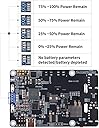
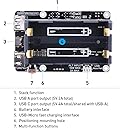
The UPS V5 Power Supply HAT is a cutting-edge uninterruptible power solution designed for Raspberry Pi models 4B through A+. Featuring dual INA219 chips for precise battery and output voltage monitoring, onboard RTC, and OTA firmware upgrades, it ensures seamless power management. This UPS HAT automatically switches between external power and a 18650 battery backup, enabling your Pi to survive blackouts with smart shutdown and restart capabilities. Complete with mounting hardware and an acrylic shield, it’s the ultimate power management expansion for professional-grade Raspberry Pi projects.


| ASIN | B09NKFYHVK |
| Best Sellers Rank | #134 in Computer Uninterruptible Power Supply Units |
| Customer Reviews | 3.6 3.6 out of 5 stars (34) |
| Date First Available | December 13, 2021 |
| Item Weight | 9.1 ounces |
| Item model number | EEST 1336 |
| Manufacturer | GeeekPi |
| Package Dimensions | 4.65 x 3.27 x 1.65 inches |
A**R
Works great
Charge/Discharge like a laptop battery - When external power plugged in, it supplies power to Pi and UPS. When no power, battery is used. Voltage of battery (for remaining battery level) and C/microUSB ports (for checking if charging/discharging) can be read from Pi through I2C. It also has a register value to power on Pi automatically when external power is connected, so basically Pi with this UPS can deal with blackout. (When blackout and no external power, shutdown Pi and UPS automatically if low battery. Then when power restored, Pi is powered on automatically) The one thing to be improved is that its automatic UPS shutdown count does not work as expected when charging (even in latest firmware). Setting shutdown count value of UPS to integer n should make UPS power off after n secs. But if charging, it takes not n secs but much longer (about 5~30 times) to be powered off. Well, even though it takes much longer, anyway it power off in minutes so this may not be a critical problem. There are more register values that can be read from UPS (details on EP-0136 page in 52pi wiki), but values above may be enough for normal use.
Z**M
Would recommend. Excellent quality.
This product works great for a raspberry pi backpack for portability, but the built in chargers don’t provide enough power to charge anything other than a small lithium battery. This product works great so far and has had no issues so far. Only issue I have with it is the power indicator is only on the backpack and you can’t see the percentage on the pi, which doesn’t matter if you just use it as a backup. Would recommend.
A**R
Does Not Work
this crap has seen untold revisions and they still cant get this crap working properly. drains and kills batteries takes like an extra amp from the module JUST TO USE IT. pointless and dumb. i want my money back. already swaped out v43 w v47 or whatever it is. geek idoits more like
A**O
It works
Works great
K**.
Functional but will kill batteries within a few years
Only used it for a few days but it did appear to work ok, seemed to use about 800 mA or about 4 watts when running on batteries (in addition to the Pi's draw, idle 4B 2GB was drawing about 3.5 watts so the total draw on the batteries was about 7 watts). The main deal breaker for me is that it will charge and hold the batteries at about 100% SoC (4.2-4.3 volts) when plugged in (UPS mode). Maintaining Li-ion batteries at full charge 24/7 will greatly increase degredation. If you've ever used a laptop that's always plugged into AC you've probably noticed that the battery will loose something like 15 or more % per year and basically be completely unable to hold a charge after 3 or 4. I did try setting the I2C registers (there's one for full voltage address 13-14) but that did not change the charging behavior. It seems that even though the address is advertised as read/write, it's really just a read of the highest voltage seen. I can confirm that the low voltage, "protection voltage", register works. So the user can set the minimum voltage/SoC to disconnect the battery but not the max for charging. Overall, the UPS board was so close to being what I wanted but that oversight ruined it for me.
A**N
All as agreed
As expected
S**M
Does overcharge batteries, does not respect configured max voltage.
Looks like this UPS does not respect the max. charging voltage and with lithium-ion batteries that's a safety issue for me. Looking at the github of this project it does seem like there are no improvements since 2021. Cannot recommend.
S**K
[UPDATE] Got it working Note on Batteries
There is a handy link included in product documentation about performing a firmware update. As of 01/28/2023, it is version 14. It seems I ran into an issue where the system was stuck on shutdown after 120 seconds. Used this to stop the shutdown cycle. bus.write_byte_data(DEVICE_ADDR, 26,0) I think the upsplus/Full-featured-demo-code.py code might of done it. Be careful and read before running the scripts. The scripts are heavily commented and very helpful if you want to create your own to pull stats. This is how I can pull version it is running, example in the code via github repo. There also appears to be an issue with battery compatibility outside the basic requirement for a 18650 battery. No, a protected top 18650 battery will not work as it is too big. Best to go with flat top. There is somewhat active discussions on battery compatibility on the github page. Probably only activity so far this year. Seems you can run into issue with battery and even with chargers that result in stats not incrementing. Have spare chargers and tune into the github discussion on batteries; Charging don't stop #87
J**N
Power connectors on the UPS failed to perform their basic duty of actually connecting to the RPI5.
M**.
I wish I could recommend this. The intended feature set really appeals to me, the included RTC is nice, and the stackable design that goes under the Pi and connects via pogo pins is really cool. The board feels as heavy as you'd want a power supply board to feel. I like the dual power inputs and the bonus power outputs and the power monitoring over I2C. I received version 5.1 PCB02b dated December 11th of 2011. The listing in the UAE still says this is compatible with the Pi 5, although it doesn't say that on the manufacturer website or in other countries' listings. Careful! Sadly, it looks like the manufacturer doesn't care about the many problems with this design. This board will charge LiPo cells to 100%, and the configuration to set a max charge voltage doesn't work. The manufacturer's comments on their Github are dismissive, like this isn't one of the most important aspects of a good UPS design. Holding the cells at max charge is terrible for the batteries, and most use cases for a UPS would benefit from a configurable maximum for increased battery longevity. The board has undergone a few revisions, but this hasn't been fixed. As a matter of fact, even the actual firmware doesn't seem to have been updated since sometime in 2021. The firmware itself is not even hosted on their GitHub, so I can't be 100% sure of anything about the firmware. Which is closed-source, it's not like the nerds back home who actually care about it are given the chance to fix anything. The intended way to update the firmware is to use the manufacturer's script that will download it from their website directly and flash it onto the UPS board. You can't (or aren't intended to) flash it yourself. This isn't a problem but it is weird and can be a liability. What if I need to roll back the version because someone uploaded a buggy or malicious version to their servers? etc I've also seen comments on their GitHub about the device not charging back up after a full discharge if auto-start on AC is enabled. Basically, it might not let you wait until the batteries charge up enough to auto-start the Pi, making it turn on and off because of insufficient power instead of powering on after reaching a stable level. Another silly oversight, frankly ridiculous. Another note: The IP5328 chip is mounted right opposite one of the batteries, which is a questionable compromise. Batteries can be dangerous! Simmering them over low heat is not the way to use them. I don't mind sticking on my own little heatsinks where they seem needed, but I can't say this decision fills me with confidence. The Pi 5 on the listing is also very strange. The Pi 5 notoriously needs 27W of juice, and this board clearly has all the power inputs labeled with 20W or 10W. No word on the maximum output power through the pogo pins. But this has Pi 5 in the title. Another bad sign. None of these things are necessarily dealbreakers if you want this to be an emergency backup and not a battery solution for spotty power. But I'm really disappointed, and I haven't decided if I'm going to just return it out of principle, because I don't want to reward the manufacturer for their oversights. I don't think it will set my apartment on fire, but the fact that I have to think about it can't be good. Sadly, it looks like all the small form factor UPS boards have some sort of issue. Very frustrating. In conclusion this is so close to being a perfect UPS for a Pi 4. But the manufacturer has decided to sell it in this incomplete state instead of making the definitive Pi 4 UPS. Or even the definitive Pi 4 and 5 UPS.
Trustpilot
1 month ago
1 week ago