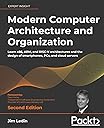
Modern Computer Architecture and Organization - Second Edition
Product ID: 399322485
A no-nonsense, practical guide to current and future processor and computer architectures that enables you to design computer systems and develop better software applications across a variety of domains Key Features: - Understand digital circuitry through the study of transistors, logic gates, and sequential logic - Learn the architecture of x86, x64, ARM, and RISC-V processors, iPhones, and high-performance gaming PCs - Study the design principles underlying the domains of cybersecurity, bitcoin, and self-driving cars Book Description: Are you a software developer, systems designer, or computer architecture student looking for a methodical introduction to digital device architectures, but are overwhelmed by the complexity of modern systems? This step-by-step guide will teach you how modern computer systems work with the help of practical examples and exercises. You'll gain insights into the internal behavior of processors down to the circuit level and will understand how the hardware executes code developed in high-level languages. This book will teach you the fundamentals of computer systems including transistors, logic gates, sequential logic, and instruction pipelines. You will learn details of modern processor architectures and instruction sets including x86, x64, ARM, and RISC-V, and take on practical challenges such as implementing a RISC-V processor in a low-cost FPGA board and writing a quantum computing program and running it on an actual quantum computer. This edition has been further updated to cover the architecture and design principles underlying the important domains of cybersecurity, blockchain and bitcoin mining, and self-driving vehicles. By the end of this book, you will have a thorough understanding of modern processors and computer architecture and the future directions these technologies are likely to take. What You Will Learn: - Understand the fundamentals of transistor technology and digital circuits - Explore the concepts underlying pipelining and superscalar processing - Implement a complete RISC-V processor in a low-cost FPGA - Understand the technology used to implement virtual machines - Learn about security-critical computing applications like financial transaction processing - Get up to speed with blockchain and the hardware architectures used in bitcoin mining - Explore the capabilities of self-navigating vehicle computing architectures - Write a quantum computing program and run it on a real quantum computer Who this book is for: This book is for software developers, computer engineering students, system designers, reverse engineers, and anyone looking to understand the architecture and design principles underlying modern computer systems: ranging from tiny, embedded devices to warehouse-size cloud server farms. A general understanding of computer processors is helpful but not required. Table of Contents - Introducing Computer Architecture - Digital Logic - Processor Elements - Computer System Components - Hardware-Software Interface - Specialized Computing Domains - Processor and Memory Architectures - Performance-Enhancing Techniques - Specialized Processor Extensions - Modern Processor Architectures and Instruction Sets - The RISC-V Architecture and Instruction Set - Processor Virtualization - Domain-Specific Computer Architectures - Cybersecurity and Confidential Computing Architectures - Blockchain and Bitcoin Mining Architectures - Self-Driving Vehicle Architectures - Quantum Computing and other Future Directions in Computer Architectures - Appendix Review: Simply impressive - Amazing book for readers who are looking to understand the principles of modern computer architecture. Great introduction to various cutting edge topics such as Bitcoin mining, Blockchain and more. A useful guide that will help you to widen your knowledge on computer architecture with practical examples and exercises. Review: A good book for Introduction to Computer Architecture - This book can be considered for the coursework of the entry level students in the field of engineering. Anyone who is interested to know about computer architecture and has no clue whatsoever this can be a good starting point for them. However , this book shall not be looked upon as in-depth reference for this topic. It is like a good collection of set of things which one can pursue if one is interested in the Computer Architecture and also can get the latest greatest knowledge about it as a starting point. Overall verdict would be : Good for beginners , more experienced folks can skip this.

| Best Sellers Rank | #446,514 in Books ( See Top 100 in Books ) #458 in Hardware & DIY |
| Customer Reviews | 4.6 out of 5 stars 84 Reviews |
A**A
Simply impressive
Amazing book for readers who are looking to understand the principles of modern computer architecture. Great introduction to various cutting edge topics such as Bitcoin mining, Blockchain and more. A useful guide that will help you to widen your knowledge on computer architecture with practical examples and exercises.
N**L
A good book for Introduction to Computer Architecture
This book can be considered for the coursework of the entry level students in the field of engineering. Anyone who is interested to know about computer architecture and has no clue whatsoever this can be a good starting point for them. However , this book shall not be looked upon as in-depth reference for this topic. It is like a good collection of set of things which one can pursue if one is interested in the Computer Architecture and also can get the latest greatest knowledge about it as a starting point. Overall verdict would be : Good for beginners , more experienced folks can skip this.
U**R
Nice book
Nice book to read, Amazing author, good work from the product team in developing this title, great resource, for the community.
N**H
Very well written.
This book was referred to me by one of my mentors. I must say the author has made sure to keep the concepts clear and simple to understand. Right from chapter 1 to the last chapter, every topic is explained considering the audience in mind. Happy to see the fundamental coverage of Blockchain, Cryptocurrency, Cybersecurity, Bitcoin mining etc. This book definitely provides a good coverage of modern processor architectures and instruction sets including x86, x64, ARM, and RISC-V. I recommend this book.
R**N
New and updated 2nd edition includes all the latest computer architectures.
I have also read and reviewed the first edition and found it to be a great read, and like the first this is very digestible and easy to follow. Though you would need to understand technology a bit, I find Jim Ledin's ability to break down complex material to make it much more comprehensible is suburb. This book covers everything from the first edition as well as much more like things such as DDR5 SDRAM, RISC-V variants like SoC and IoT now using AI and ML, iPhone13, NVIDIA GF RTX, Ryzen 9, Cloud Applications, Cybersecurity, Cryptocurrencies, Self-driving cars, Quantum computing and more. This book is wonderful for anyone looking to get into the computer architecture or software architecture industries. It is also valuable for anyone still in school or still seeking out what focus they should start working towards within the computer science or any related technology centered classes. That to me is one of the greatest achievements of a book like this, is that it gives someone such a broad range of knowledge about so many different technologies that one can easily determine what interests them and what does not. Technology is fascinating, and this book does a great job at bringing the reader down to a pretty low level of how it all operates but does not bring you down so low level that you are trying to understand hard to follow proofs or things like this, it is all very easy to read and I highly recommend to anyone into technology.
M**S
Comprehensive Easy Read (even for old blokes)
Liked - everything. Didn't Like - anything significant. As a long retired microprocessor systems engineer from the 70's I chose this book as some holiday reading hoping to further update and consolidate my understanding of modern processor architecture. I picked up the book and began browsing through it like any other technical book from the back! I found the book immediately engaging and easy to explore with hundreds of topics scanned in 2 hours and now being read in order of interest like a magazine. A very meaty magazine, amost encyclopedic given the breadth of topics covered and at a depth suitable for conceptual understandng. A side benefit was for me to get a much better handle on the ever expanding glossary of terms, standards, product series etc which can unecessarily detract from a readers understandng or even the desire to understand. Each topic includes a handful of current or classic technology examples or standards. The author's choice in these was for me enjoyable and relevant. Of course it would be impossible to cover everyone's favourite areas to the depth desired or even at all. If there is a further edition of this wonderful book I would like to see acknowledgement and processor examples from the Motorola 6809 and 68000 processors that introduced the possibility of key processor functionality like: Unified addressing modes allowing a RISC like instruction set, position indepependent code and segmentation the the use of relative addressing, easy to write HLL compilers through stack relative passing of pointers and variables, easy systems programs such as RTOS with dual stack pointers etc. Finally I note the mention of micro-ops being used to make increasingly complex and sophisticated predictive pipelines. Perhaps a section on micro-programmed vs hard wired instruction sets would be good in the historical lead up to the current super processors. All in all a very enjoyable read awaits the reader. Thanks Jim!
M**D
Computer Architecture
The suitable book for computer architecture and organization
R**A
Arquitectura por Computadora
Arquitectura por computadora
A**X
Fundamentos muy bien explicados
El libro explica los terminos de forma clara, entendible y describe desde los fundamentos la arquitecturas actuales.
Trustpilot
4 days ago
1 month ago