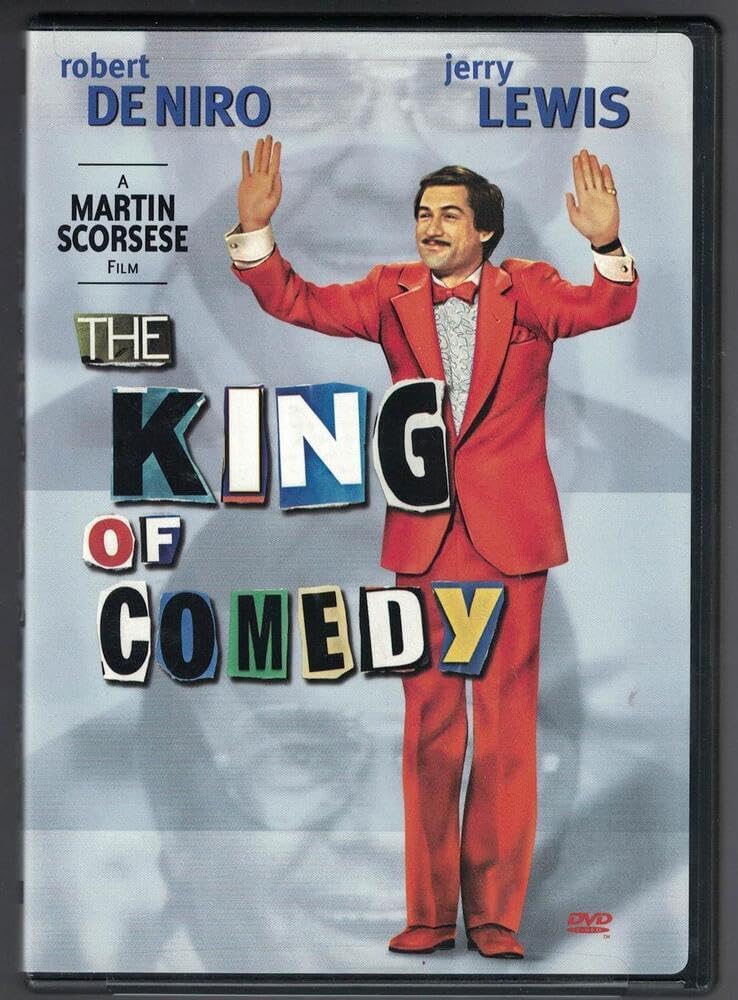
King Of Comedy The
Product ID: 4236351
Details
- FormatAnamorphic DVD
- GenreComedy
- LanguageEnglish
- Runtime1 hour and 49
Desertcart purchases this item on your behalf and handles shipping, customs, and support to Philippines.
Aspiring comic Rupert Pupkin wants to achieve success in showbiz, by resorting to stalking his idol, a late night talk show host who craves his own privacy. Starring Robert DeNiro, Sandra Bernhard and Jerry Lewis. Special features includes: Making-of featurette; Deleted scenes; Behind-the-scenes footage; Still gallery; Theatrical trailer. Review: squirm... (plus comments on the Blu-ray) - I almost didn't buy the Blu-ray, because of negative comments about a poor transfer. The transfer is supposedly from the camera negative, and often looks it, as in the first scene with Rupert and Rita. The blacks are deep, the colors rich, and the sharpness and detail exemplary. (I sometime wonder what equipment some viewers own.) You can buy the Blu-ray without fear. "The King of Comedy" is the complementary "bookend" of another Scorsese masterpiece, "Taxi Driver", with Robert DeNiro playing asocial, near-psychotic fame-obsessed characters in both. Both films play strongly against audience expectation -- "King" even more than "Taxi". In "The King of Comedy", DeNiro's character, Rupert Pupkin -- a seemingly untalented standup-comic wannabe -- is played for very black non-laughs. Rupert is so cut off from normal social interaction that he's unable to make any progress towards becoming the "king of comedy" he knows he's destined to be. When an encounter with his late-night idol Jerry Langford (Jerry Lewis) finally opens the possibility of appearing on television, he completely blows the chance, throwing him into the anguish that provokes increasingly demented assaults on his idol. On your first viewing -- and likely your third and tenth -- you'll be so violently embarrassed by Pupkin's self-destructive behavior that your toes will spastically curl down -- and stay there. You'll squirm so much you'll think you've mutated into a graboid. Rumor has it the actors //themselves// were so embarrassed that scenes which should have taken hours to film took //days//. This acute discomfort explains the film's box-office failure (not to mention its "sitting in the can" for a year) -- the average viewer isn't interested in a protagonist devoid of any sympathetic or redeeming characteristics -- until the end. The ending wholly upsets our expectations. Though we've been lead to believe Rupert lacks any mirth-provoking skills, he shows himself quite able to get an audience to laugh. His routine might not be brilliant, but he's no less funny than most comedians guesting on late-night talk shows. Significantly, Pupkin's routine isn't a series of jokes, but a more or less literal recitation of his miserable childhood. What the audience finds funny is actually Rupert's personal tragedy. We finally understand why he's so screwed up. (I emphatically disagree with Roger Ebert that the film has no "payoff" and the ending is "cynical and unsatisfying". But then, Ebert had trouble with unconventional comedies.) Though "Taxi Driver" and "The King of Comedy" are fundamentally similar, the latter inverts two important elements of the former... >> Despite its gritty look, "Taxi Driver" is fundamentally romantic, while "King of Comedy" treats the material in a semi-documentary style. Scorsese never "tells" us how we're supposed to react to the characters. >> We're initially annoyed (to say the least!) by Rupert Pupkin, then ultimately sympathize with him. Travis Bickle is at first the sympathetic loner, until we realize he's a psycho -- underscored (pun intended) by Bernard Herrmann's re-use of the three-note "mad house" theme at the end. Which brings us to the films' use of music. The "Taxi Driver" score came from the greatest film composer yet to have set pen to paper, while "King of Comedy" has //no// score. Why? Bernard Herrmann felt music was needed to make an emotional connection between the screen and the audience. This ain't necessarily so -- you can fully convey the most-profound emotions in a scoreless film (eg, "The Execution of Private Slovick"). Music's ability to enhance emotion is //so// strong it can override the director's intentions. This is probably why Hitchcock initially told Herrmann //not// to score Janet Leigh's shower. Without music, the scene is indescribably brutal. With Herrmann's music, its Expressionistic elements are raised to the Nth power. Is it any wonder Hitchcock was thrilled and let the music stand? Scorsese must have recognized this, and realized that any musical "comment" on Rupert Pupkin's behavior would only soften and sentimentalize the audience's reaction to him. When Pupkin makes an utter fool of himself, the audience has to experience it directly -- gurgling bassoons can't be telling the viewer they're not supposed to take it seriously. Similarly, when we finally begin to understand Rupert at the end, Scorsese doesn't want to sentimentalize the moment. If you have any lingering doubts about seeing "The King of Comedy", there's //one thing// in it (ignoring even DeNiro's incredibly perfect "should have won an Oscar" performance -- he //is// Rupert Pupkin) that fully justifies a viewing: After kidnapping Langford, Pupkin and Masha tie him to a chair, then duct-tape his mouth. The sight of "Mr. Greasy-Hair No-Talent" himself, Jerry Lewis, with his mouth taped shut (Oh, joy! Oh, rapture!), is worth the price of admission, many, many times over. If all of Martin Scorsese's work were destroyed, except for this one scene, it would be enough to sanctify his art as a movie maker. I grovel at Scorsese's feet, for (at least symbolically) putting the French toast of intellectuals in his place. It's doubly pleasing, because Lewis's turn as Langford is, consciously or not, strikingly self-satirizing. He was the //only// actor for the role. If you have Microsoft Cinemania, look up the Ebert and Kael reviews. Ebert's shows why he is one of the finest critics around -- whether or not you agree with him, you come away with a better understanding of a film. (It's also worthwhile reading Ebert's review of "Taxi Driver" to see how much of what he says about that film can be applied to "The King of Comedy.") Kael's review shows that the only insight she has into anything is her own self-serving attitude. There was never a "serious" movie critic who brought //less// -- intellectually or emotionally -- to the reviewing process than Pauline Kael (qv, her review of "2001"). Is "The King of Comedy" a truly great film? I don't know. But it //is// a terrific piece of totally uncompromising film making. Anyone who claims to love movies should see it. Review: One of Scorsese's best films......... - While remaining one of Scorsese's least appreciated films, it is nevertheless one of his best, full of brilliant insight and dark humor. Robert DeNiro (in a fascinating, chilling performance) portrays Rupert Pupkin, a deluded loser who dreams of being a stand-up comic. In order to realize his dream, Pupkin solicits the aid of his wacked-out friend (played by Sandra Bernhard) in a scheme to kidnap the host of a popular talk-show (played by the smarmy Jerry Lewis). The film works so well because Pupkin is clearly untalented (bordering on the offensive in how unfunny he really is) and there is no possible way to identify or sympathize with his plight. He is obnoxious, myopic, and quite possibly insane, yet Scorsese forces us to acknowledge how common his "sort" is in our fame-obsessed culture. Every scene hits the right note; every performance is dead-on; and each development plausible despite the absurd premise. Still, the stroke of genius remains the final sequence; sufficiently ambiguous to allow for two vastly different, yet equally powerful, endings. Depending on which one we choose, it is either an indictment of our culture or a further exploration of Pupkin's madness. Both work and Scorsese trusts the audience enough to come to its own conclusion. Overall, a great film that remains unjustifiably ignored.
| Contributor | Arnon Milchan, Diahnne Abbott, Edgar J. Scherick, Frederick de Cordova, Jerry Lewis, Kim Chan, Margo Winkler, Martin Scorsese, Robert De Niro, Sandra Bernhard, Shelley Hack, Tony Randall Contributor Arnon Milchan, Diahnne Abbott, Edgar J. Scherick, Frederick de Cordova, Jerry Lewis, Kim Chan, Margo Winkler, Martin Scorsese, Robert De Niro, Sandra Bernhard, Shelley Hack, Tony Randall See more |
| Customer Reviews | 4.5 out of 5 stars 1,549 Reviews |
| Format | Anamorphic, Closed-captioned, Color, DVD, NTSC, Widescreen |
| Genre | Comedy |
| Language | English |
| Runtime | 1 hour and 49 minutes |
W**K
squirm... (plus comments on the Blu-ray)
I almost didn't buy the Blu-ray, because of negative comments about a poor transfer. The transfer is supposedly from the camera negative, and often looks it, as in the first scene with Rupert and Rita. The blacks are deep, the colors rich, and the sharpness and detail exemplary. (I sometime wonder what equipment some viewers own.) You can buy the Blu-ray without fear. "The King of Comedy" is the complementary "bookend" of another Scorsese masterpiece, "Taxi Driver", with Robert DeNiro playing asocial, near-psychotic fame-obsessed characters in both. Both films play strongly against audience expectation -- "King" even more than "Taxi". In "The King of Comedy", DeNiro's character, Rupert Pupkin -- a seemingly untalented standup-comic wannabe -- is played for very black non-laughs. Rupert is so cut off from normal social interaction that he's unable to make any progress towards becoming the "king of comedy" he knows he's destined to be. When an encounter with his late-night idol Jerry Langford (Jerry Lewis) finally opens the possibility of appearing on television, he completely blows the chance, throwing him into the anguish that provokes increasingly demented assaults on his idol. On your first viewing -- and likely your third and tenth -- you'll be so violently embarrassed by Pupkin's self-destructive behavior that your toes will spastically curl down -- and stay there. You'll squirm so much you'll think you've mutated into a graboid. Rumor has it the actors //themselves// were so embarrassed that scenes which should have taken hours to film took //days//. This acute discomfort explains the film's box-office failure (not to mention its "sitting in the can" for a year) -- the average viewer isn't interested in a protagonist devoid of any sympathetic or redeeming characteristics -- until the end. The ending wholly upsets our expectations. Though we've been lead to believe Rupert lacks any mirth-provoking skills, he shows himself quite able to get an audience to laugh. His routine might not be brilliant, but he's no less funny than most comedians guesting on late-night talk shows. Significantly, Pupkin's routine isn't a series of jokes, but a more or less literal recitation of his miserable childhood. What the audience finds funny is actually Rupert's personal tragedy. We finally understand why he's so screwed up. (I emphatically disagree with Roger Ebert that the film has no "payoff" and the ending is "cynical and unsatisfying". But then, Ebert had trouble with unconventional comedies.) Though "Taxi Driver" and "The King of Comedy" are fundamentally similar, the latter inverts two important elements of the former... >> Despite its gritty look, "Taxi Driver" is fundamentally romantic, while "King of Comedy" treats the material in a semi-documentary style. Scorsese never "tells" us how we're supposed to react to the characters. >> We're initially annoyed (to say the least!) by Rupert Pupkin, then ultimately sympathize with him. Travis Bickle is at first the sympathetic loner, until we realize he's a psycho -- underscored (pun intended) by Bernard Herrmann's re-use of the three-note "mad house" theme at the end. Which brings us to the films' use of music. The "Taxi Driver" score came from the greatest film composer yet to have set pen to paper, while "King of Comedy" has //no// score. Why? Bernard Herrmann felt music was needed to make an emotional connection between the screen and the audience. This ain't necessarily so -- you can fully convey the most-profound emotions in a scoreless film (eg, "The Execution of Private Slovick"). Music's ability to enhance emotion is //so// strong it can override the director's intentions. This is probably why Hitchcock initially told Herrmann //not// to score Janet Leigh's shower. Without music, the scene is indescribably brutal. With Herrmann's music, its Expressionistic elements are raised to the Nth power. Is it any wonder Hitchcock was thrilled and let the music stand? Scorsese must have recognized this, and realized that any musical "comment" on Rupert Pupkin's behavior would only soften and sentimentalize the audience's reaction to him. When Pupkin makes an utter fool of himself, the audience has to experience it directly -- gurgling bassoons can't be telling the viewer they're not supposed to take it seriously. Similarly, when we finally begin to understand Rupert at the end, Scorsese doesn't want to sentimentalize the moment. If you have any lingering doubts about seeing "The King of Comedy", there's //one thing// in it (ignoring even DeNiro's incredibly perfect "should have won an Oscar" performance -- he //is// Rupert Pupkin) that fully justifies a viewing: After kidnapping Langford, Pupkin and Masha tie him to a chair, then duct-tape his mouth. The sight of "Mr. Greasy-Hair No-Talent" himself, Jerry Lewis, with his mouth taped shut (Oh, joy! Oh, rapture!), is worth the price of admission, many, many times over. If all of Martin Scorsese's work were destroyed, except for this one scene, it would be enough to sanctify his art as a movie maker. I grovel at Scorsese's feet, for (at least symbolically) putting the French toast of intellectuals in his place. It's doubly pleasing, because Lewis's turn as Langford is, consciously or not, strikingly self-satirizing. He was the //only// actor for the role. If you have Microsoft Cinemania, look up the Ebert and Kael reviews. Ebert's shows why he is one of the finest critics around -- whether or not you agree with him, you come away with a better understanding of a film. (It's also worthwhile reading Ebert's review of "Taxi Driver" to see how much of what he says about that film can be applied to "The King of Comedy.") Kael's review shows that the only insight she has into anything is her own self-serving attitude. There was never a "serious" movie critic who brought //less// -- intellectually or emotionally -- to the reviewing process than Pauline Kael (qv, her review of "2001"). Is "The King of Comedy" a truly great film? I don't know. But it //is// a terrific piece of totally uncompromising film making. Anyone who claims to love movies should see it.
B**6
One of Scorsese's best films.........
While remaining one of Scorsese's least appreciated films, it is nevertheless one of his best, full of brilliant insight and dark humor. Robert DeNiro (in a fascinating, chilling performance) portrays Rupert Pupkin, a deluded loser who dreams of being a stand-up comic. In order to realize his dream, Pupkin solicits the aid of his wacked-out friend (played by Sandra Bernhard) in a scheme to kidnap the host of a popular talk-show (played by the smarmy Jerry Lewis). The film works so well because Pupkin is clearly untalented (bordering on the offensive in how unfunny he really is) and there is no possible way to identify or sympathize with his plight. He is obnoxious, myopic, and quite possibly insane, yet Scorsese forces us to acknowledge how common his "sort" is in our fame-obsessed culture. Every scene hits the right note; every performance is dead-on; and each development plausible despite the absurd premise. Still, the stroke of genius remains the final sequence; sufficiently ambiguous to allow for two vastly different, yet equally powerful, endings. Depending on which one we choose, it is either an indictment of our culture or a further exploration of Pupkin's madness. Both work and Scorsese trusts the audience enough to come to its own conclusion. Overall, a great film that remains unjustifiably ignored.
J**T
Fun Times at Late Night High
Dramatic and funny at the same time. Expertly acted by the entire cast
H**N
DVD transfer is terrible and there aren't many special features, but I can't bring myself to give this film less than 5 stars.
This is a marvelous film from Martin Scorsese. If it weren't such a classic, I would have docked a star off of my rating for the quality of the DVD. I was disappointed in the quality of the picture and sound on the DVD release. I usually don't mind if the print is a little dated, but "The King Of Comedy" needs to be remastered b/c the transfer here is just awful. Blurry (and yes, it's supposed to look like a blurry broadcast at times, but not ALL the time) and VERY GRAINY. And it's a shame too, because this is a fantastic film. There are 2 deleted scenes, both Jerry Lewis scenes, with the most valuable being a deleted monologue from Lewis. Other than that, there's an 18 minute "making-of" documentary which is ok, but doesn't delve into De Niro, the actor, as much as I'd hoped. That's all we've got here. However, I would still encourage anyone considering it to buy this item. I don't think you'll regret it if you have an appreciation for subtle and mature humor. "Better to be king for a night than a schmuck for life." - - Rupert Pupkin is a wannabe comedian played magnificently by Robert De Niro in this often overlooked Martin Scorsese classic. If you are expecting the style of humor you would get in a modern classic like "Dumb and Dumber" then you should look elsewhere. There are some very funny laugh-out-loud moments in this picture, but much of the comedy is black and subtle. As almost any review of this film states, De Niro's character (Pupkin) is similar to the character he played in "Taxi Driver", Travis Bickle. Both characters are isolated and shunned by the world. Both characters are embarrassingly inept at achieving their goals. The 2 characters are both loners that are simply trying to get some sense of satisfaction in an otherwise distasteful life. In "The King Of Comedy" however, we aren't frequently presented with drama, and when we are, it's hilarious. So this is for people who enjoy a black comedy and subtle humor (maybe in other words, clean and mature adult humor). And if you love Scorsese and De Niro like I do, this was the film that they made together following "Raging Bull" and proceeding "Goodfellas" so this is right in Scorsese and De Niro's hay-day. Jerry Lewis notably stars in a supporting role and is fantastic as well. Even Sandra Bernhard is tolerable in this film. That's all thanks to Marty though. A classic. 5 stars.
J**A
"Better to be King for a Night than Schmuck for a Lifetime."
I'll never forget the first time I saw The King of Comedy in 1983. I was in Manhattan, and sat alone in anticipation of this film, knowing something of what to expect but not fully prepared for the stunning, overpowering experience on the screen. I squirmed with discomfort as two delusional fans of a talk show host refuse to acknowledge the reality of rejection that is heaped upon them by the object of their devotion and the maddeningly obvious isolation of their actual lives (such as they are.) View your reaction to this pining for any brush with fame to Jerry Lewis' walk down the street along side the mobs of construction workers, tourists, people on pay phones and even a cab driver vie for his attention. The audience is uncomfortable to see this adoration, clearly because it reflects us, as a society -- but we can also see it through the eyes of Jerry Lewis. Every frame brings greater uneasiness, to the point that I ache with psychological pain. It's important to note that Sandra Bernhardt steals every scene with a raw portrayal of a celebrity stalker. Either Jerry Lewis is the greatest actor in the world, or he was genuinely terrified of Bernhardt's behaviors. Is this Scorsese film a glimpse into reality? Turn on your television and realize that any wannabe of lower talents than a Pupkin can achieve fame. Even a pretense of talent is no longer required. But the American public will always be standing by ready to proclaim, "I'm gonna love you, like nobody's loved you, come rain or come shine." Completely brilliant beyond my wildest expectations.
A**Y
One of the Best Comedies of All Time
Robert De Niro is incredible as a struggling stand-up comedian. It's hard to believe it is DeNiro, and his obsessed fan friend, Sandra Bernhardt, as they both want to get in touch with the hot Late Nite Talk Show host, 'Jerry Langford', played by Jerry Lewis. DeNiro needs a break in show biz, and Bernhardt has a manic crush on him and wants to give him a sweater she knitted, but neither can get past Reception. Desperate, the two kidnap Jerry and will not let him go until DeNiro gets to give the opening monologue on the show. Bernhardt shows a great singing voice in her intimate time with Jerry in what must be a classic scene now. I have watched my vhs home made tape of this so many times, I decided to break down and get the DVD. Love it, Love it, Love it. Of course it is a Martin Scorscese film!
N**N
Can a mob boss be funny?
Charming, atypical and entertaining Deniro film that most people never heard about, including me because it's sadly underated, due to popular opinion bent on cast typing. Loved it.
J**H
A highly flawed classic?
It's interesting that people now seem to consider this film a classic as I remember this movie not being well received when it came out. I never saw it, though, and somehow even got it mixed up in my mind when this came out. Anyway, this film has some interesting concepts, and the overall message is clear, but maybe it's just time but the supposed darkness of the film feels muted to me. The scariest thing, honestly, is the truth in the perception of the medias representation about this concept and how it can glorify certain behaviors. I didn't find this film particularly dark. It's about a sad man (sad more as in a loser not necessarily actually sad), who is- in a way- part of a group of sad people who live their lives trying to be someone else. Constantly hounding celebrities. Mainly, it seems, so they can be a part of their work. They don't want to hear that they have to work for it. They believe that they deserve it- because they want it. In this belief they find themselves capable of certain ways of thinking. They feel justified in overreacting to the way they are treated by their idols and in so being they feel they can choose the way in which they themselves can be celebrity. Unfortunately, the film doesn't go anywhere significant. Robert Deniro would later do other films similar (Cape Fear or The Fan) which touch on these ideas in significantly scarier ways. This film feels afraid to go that far. Maybe this is because of the message which to me is a bit muddled. It feels like it is suggesting that the media is gross in how it glorifies misbehavior, as long as that behavior can be narcissisticly justified, however it will get you everything you want so make of that what you will. Interestingly it leaves all this messaging vague in the telling. We are given many examples of the characters tendency to day dream so we never truly know what happens at the end because the movie doesn't seem to want to glorify this behavior. Especially given that fans of film and TV can be incredibly malleable and it would be terrifying to a creator to think they gave any strange people an idea. I appreciate that some were inspired by this film, but I think this concept is done much better in other places. The main character here, Rupert, does bad things, but nothing I consider particularly dark. They're just sad. He could have just as easily spent 6 years (the amount of prison time the film says he got for his crimes in the movie- which the movie even says he didn't fully serve) working his way up in the clubs honing his craft. Ultimately, to me, the film is just about entitlement culture and how sad it is that people think they are owed fame because they waste their time stalking people on TV or in movies. The way fame works now is different, but the idea is still the same so it still makes sense, but nothing ever comes of it. His crime is mild, and it's brought on by mild celebrity arrogance. No one in the film is particularly evil, and no one is particularly good or anything. They're just various levels of people doing things, and some people feel entitled to what other people have. That's kind of all this movie is. I don't feel this movie is all that inspiring as a film buff, and I think it's really strange seeing these reviews that want to quote certain lines from this film like it's something to aspire to or at all memorable. The man depicted in the film is a bad person and of low moral fiber, and that's what the film is trying to say he is. He is not to be admired nor is he a hero, and sadly is not even particularly memorable. Maybe this is what the film is going for, it feels possible, but it didn't make for a particularly interesting commentary on society for me.
C**E
This is one of scorsese's finest, yet one of his most underrated films to ...
This is one of scorsese's finest, yet one of his most underrated films to date. Unlike the rest of his films at this period, he transistoned from his Dark Deniro thrillers and dramas ( like Raging bull and Taxi Driver) and made this, a dark comedy thriller. I believe this and 'Hugo' are his only PG rated films, yet unlike the other iw ould not classify this as a kids film... This is a film of desperation, crippiling ambition and the dark reality of new york life. The cast is spectaculer with Jerry Lewis playing De Niro's hero/enemy, of Whom Deniro wants to become. I would rate this film a solid 10/10 and the DVD itself was clean and in great condition, and the extras offered a lot of insight into what was really going on on set and the intentions of the crew when making this opus.
F**V
Great !
Great film and terrific on Bluray x good price too xxxxx stars
V**E
Tiene castellano
Opinión de King Of Comedy [Italia] con ASIN : B00HVAFOXU Película con audio castellano. Los extras no tienen subtítulos en español, solo en italiano. ¡Un saludo!
D**0
Re per una notte bluray
Edizione inglese ma è presente anche la lingua italiana , capolavoro assoluto del grande martin scorsese con un ottimo robert de niro , film stupendo , tutti gli appassionati dovrebbero possedere questo bluray !
A**L
Und jetzt sagt Hallo zu Jerry..........
..............und natürlich zu Robert, dessen Rolle hier gleichermaßen zur Beängstigung wie zum Fremdschämen anstachelt/ anregt. Diese penetrante Anmache eines von sich über alle Maßen eingebildeten Wichtigtuers gegenüber seines Idols Jerry ist nicht nur voll schräg, sondern nicht minder die Spitze des schwarzen Humors. " Man sagt nicht: Hey Freunde, jetzt kommt die Pointe,.....man bringt sie einfach! " Rupert Pupkin ist ein Wahn.sinniger. Er ist besessen vom Wahn, berühmt sein zu wollen. Er ist überzeugt davon, dass er ein guter Komiker ist. Dass er witzig ist. Und negative Reaktionen blendet er aus. Und letztlich ist ihm jedes Mittel recht, sein Ziel auch zu erreichen. KING OF COMEDY ist aufwühlend spannend, KING OF COMEDY ist tatsächlich ein Thriller, denn die Kombi aus falscher Selbsteinschätzung und aus nicht ernst genommen werden hat brutale Folgen für alle Beteiligten. Ein wahnsinniger, wahnwitziger Film eben. Und großartig wie Lewis und DeNiro. Eben. " Tut mir leid, er hat keinen Termin mit Ihnen. " ******************************************************************************** Story: Ein Möchtegern- Entertainer, der sich für ein unentdecktes Talent hält, entführt sein großes Idol und erzwingt sich damit den Platz in dessen Fernsehshow? Kaum zu glauben, oder? Seht selbst. ********************************************************************************* Fazit, mein grandioses: Eine grandios gespielte und bitterböse Farce: KING OF COMEDY! Ein Film voller bizarrer Szenen, schrägstem Humor und komischster Schärfe komischer Einlagen, über die ich ernsthaft lachen konnte. DeNiro überzeugt als narzisstische Nervensäge, die sich für einen göttlichen Komiker oder sogar für Gott hält. Der personifizierte Wahnsinn, der am Ende als bemitleidenswerter Wicht enttarnt wird, der in einer Traumwelt lebt. " Haben Sie ihn gebeten, zu gehen? " - " Ja. Aber er geht nicht. " Genial doch die Szene, in der Rupert in seinem Zimmer sitzt und mit fiktiven Gästen in einer fiktiven Talkshow quatscht- während er dabei von seiner Mutter unterbrochen wird, die aus dem Erdgeschoß nach oben ruft, dass er doch nun endlich den Müll rausbringen soll. " Also wenn Sie jetzt nicht mitspielen, Jerry,..........könnte das ein Problem geben. " Nur zu gut erinnere ich mich an dieses Zitat: `In jeder Straße, in jeder Stadt gibt es einen Niemand, der davon träumt, ein Jemand zu sein. Ein einsamer, vergessener Mann, entschlossen zu beweisen, dass er noch lebt. ` Ja, das stammt aus Paul Schraders Feder, ist die Tagline von " Taxi Driver " aus dem Jahr 1976- die Geschichte von Travis Bickle, der einen Amoklauf verübt, um " die Straße vom Schmutz zu befreien ". Und um seine Männlichkeit zu beweisen.....beinahe so könnte man die Linie von Rupert Pupkin beschreiben, der hier in KING OF COMEDY noch bei seiner Mutter lebt und dessen großes Ziel es ist, wie der berühmte Jerry Langford zu werden. Beinahe. Mit all seinen Boshaftigkeiten und seinen inneren Dämonen. " Soll man das für möglich halten? Dieser Irrsinnige bedroht Jerrys Leben und ihr sorgt euch um die Sendung?! " Also: Sowohl " Taxi Driver " als auch KING OF COMEDY handelt von kranken Individuen,.........aber auch von einer kranken Gesellschaft. " Hallo, wer ist da? " - " Ich bin der King. " KNG OF COMEDY- ein Film über die Leere hinter der vorfabrizierten Fröhlichkeit. KING OF COMEDY- ein wirklich besonderer Film. " Verhaftet? Fein. Ich glaub`, ich muss jetzt zum Make up. " - " Ich würde zu gerne etwas Farbe in Ihr Gesicht bringen. " - " Hähä, haha. " :DD Und: Mein großer Dank gilt Daniel Zynda- ohne seine klasse Rezension hätte ich mitnichten den für mich immer nur witzigen Jerry Lewis in einer so ernsten Rolle erleben und bewundern können.:-) Lauflänge: 104.20 Minuten ( mit Abspann ) ! Bonus ( deutsche Untertitel ) : - Der Versuch, nach oben zu kommen: Making of= 18.40 Minuten! - Unveröffentlichte Szenen= 6.15 Minuten! - Original Kinotrailer + kanadischem TV- Spot! Ja, ein wirklich besonderer Tipp!
Trustpilot
2 months ago
5 days ago