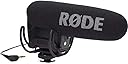
🎬 Elevate your video sound game — don’t just record, captivate!
The Rode VideoMic Pro Compact is a professional shotgun microphone designed for HDSLRs and camcorders, featuring a broadcast-quality condenser capsule with supercardioid pickup for focused audio capture. Its ultra-lightweight, compact design (150mm length, 85g weight) ensures portability without sacrificing performance. Powered by a single 9V battery, it delivers up to 70 hours of continuous use. Integrated shock mounting and a foam windshield minimize handling and wind noise, while adjustable gain levels and a high-pass filter provide precise audio control. Ideal for millennial content creators seeking crisp, hiss-free sound with easy setup and reliable durability.
| ASIN | B004K8WPUQ |
| Antenna Location | Singing |
| Audible Noise | 10 Decibels |
| Audio Sensitivity | 20 Decibels |
| Brand | Rode |
| Built-In Media | 1 |
| Color | Black |
| Compatible Devices | Camera |
| Connectivity Technology | XLR |
| Connector Type | 3.5 mm Jack |
| Customer Reviews | 4.3 out of 5 stars 839 Reviews |
| Enclosure Material | Metal, Plastic |
| Global Trade Identification Number | 00698813002092 |
| Hardware Platform | Camera |
| Item Dimensions | 10.5 x 2.25 x 5.2 inches |
| Item Weight | 86 Grams |
| Manufacturer | RØDE Microphones |
| Mfr Part Number | VIDEOMICPRO |
| Microphone Form Factor | Shotgun |
| Model Name | VideoMic Pro Compact VMP Shotgun Microphone |
| Model Number | VMP |
| Number of Batteries | 1 9V batteries required. |
| Number of Channels | 1 |
| Polar Pattern | Unidirectional |
| Power Source | Battery Powered |
| Recommended Uses For Product | Singing |
| Signal-to-Noise Ratio | 76 dB |
| Special Feature | The RODE VideoMic Pro raises the bar set by the original RODE VideoMic, by combining broadcast quality audio with an ultra compact and lightweight ergonomic design. Incorporating new features specific to high end video, the VMP also evolves many of the features that have made the VideoMic so successful. Noise transference has been significantly reduced using both a revised, more elegant shock mounting system and a lightweight premium cable. Special Feature The RODE VideoMic Pro raises the bar set by the original RODE VideoMic, by combining broadcast quality audio with an ultra compact and lightweight ergonomic design. Incorporating new features specific to high end video, the VMP also evolves many of the features that have made the VideoMic so successful. Noise transference has been significantly reduced using both a revised, more elegant shock mounting system and a lightweight premium cable. See more |
| UPC | 617724697579 698813002092 989898424696 |
| Unit Count | 1.0 Count |
| Warranty Description | 10 years. |
W**R
Perfect solution for problematic Canon DSLR hiss
I've been a Canon user and Canon fan for many years, but Canon video cameras always seem to have some sort of sound problem. In the case of Canon DSLRs with video capability, the problem is the loud and annoying hiss that occurs when you use an external microphone in a quiet setting. The first time I used my new Canon 60D to make a video, I quickly realized that the onboard microphone, while adequate for perfect circumstances, was not a good fit for outdoor use or pro-style interviews. I decided to buy an inexpensive $45 shotgun mic - big mistake - which produced the loudest ambient hiss I've ever heard on a recording. After a bit of research, I found that the 60D and other Canon DSLR cameras (and no doubt other brands as well) almost always produce a notable degree of "quiet room hiss" when used with most external microphones--and of course it's usually worse with a cheap mic. Further research led to further frustration, with all the "experts" suggesting that quality in-camera recording is just not feasible on DSLRs and you should buy an expensive independent recording system and then "sync" the sound to the video in post. What?!?!? I don't work for Sony Pictures, I just want to do some good quality commercial work for Internet posting. Then I ran across a YouTube video of a guy testing Rode microphones. He said that, after posting his video of a test with a Canon DSLR, Rode contacted him and told him that by setting the Rode Videomic Pro's dB switch to +20 and adjusting the manual sound level setting on the camera to about 20%, he could achieve a virtually hiss-free recording. Thus I ordered this mic from Amazon. It arrived on-time and in perfect shape, I ran a series of tests under various conditions, and I couldn't be more happy with my purchase. Interestingly, the suggested DSLR setting is right there in the Rode manual--perhaps they added it after the YouTube video was made. Bottom line, if you're shooting video with a DSLR and you want simple, high-quality sound for a reasonable price, this is your mic. Buy anything less, and in my opinion you will be unhappy with the results. One small caveat: This is a professional mic with a 10 year warranty, but it's not for people who don't take care of their equipment. The mini-jack cable is thin and could easily catch on something and break or be ripped from the mic if you aren't careful. The "rubber band" shock mounting system--while clever and effective--is easily pulled from its mountings and could be easily lost. (One extra set of replacement bands comes with the unit.) In other words, be prepared to handle with care, and you'll no doubt get years of use from this excellent pro microphone.
C**N
Awesome mic, great sound and no hiss with my Canon Rebel!
I bought the Rode Videomic Pro after wasting time with the Azden SMX-20 which I promptly returned because it was tinny and hissy--worse than the stock mic built into my Canon T3i. As I found out from a helpful video blog, the Canon Rebel suffers from a poor audio input circuit leading to a great deal of hiss when most brands of external mic are used. The workaround presented in that video is to employ a headphone amplifier in series with the low gain external mic. This lead me to believe the cure is to use a mic having high gain natively, and the only mic I can find with gain is Videomic Pro. All mics, at least the ones over $100, should have high gain option, IMO. Seems to me that a mic which is powered anyway should be designed to also output line-in levels with a switch or tweak of a pot and not limit itself to standard mic levels. I unpacked the Videomic Pro, popped in a 9V battery, turn it on with +20dB gain, and plugged it into my T3i. It took me a few minutes to decide the optimal manual mic level for good amplitude and lowest hiss, in between 25-30% maximum. This mic has virtually no hiss and excellent frequency response. Even with the high pass filter turned on, it has great bass response. Voices sound natural. It illustrates the rotten acoustics of a typical room however, the curse of high sensitivity and low directionality. It would be nice if it was more highly directional to prevent picking up echoes and non-content coming from the sides and back. My complaints are that this mic too big and heavy, and the rubber shock mount is too weak for the suspended mass thus making it too bouncy and wobbly. Despite protruding out a ways, it still picks up lens noise (manual focus is widely recommended for that reason). To make it perfect, move the battery to the shoe portion of the suspension, perhaps replace it with a lighter battery (stack of button cells), make it much more directional, make the mic body shorter, and the wind screen smaller and removable. But then it would be a lot more expensive, right? I'd give it 4-stars not considering price or competition, but have to bump it up to 5-stars because it is such an excellent value for the price and performs so drastically better than a mic list price only $75 less. Purchased this 'used' (nearly 20% off new price), factory-sealed, dented box and fulfilled by Amazon. Very fast ship, in perfect condition. Great savings for a great mic.
J**L
really high quality, light, and CLEAR mic!
All I can compare this mic to is the built-in one on my D800. The mic on the D800 is really nice, but I've had all I can take of the motor noise of the AF system. External: Packaging is as expected, mic comes in a paper box - with cut foam fitted for the mic. (Years ago, I bought a similar mic made by Sony called a "Zoom Mic" that was shaped like the letter "Z"). Rode's mic was packaged similar. Hmm, no coupon for a free dead cat. Wish I had bought this when the dead cat was offered. I did get the dead cat anyway (more on that later). I've seen a lot of comments regarding the plastic build. I like the lightness and since the feel seems solid enough, I am guessing the plastic is a good choice? The shock absorber does make the mic feel a bit fraile. For those who do not know (the "Z" mic mentioned earlier did not have this feature...) the mic sits on a rubber shock absorber and not fixed solid to the base. This helps keep a lot of excess noise down. Internal: The manual is nice - but the instructing for getting the nine volt into the mic - lol - well, it does take some care and attention. The good side(s) though is that the battery will NOT fall out, and you do not have to change the battery too often. Mic function: Very NIce. I turned the camera's mic input down, and left the mic on "0" gain. While capturing video, I watched the vue meter on the camera just to be sure that the input was not too loud (away from the red). This worked nicely. I guess I will have to tweak/retweak every time I use the mic. Every situation/location will be different. While I like the extra controls (i.e. mic gain/cut, and high pass) it'd be nice if this can be done auto-magically. I can slightly still hear the AF motor, but I really have to concentrate. I did order the dead cat and after figuring out how to put this thing on, all is well. Is it worth $30? lol. There are videos online of folks making similar devices much cheaper and works just as well. HTH.
B**D
Great dSLR mic, 10 year warranty, but a short cable
This mic is worth the price for it's quality. The difference between this mic and the regular Rode VideoMic is noticeable, especially if you're plugging it into your dSLR. dSLRs all have a noticeable static hiss, just watch any YouTube video filmed on a standard Rode VideoMic and you'll hear it. The VMP has a +20dB boost option, which, when combined with lowering your mic levels in camera, effectively neutralize that annoying dSLR hiss. It's important to note though, that you need a dSLR which allows you to set the mic levels manually to utilize this. The popular entry level Canon Digital Rebel T4i can do this. The construction is solid and the way this mic is suspended is far more sturdy and reliable than the awkward mount on the regular VideoMic. I bought the deadcat for this mic and leave it installed 24/7 to kill most wind noise. It lasts a LONG time on a single 9V battery, which is great since I often forget to turn it off for hours after use (whoops). I do have 2 gripes with this mic though. First, the shoe mount can be unscrewed to allow this mic to be attached to a tripod or boom. The screw for this often loosens which causes the mic to not stay snug on the camera and wobbles around. since I don't foresee myself using this on a tripod or boom, I may use some thread locking fluid to prevent this from happening anymore. Secondly, the cable comes out of the left side of the mount, and then is supposed to run across to the right side, passing through a very small clip on the front of the mount. The cable frequently falls out of this loose clip (more like a divot). Also, this leaves the cable on the right side of the mount, which is odd since nearly all dSLRs have their mic input jacks on the left side of the body. This means the cable has to do a contorted loop around the camera to properly be isolated and plugged in. The cable is also fairly short at roughly six inches. I'd like to use a shoe V mount adapter so I can use this and a light, but the cable' short reach makes this impossible. Overall, this is an excellent shotgun mic for dSLRs. For most the Rode VideoMic will be sufficient, but for the discerning user who really cares about getting broadcast quality audio without that hiss in a smaller higher quality shell, the Rode VideoMic Pro is perfect. It comes with a 10 year warranty and a free license to the plural eyes software. Pros: - Excellent audio quality - High quality sturdy isolation shock mount - +20dB boost eliminates dSLR hiss - 10 year warranty Cons: - Expensive - Short cable - mount screw requires frequent tightening
C**H
Go ahead and budget this into your DSLR video purchase
I recently purchased a Canon T3i. I got it almost exclusively for video work (I already own DSLRs and have a good lens collection). Anyhow, the on-board audio on the Canon T3i is terrible. I've also used a Nikon DSLR (model?) for video and had the same issue. I guess I should point out that my opinion about video production is that audio recording is critical to the overall result. This microphone solves the problems of the newer DSLR issues around audio. The mic records mono, but the input plug carries the signal to two channels giving you dual mono into your stereo input, so you don't have to correct it in production later on (or with extra signal splitting plugs). The quality of the mic is outstanding. You will need to experiment with the settings in your camera and on the mic to get the best balance of volume and hiss. I did some experimenting, and I set my Canon T3i to manual audio and click the gain to 8 or 9 clicks above zero (about 20%). I then set the mic to +20 on the gain. This seems to give me a good clean signal. Other settings give alot more hiss or not enough amplitude. I also use the mic on my HF G10 camcorder. I use a different balance on the G10 (default settings on both the camera and mic seems to work fine). It offers a more targeted pick up than the onboard G10 mics, and I use the deadcat wind shield to eliminate wind problems when outside. I did have to purchase a shoe adapter for the G10 because the Canon "advanced mini-shoe" is incompatible (too small). It's expensive, especially with the deadcat and mini-shoe adapter, but overall worth it if you shoot with a DSLR or intend to shoot outdoors with a camera that lacks a good wind screen. Others have commented about the thin cable, and I agree that it is too tender. The complaints about the shock mount are unfounded. I have found it to be of an excellent build and have not had any problems with it dismounting, even when I have been less than gentle with it. The 9 volt battery is wonderful, although please remember to take it out before going through airport security. The battery alone attracted special attention from homeland security on a recent trip. On the return flight, I removed the battery ahead of time and had no problems. The "on" light is my favorite feature (I have several powered mics with out a light, and have burnt through countless batteries in my forgetfulness). I do teach video production, so I guess I'm a professional of sorts. I don't think I would recommend spending this much for casual video production (like home movies). You might be satisfied with a less expensive mic. Try Audio-Technica. They seem to offer decent mics for much less, however the audiophiles out there will not be pleased with anything less than the Rode VMP.
J**H
Solid 3 stars - The good and the bad
By no means is this a "pro" microphone, however I would say it lives on the top of the pro-sumer list. NOT for broadcast, or anything super critical. Perfect for web videos, run and gun stuff, etc. PROS: Great product for my DSLR to capture sound - however if you are a professional, like myself, then you know that this is not the only thing you will need. I use it like this: to capture the best possible natural sound from my DSLR so I can properly sync up the video to my other audio recording device, like my Zoom, which might act like a primary audio capture device, most likely a wireless lavalier on the subject. Plugging this in will make your video sound 1000x better than the on-board mic of your DSLR. CONS: What I dont like about this mic is the build quality. For the price, I guess, but the rubber bands have come loose on mine many times, and the battery door is a little hard to finagle with. The cord that goes into the mic jack is ridiculous. This was most certainly an afterthought, rushed, and no good. It is flimsy, with no spring. This was why I took this review from 4 to 3 stars. The battery will last forever - buy the best you can find and always have a back up but this device does not pull / waste a ton of juice. I do like the size of this thing. Also - and this is nitpicky...but must these companies splash their names all over the products? We know its RODE for god sakes....and we have already purchased it. Must we advertise it for you now, too?
T**K
It's small footprint & ease of setup will have you using it in place of other audio equipment you might have typically favored.
My Blackmagic Pocket Cinema Camera is a pretty low-profile camera...one of the major reasons for my purchase of it -- and for that reason, a quality I would prefer to retain when purchasing add-ons. This Rode VideoMic Pro, thankfully, fits this role perfectly. Admittedly, the mic is pretty much the same size as the camera itself...but that's not because the mic is big...it's simply that the camera is so comically small in comparison to anything else you would be attaching it to. Really though, the quality is what matters, and the mic delivers in this arena on multiple levels: 1) It is very well stabilized; even with handheld footage, unless you are literally trying to...the mic will float freely without making any 'contact' sounds. 2) On certain cameras (like mine) the +20db boost is absolutely essential to get quality audio. 3) Since it uses a minijack plug, it can easily be adapted to pretty much any other connection you might need. 4) The mic, of course, sounds good. There are obviously better mics out there that cost more money, but this will provide great sound for the price you pay, and also remain extremely portable & flexible. As a testament to its ease-of-use & flexibility...my buddy has a Blackmagic Cinema Camera and an XLR mic / pre-amp to go along with it. It sounds great, but is a hassle to hook everything up...and it is bulky. Just last night we needed to do ADR, and instead of hook up all his equipment, we used my mic, and everything sounded great -- just put it on a tripod, plug it in, and record. Easy-weasy. :)
L**Y
Great quality and value
I've taking this traveling internationally and it's performed well and without issues. The battery life is long and the sound quality is great. The noise floor is quite low and for a small shotgun, the directional quality is good. Not great, but good for what it is. I recommend using this for short to medium distances from your subject. If you get more than a couple meters away it's going to start picking up quite a bit of background sound, but then again, it's a small shotgun mic and cannot compare in that regard with standard models that you would mount on a mic stand. Overall, I'm very happy with this mic. The one small issue I have is that the battery cover is a little difficult to remove and replace. It always seems hit-or-miss as to how it fits, but it eventually falls into place. I like the fact that it has a low-end roll off (which eliminates low rumble) and a +20 dB setting to bump up the gain for certain situations. I usually leave it on roll-off and +20 dB and it sounds great.
S**S
Nice mic, improve your on camera audio
Great mic, highly directional. audio is decent enough, and the "holding the camera " or sounds of the lense focussing aren't heard by the mic. Only difficulty is when thyou user plugs the mic in but doesn't turn it on, which means no audio is being recorded by your DSLR. The shock mounts hold up pretty well and are easy to pop back in when they do come out.
M**N
Excellent microphone: buy this one
I purchased this microphone from Amazon.co.uk on Sept 17th, and it arrived the next day first thing in the morning on the 18th with Express Delivery... helpful service as needed it delivered direct to a client ready for filming on the day. So straight out of the box and into a shoot and it performed fantastically well. Simple and intuitive to use, no complications. Shooting on my Canon 5D mark III with a 24-70mm lens, this mic is great for recording interviews and pieces-to-camera at close proximity. Even when filming in relatively noisy surroundings, in woodland with wind blowing through the leaves, it has recorded clean audio, with minimal if any distracting background noise. With your subject right in front of the lens, this picks up their audio as good as it gets. Being a broadcast cameraman used to using radio mics, I can honestly say the performance is equal to a professional radio mic when recording this close to the lens, without the possibility of rustle. Following the advice from other reviewers, I set the mic level to +20dB, and turned the sound levels on the camera down to about 1/8 level, which produced these great results. Other pros are that it is low profile and lightweight, so it won't weigh you down or get in the way. Slight negatives are I can see the rubber supports coming loose fairly frequently if on the move using handheld a lot, and the mic cable is quite thin, but I think this shouldn't cause any major issues, unless snagged hard, so handle with care. Essential to spend the extra £26 to buy the dead cat windshield for outdoor use. Definitely worth paying extra for this mic over the predecessor if you're in two minds, its a good long term investment. 10 year warranty says it all. [...]
T**O
Genial con el Audio de la cámara en modo Manual
Os cuento mi experiencia con este micro y una cámara reflex Canon 60D. Si no queréis meter ruido en el audio del vÃdeo, es necesario poner la cámara en captación de audio manual y bajarle el nivel a tope, para posteriormente subirlo 4 clicks hacia la derecha. Configurado asà y con el micro captando a 20db, va fenomenal en la mayorÃa de los casos que se nos pueden presentar. El problema viene cuando el sonido satura en condiciones en las que los niveles de audio del ambiente son muy cambiantes (tracas, orquestas, charangas, ...). En mi Canon 60D, puedo ver si el sonido satura a través del menú, pero una vez empiezo a grabar, ya no veo como están los niveles de audio que han podido ir cambiando desde que yo lo miré en el menú. En este caso, la solución es jugar con el firmware alternativo que existe para las Canon, llamado Magic Lantern, que entre muchas virtudes, permite añadir una imagen en la pantalla principal de la cámara que te permite monitorizar los niveles de audio en tiempo real durante las grabaciones. Por ejemplo, en una boda, yo empiezo con el micro configurado a 20db, pero de repente empieza a tocar una charanga y me satura el audio. Pues sà soy capaz de estar monitorizando los niveles de audio, me doy cuenta y pongo el micro Rode a 0db o incluso a -10db según me convenga. Esto es rápido y fácil de hacer. Con el audio de la cámara en automático no aprovechamos el Rode Videmic Pro en todo su potencial, porque en los silencios, la cámara interpreta que se escucha poco y tiende a subir la ganancia, con lo que sube también el ruido en los silencios, teniendo subidas y bajadas de ruido que luego quedan fatal. Resumiendo, este micro mejora muchÃsimo el audio de las cámaras Reflex sin tener que llevar un sonidista al lado, pero requiere estar pendiente de la saturación de audio para sacarle su rendimiento.
B**N
Works very well with the Lumix GH3
Just received the Rode Videomic Pro and tested it on my porch. It definitely captures better audio than the Lumix GH3's internal mics. For over $200, it should. It's not as fantastic as the sound from a lavalier mic, but this mini shotgun mic will probably be better than a lavalier for interviewing two or three people. And it's more convenient than working with a wired lavalier. As recommended by others, I set the mic to +20 db and reduced the camera's recording level to 1. That worked OK, but I had no problem increasing the camera's recording level to 4. I don't notice any noise from the camera's AGC when I increase the recording level from 1 to 4, and the audio didn't clip, although I was speaking softly. I'm eager to try it under more diverse conditions.
D**R
Reporterqualität - Wichtig für einen guten Film ist der Ton
Das Beste am Film ist der Ton! Meine Canon 5D Mark II macht sehr gute Videos möglich. Das eingebaute Mikrofon ist zwar brauchbar, aber nicht wirklich top. Es werden Nebengeräusche besonders durch die Kamera, z.B. auch durch Motoren im Objektiv, mit aufgenommen. Das macht jedes noch so gute Video zweitklassig. Wichtig ist besonders die Sprachverständlichkeit im Video selber. Ich filme gerne bei Events, also Feiern etc.. Die Sprache ist dabei mit dem Rode sehr gut verständlich, glasklar und ausgeglichen. Da klingt nichts scheppernd oder blechern oder verdämmert. Auch in mehreren Metern Entfernung vom Mikro scheint der Sprechende vor einem zu stehen. Durch die Richtwirkung des Mikrofons werden externe Störquellen, wie z.B. Musik von einer benachbarten Kapelle oder Lautsprecherboxen, gut ausgeblendet. Die schwingende Aufhängung des Mikros unterdrückt Störungen durch die Kamera selbst bestens. Ein Stereo-Mikrofon habe ich nicht gewählt, da ich Menschen mit möglichst guter Verständlichkeit aufnehmen will, und keine Musik. Zu empfehlen ist noch ein Windschutz, auch DeadCat genannt. Dieser unterdrückt Windgeräusche effektiv. Leider ist er nicht ganz billig. Das Mikrofon selbst ist erfreulich leicht und kompakt und trägt überhaupt nicht auf. Für eine gute Kamera absolut empfehlenswert.
Trustpilot
1 week ago
5 days ago