The Great War and Modern Memory
Product ID: 4810415
📚Classic literary critique
🧠Psychological & cultural analysis
🕰️Deep historical insight
Desertcart purchases this item on your behalf and handles shipping, customs, and support to Philippines.
📖 Unlock the trenches of history and mind—where memory meets literary genius.
The Great War and Modern Memory is a critically acclaimed, used edition of Paul Fussell’s classic work that combines literary criticism, historical detail, and psychological insight to illuminate the cultural legacy of World War I. Praised for its vivid trench narratives and profound analysis, it remains a top-ranked essential for readers interested in literature, history, and trauma studies.
| Best Sellers Rank | #156,365 in Books ( See Top 100 in Books ) #11 in American Literature (Books) #40 in Military History (Books) #76 in English Literature |
| Customer Reviews | 4.4 out of 5 stars 432 Reviews |
J**M
LITERARY CRITICISM AT ITS BEST
It may have been the length of the book--or perhaps the size of the font--that had led me to put off reading this amazing book for so long. And amazing it is. Indeed, confirming one of the book's primary theses (that we draw from past narratives to make sense of contemporary experiences), my first instinct is to compare it to another book I read: Klaus Theweleit's "Male Fantasies" (2 vols.- link below). Fussell does for the British what Theweleit does for the Germans; that is, drawing from literature and personal correspondence, he paints a portrait of the national psyche--the zeitgeist, if you will. While Theweleit's book concerns WWII, or more precisely the experiences and fantasies of Nazi soldiers, Fussell's work limits itself to those of British infantrymen stuck in "the troglodyte world" of the trenches of WWI. Both critics take a sort of inductive, post-Freudian approach to their research (though Theweleit is more influenced by Gilles Deleuze, Fussell by Northrop Frye), and in both cases the result is propitious, to say the least. In his afterward, Fussell says that, were he to write the book again, he would not draw nearly so much from Frye. It's my contention that if this were the case, the book could not be written. Frye's "Theory of Modes" is ultimately what gives structure and unity to Fussell's book, and the result of this applicatiaon of Frye's theory is so rich--not just in teasing out the meanings of many of the most salient British literary works of the 20th century, but also in its revelations about memory and meaning--that I balk at even attempting anything akin to a synopsis. The book will perhaps appeal most to those whose interests are literary, but there is plenty here for anyone interested in the history of the "The Great War," or even general psychology. With regards to the latter, I would argue that any collection of books on PTSD or Trauma Studies would be incomplete without this text, and that this book is probably the single best argument for the relevance of Bibliotherapy (though nowhere is it mentioned in the book). One can only hope that, with thousands of our own soldiers returning from multiple tours in the Middle East, counselors and VA officials will make reading this book one of their priorities. Honestly, I cannot speak highly enough of this book: it is lucid, provocative and even suspenseful. I feel as though I have a better understanding not only of the war itself, but of the literature it produced, and the legacy it has left us with--in narratives, language, and popular culture. Readers interested in the Nazi mindset from the literary and psychoanalytical angle should check out Theweleit's Male Fantasies, Vol. 1: Women, Floods, Bodies, History and Male Fantasies: Volume 2, Male Bodies, Psychoanalyzing the White Terror. .
A**S
Perhaps The Best Book of All On World War One
With the 100 year anniversary of World War One upon us, there has been an outpouring of new books on the war. Some of these are very good indeed, but reading a few new ones drew me back to this classic. I think it may be the best book I have ever read on the War, for two reasons. First, while the book is mostly about the war in literature and memory, Fussell captures and shows the actual day-to-day experience of the soldiers in the trenches more vividly than anything else I have read. He was in combat in Europe World War II, so he knew things in visceral terms that non- combatants don't know (and, as he points out, very often did not and do not want to know). Also, while much of his research was literary, the rest of it was about as immediate as you can get: he spent three months in a room at the Imperial War Museum, reading the Museum's (unsorted) archive of papers of the British troops in World War I. In so doing, he says, "For three months I lived in the trenches with the British soldiery, accompanying them on raids on the German trenches across the way, consoling myself with their rum, pursuing and crunching lice in my trouser seams, and affecting British phlegm as they jumped the bags and dashed directly into machine gun fire." The day to day experience he conveys is horrible, claustrophobic, and increasingly pointless. Soldiers on both sides began to believe that the war would never end; "the war", indeed, begins to seem a great pitiless machine that chews up rank after rank of men, and spits out corpses. This is not a new thought -- no one who has read much about the War is going to believe that trench life was fun. But Fussell conveys more strongly than anyone else I have read just how awful, and endless, it was. He intended his description to make war look horrible, and it does. Second, Fussell's most important literary observation, it seems to me, is less about literature per se than about a way of thinking -- the modern way of thinking, if you will. He goes through key themes as they appeared in the writings of several major authors of the War. What emerges overall, however, is a sense that for many the ability to believe in ideals was killed in the war, shifting the postwar world to an attitude of pessimism and irony. Many have criticized Fussell's focus on a small group of British writers, but I think his point is still valid. The First World War made it impossible for thinking people to believe in human progress, or in the basic goodness of humankind. In the century since then, it has been too easy to remain disillusioned. This is a terrific book, for those whose interests are primarily historical, as well as for those who have literary inclinations. Read it.
A**R
More about how WWI was perceived and remembered.
This is not a history of WWI, but an essay on the impact and lasting influence of the War experience as recorded by participants - most notably British Infantry engaged in trench warfare and most specifically a group of British warrior-poets and authors. It includes references to and excerpts of many powerful and tragic poems depicting the particular horrors of that War which claimed millions of lives and leaves us to ask why.
F**M
Reading a War Through Its Words
The Great War and Modern Memory is outstanding, filled with insights based on Fussell's reading through the entire collection of WW I ephemera (diaries, postcards, field reports, &c.) at the Imperial War Museum (London), having "steeped" himself (his term) in the poetry and autobiographies of Sassoon, Owen, Graves, et al. Fussell's literary acumen and vast familiarity with the range of English literature enables him to shed light on many allusions, citations, and references to that literature in the works of, e.g., Graves, Sassoon, Owen--famous writer-soldiers of WW I; he also shows that many writers who tried to describe WW II depended heavily on the works of those men who had been in the trenches, raising the question of a single "World War", interrupted briefly by the Treaty of Versailles. He addresses a large number of themes, asks why irony and litotes were the "order of the day" for WW I writing, and offers substantial commentary on specific works, such as "Good-bye to All That", by Robert Graves, "Undertones of War", by Edmund Blunden. Much of this is necessary reading for those who enjoy WW I "memoirs", since--as he demonstrates--Graves wrote what amounts to "fiction disguised as a memoir" (220), to which he contrasts Evelyn Waugh's "Sword of Honor" trilogy ("memoir disguised as fiction"). He also lists a number of ongoing effects of The Great War (as of 1975) that are quite striking, such as the skepticism created by the vast gulf between soldiers' experiences and the reports in the press, and has a wonderful section on the etymology of words that originated in the trenches (e.g., "plonc" (cheap wine) < French vin blanc). A study of the trench war through the literature that it produced ("literature" both formal, as in the poetry of Owen et al., and informal, such as diaries, letters, &c.), this is an obvious precursor (preamble? prelude? lead-in?) to his book Wartime: Understanding and Behavior in the Second World War--many of the emotional, social, psychological issues that he either mentions or alludes to in this book receive full-blown exposition in the other. And Fussell writes all of this in a relaxed style that makes it possible to forget that is reading a seminal work by a world expert. Highly enjoyable, insightful, and informative.
E**F
" and he caught and held my attention for the better part of an hour
I first learned of Paul Fussell when I heard an interview with him on the University of Illinois radio station in the fall of 1989. He had just released "Wartime, Behavior and Understanding in the Second World War," and he caught and held my attention for the better part of an hour. I marked this book as one I wanted to read and obtained a copy a couple of months later. Once I started reading, I could not put it down. Fussell was erudite, observant, and always suffused with a keen sense of the ironic. (I realize this is not a review of "Wartime," but I will add an unsolicited recommendation for it without reservation...read it, by all means!). I picked up "The Great War and Modern Memory" with the expectation that it would be another tour de force. It was not nearly as satisfying as Wartime, however; the subject material was much narrower in this work (limited to literature, particularly poetry, produced by members of the British officer corps) than in "Wartime" (which included wartime propaganda, popular song, advertising, bawdy humor, military buffoonery, and behavioral compensation in the face of shortage and sacrifice). "The Great War and Modern Memory" was worth the time invested in reading it...it was well-written, incisive, and informative...but unfortunately "Wartime" had primed my expectations and whetted my appetite for more than this book delivered.
T**S
A page-turner and absolute must read
The paradox of the Great War is that it was so vast and transformative that it is quite impossible for a single human mind to comprehend in its totality. Fussell's excellent writing and scholarship comes closest to opening modern eyes to the full enormity of the event. For some time I have been devouring as much literature as I could find on the Great War, but this book absolutely takes first place. If I could recommend just one book on the subject to any interested reader, this would be it. Fussell describes the impact of the war on the culture and psychology of the 20th century, illustrating what, for me, were jaw-dropping insights, drawing on the memoirs and artistic expressions of the participants. I have been pondering it ever since reading it last year and it has generated many productive conversations with others. A page-turner and absolute must read. It will transform your view of modern history.
S**G
Intellectual history at its best!
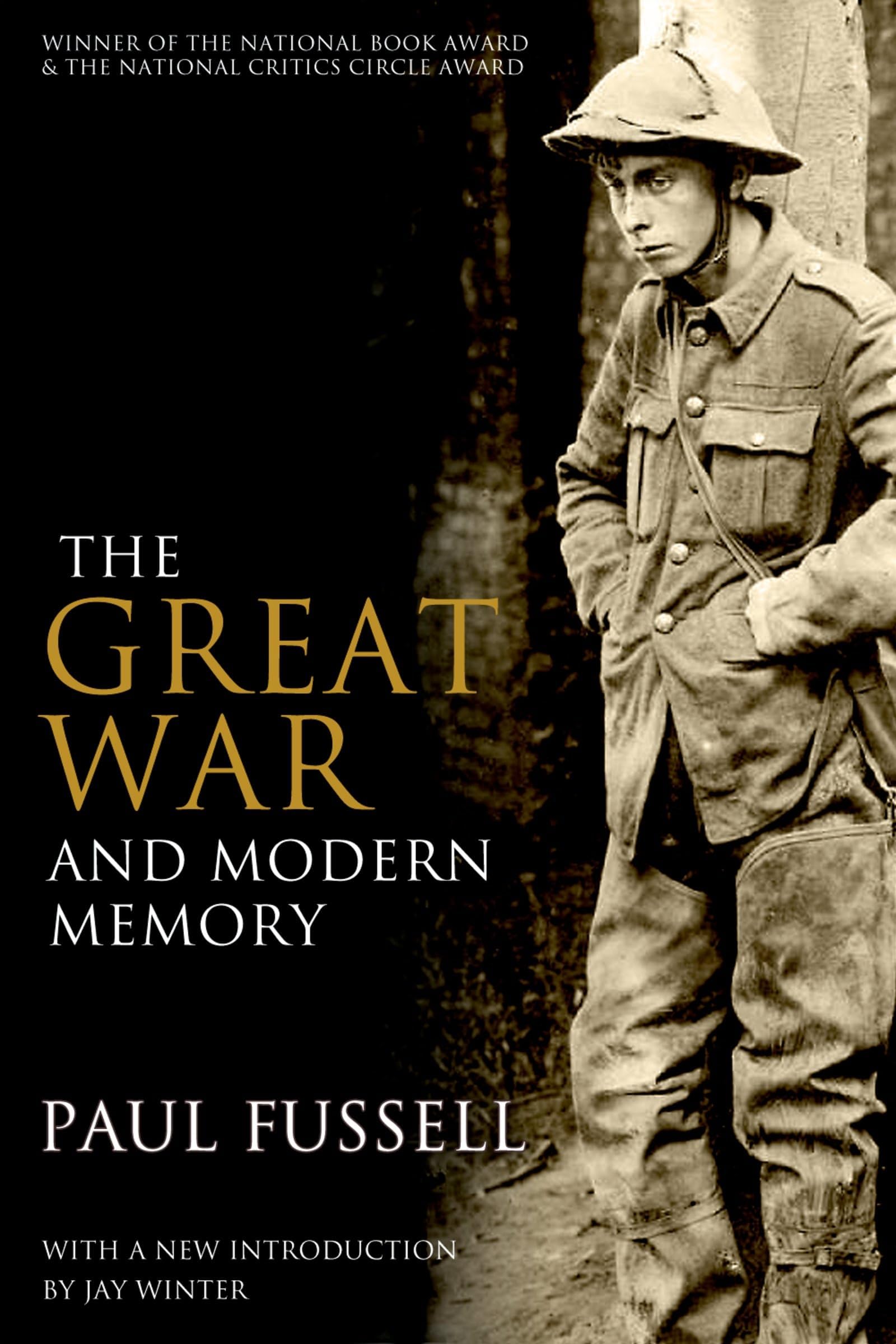
The book opens not with words, but with the pitiful picture of a shell-shocked "warrior" on the front cover. How did this man come to be this way, and is his visage ours now, also? This book helped me understand the enormous tsunami-like effects of World War I, waves of which still wash over us in our literature, art, aesthetics, language, politics, our thinking, myth, and metaphor. Beautifully written, and with hundreds, perhaps thousands, of quotes from writers big and small from the era, you get a sense of the massive personal and social dissociation of pre-WWI from post WWI. The world became, as another writer G.L. Myer, in a book of the same name, said, "a world undone." I found this book helpful in a number of ways. I understood more deeply why I was so unfulfilled by the accounts of Verdun (Alistair Horne, The Price of Glory) or the Somme (Peter Hart, The Somme: The War's Darkest Hour). (In my studies, I still have Passchendaele still to go: Robin Prior et al.) I understood more deeply why a great uncle of mine moved to Phoenix after WW I (he had been gassed and needed what his New York doctor called "clean air") and finally put a bullet through his head. I began to understand why I never really understood my grandfather, whom I loved dearly, who was the last of the Edwardian era. His humor, the books he loved, the stories he cited, were all so different from those I came to know and love. Besides all this, is this: The writer writes beautifully, fluidly, coherently.
P**R
Great book. Kindle version needs proofreading.
This is truly one of the great war books (and great Great War books) of our time. It is written at a level for any thinking adult, although someone who is interested in military minutia will likely be disappointed, and, obviously, some bored undergraduates will be exasperated. The Kindle version was apparently scanned, converted to text, but not adequately proofed, because it contains an excessive number of characteristic image-to-text conversion errors, such as rendering "m" as "in".
S**N
Five Stars
Focussed on Anglo experiences but marvelous.
A**Y
One of the very finest works on how the Great War was remembered by its participants
Paul Fussell's The Great War and Modern Memory is possibly the finest, most scholarly source on the way in which the Great War was remembered by its participants. Drawing on the memoirs of soldiers together with a forensic examination of the events that shaped them, Fussell's book is an insightful, compassionate, moving and skillfully written work. Few texts on the Great War equal its power to stir the intellect and the emotions.
C**L
Classic and timeless
"The" book on World War I remains as valuable and useful today as when it was published, more than 50 years ago. A must-read, along with "The Sleepwalkers: How Europe Went to War in 1914" by Christopher Clark. Parallels with today's situation are more than a little uncomfortable.
M**M
One of the few history books I read in one ...
One of the few history books I read in one sitting. Couldn't put it down. Looks at that awful war from interesting perspectives -- mainly those of the ordinary men and women who were doing the fighting and dying, not the generals.
B**I
Very good
I am satisfied both with the book's condition and the speed of its delivery. I recommend this service wholeheartedly. Thank you.
Trustpilot
2 weeks ago
2 days ago