We remain fully operational. Our teams are working around the clock to ensure your deliveries continue safely.

DOWNLOAD THE APP


Customer Services
Copyright © 2025 Desertcart Holdings Limited
DOWNLOAD THE APP
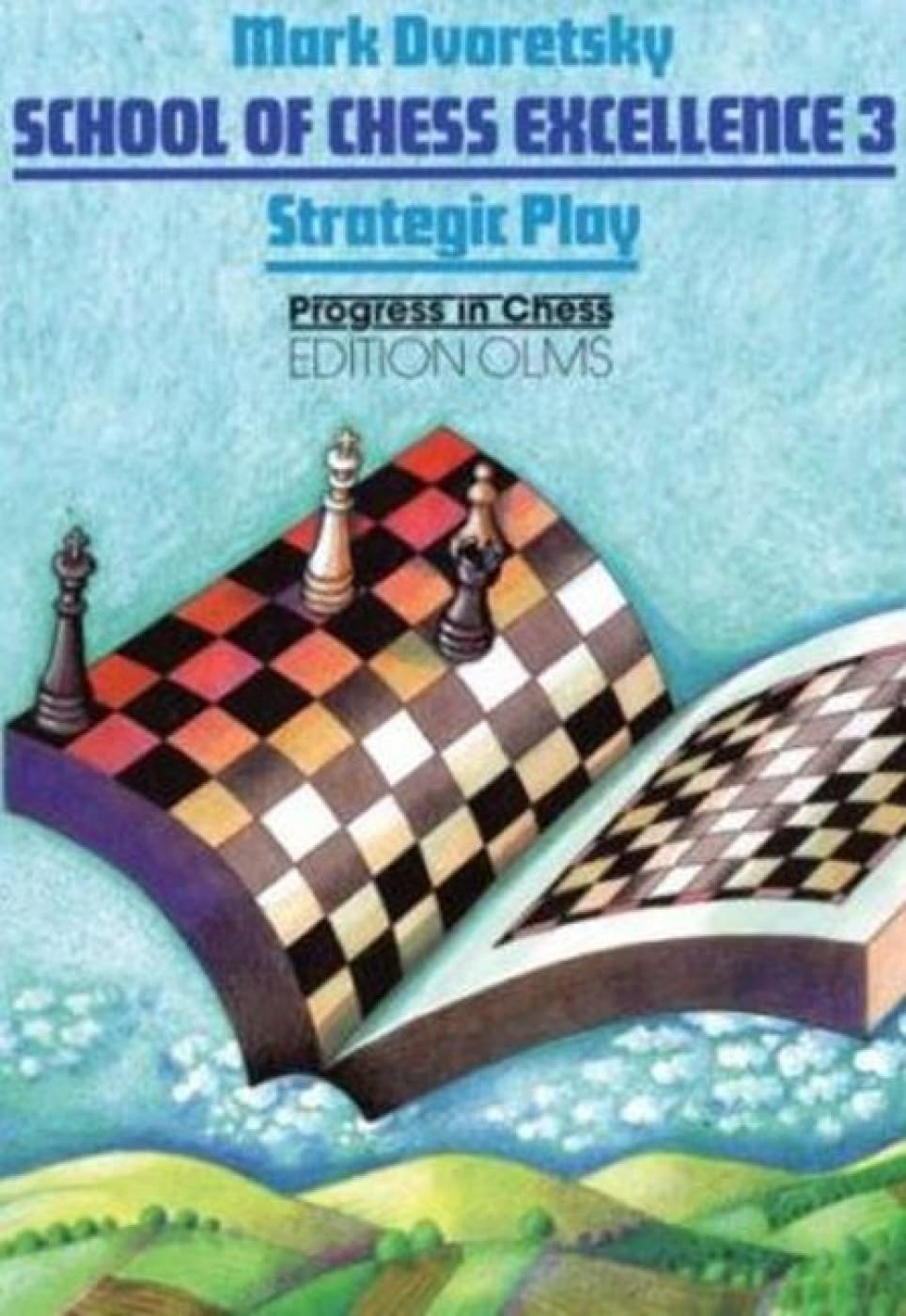

School of Chess Excellence 3: Strategic Play [Dvoretsky, Mark] on desertcart.com. *FREE* shipping on qualifying offers. School of Chess Excellence 3: Strategic Play Review: Excellent book - I have nothing to add except to say this is another outstanding Dvoretsky book with great coverage of chess strategy. I have no doubt that the chess world and especially Russia will miss this former great trainer of master chess players. Review: Practicality - It's a book by the master Dvoretsky this is a fine work, the master strikes again.
| Best Sellers Rank | #783,917 in Books ( See Top 100 in Books ) #732 in Chess (Books) #21,718 in Schools & Teaching (Books) |
| Customer Reviews | 4.8 4.8 out of 5 stars (34) |
| Dimensions | 6.67 x 1.33 x 9.5 inches |
| Edition | Illustrated |
| ISBN-10 | 3283004188 |
| ISBN-13 | 978-3283004187 |
| Item Weight | 1.25 pounds |
| Language | English |
| Print length | 220 pages |
| Publication date | July 19, 2002 |
| Publisher | Edition Olms |
G**S
Excellent book
I have nothing to add except to say this is another outstanding Dvoretsky book with great coverage of chess strategy. I have no doubt that the chess world and especially Russia will miss this former great trainer of master chess players.
G**S
Practicality
It's a book by the master Dvoretsky this is a fine work, the master strikes again.
D**.
Five Stars
Like all of his books up to a standard of excellence.
A**E
Five Stars
ok
D**U
Dvoretsky Lets Positional Chess Insights Out!
Dvoretsky's reputation as a coach's coach is well deserved as he proves book after book, if not student after student, that he is the leading chess trainer in the world. This book, his third in the series, School of Chess Excellence, rumored to be a revised and updated reissue of his acclaimed book on Positional Play, (1996), indeed, follows in his tradition of excellence! Beyond its tutorial content, the exercises in the book are very instructive. This book bids to improve its reader's positional understanding under the following themes summarized in the first chapter: positional operations conducted by piece placement, pawn play and exchanges; evaluating and prioritizing factors in specific positions; planning the course of play in the short- and long-term; prophylaxis, that is blunting the edge of the opponent's perceived intentions preemptively; typical positions resulting from specific openings; typical game situations including those that invite psychological strategies; the technique of converting an advantage into winning chances; the interplay of positional play with tactics and dynamism; the possession of the initiative and finally, the concrete analysis of positions at critical moments of transformation. The remainder of the book deals with what Dvoretsky characterizes as "simple positions" that he defines as those in which each player has two or more pieces as the transition from the middlegame to the endgame begins. In this section, the author prescribes sustained attacks, active defense and, above all, warns against indifference in quiet and apparently even positions. He reaffirms Yogi's baseball maxim, "it ain't over till it's over" with exclamatory examples from grandmaster games. No doubt, the themes of the book are copiously illustrated with quaint examples and mostly complete games at that! About half of the games are his or those of his pupils, Dolmatov and Yusupov, through whom his ideas are tested vicariously over the board. The text is awash with nuggets of chess wisdom, if not his secrets, like, on page 42, he reveals: "Every player has his opening tastes. In closed positions I often chose plans involving the exchange of my `bad' bishop. In the French Defence I liked to play ...b7-b6 and ...Bc8-a6." What's good enough for Dvoretsky is good enough for most of us! Dvoretsky cannot say too often that one must develop the habit of prophylactic thinking, the hallmark of almost flawless play by its distinguished exponents, one-time world champions Petrosian and Karpov. If conceived and executed correctly, the author assures one that this brainchild of Nimzowitsch will give ones play stability. Any reader who works painstakingly through this book will be rewarded with a lifetime of enlightened chess play. It is far better to do the right thing poorly than to do the wrong thing very well and this book teaches one the right strategic aims to pursue in oft-occurring positions. Before tackling this gem of a book, a serious positional player is urged to read or reread Nimsowitsch's "My System." A highly-recommended, contemporary complement is John Watson's "Secrets of Modern Chess Strategy: Advances Since Nimzowitsch." Israel Gelfer's "Positional Chess Handbook" is directly accessible and stay tuned for Michael Stean's revision of "Simple Chess" that was admirably succinct in the first edition.
G**K
ok
Trustpilot
1 week ago
2 weeks ago