Buy anything from 5,000+ international stores. One checkout price. No surprise fees. Join 2M+ shoppers on Desertcart.
Desertcart purchases this item on your behalf and handles shipping, customs, and support to Philippines.
🌿 Grow Together: Cultivate Your Green Thumb with Confidence!
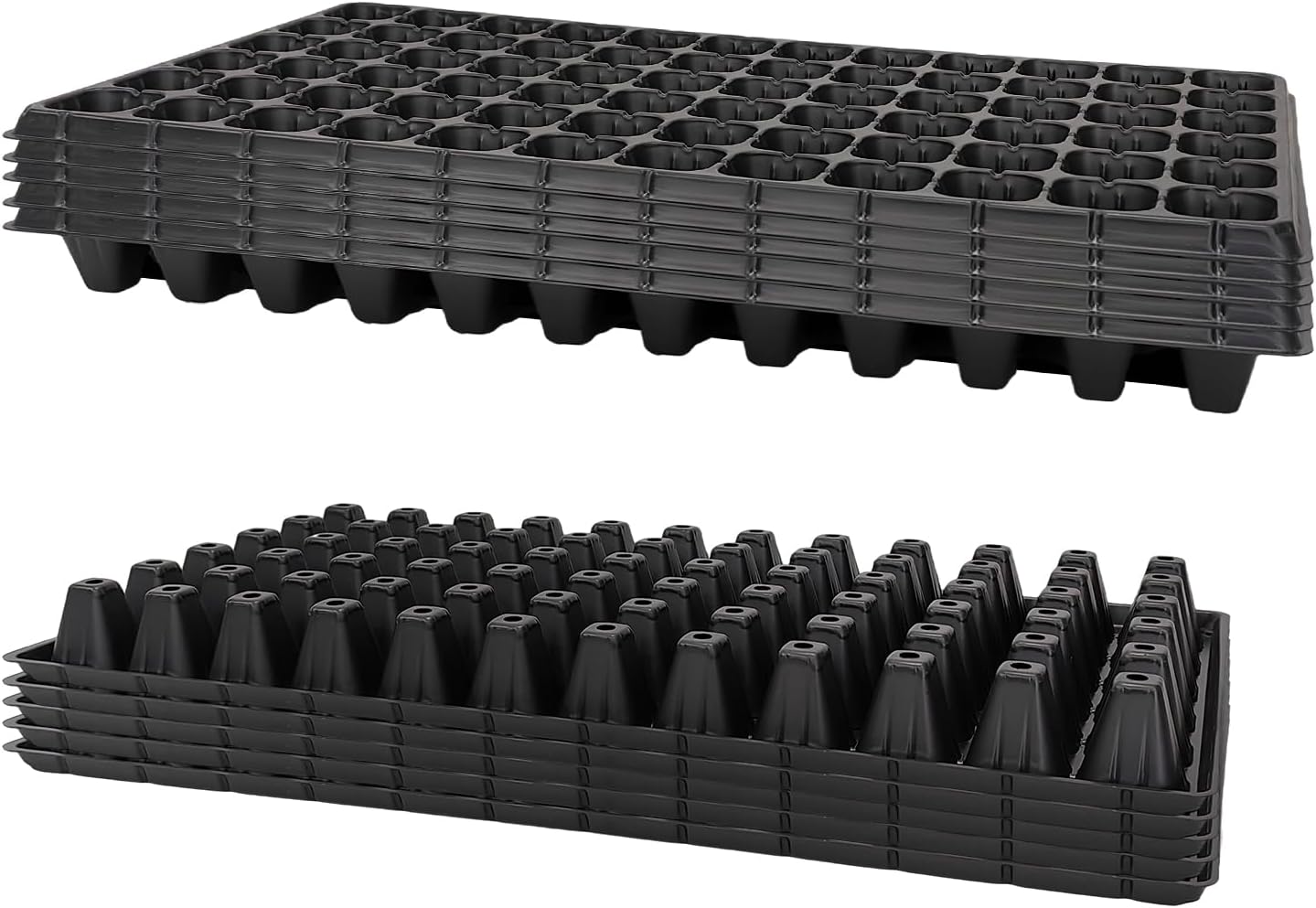
The 72 Cell Seed Trays are made from thick, durable plastic, designed for optimal seedling growth. Each tray features a breathable design with top drip ports and bottom holes, ensuring balanced moisture for various plants. Ideal for use with 1020 flat trays, this 10-pack offers versatility and value for any gardening enthusiast.


| ASIN | B08Z2ZJ6Y2 |
| Best Sellers Rank | #29,070 in Patio, Lawn & Garden ( See Top 100 in Patio, Lawn & Garden ) #37 in Plant Germination Trays |
| Brand Name | RooTrimmer |
| Capacity | 38 Milliliters |
| Color | Black-72c-l |
| Customer Reviews | 4.5 out of 5 stars 590 Reviews |
| Finish Types | Unfinished |
| Included Components | Plug |
| Indoor Outdoor Usage | Indoor |
| Item Dimensions | 21.26 x 11.02 x 2.76 inches |
| Item Dimensions D x W x H | 20"D x 10"W x 1.79"H |
| Item Type Name | 72 Cell Tray 10-Pack |
| Item Weight | 1.88 Kilograms |
| Manufacturer | Grow-Green |
| Manufacturer Part Number | 200 Cell Tray 20-Pack |
| Material | Plastic |
| Material Type | Plastic |
| Model Number | 200 Cell Tray 20-Pack |
| Mounting Type | Tabletop |
| Number of Levels | 1 |
| Number of Pieces | 10 |
| Other Special Features of the Product | Drainage Hole |
| Pattern | Solid |
| Plant or Animal Product Type | plant |
| Planter Form | Tray |
| Product Style | Garden |
| Shape | Rectangular |
| Size | 72C-10P |
| Special Feature | Drainage Hole |
| Style | Garden |
| Theme | Gardening |
| UPC | 762944387769 |
| Unit Count | 10.0 Count |
G**S
From Seed to Outdoor Planting: A Real Butterfly Milkweed Propagation System
This review details the progression from seeds to seedlings to the ready-to-plant-outdoors stage, with a balanced focus on quality and cost. This setup was used in the Piedmont region of North Carolina. I purchased these deep, seed starter trays specifically for raising Butterfly Milkweed (Asclepias tuberosa) seedlings, a species that develops a taproot very early in its life cycle. Standard shallow seed trays were not sufficient for what I wanted to accomplish, especially since my goal was to raise seedlings to the hardened-off, outdoor-ready stage before transplanting. The additional depth of these trays proved extremely useful during the seedling phase. The deeper cells allowed for substantially more vertical root development than standard shallow trays while still fitting into standard 1020 propagation systems. In my setup, these trays were used as part of a larger multi-stage indoor propagation workflow that included controlled PPFD lighting, bottom watering, airflow management, staged humidity reduction, and eventual outdoor hardening-off. The remainder of this review documents the full propagation workflow and explains how these trays fit into the overall system. This review details the progression from seeds to seedlings to the ready-to-plant-outdoors stage, with a balanced focus on quality and cost. Stage 1: Germination # Infrastructure - 1. 6-Tier Rack (https://www.amazon.com/dp/B0CHVFVX7L) - Variable Speed Rack Fan (https://www.amazon.com/dp/B09PVQBHB5) - Timers for devices not having built-in timers (https://www.amazon.com/dp/B073DGGHD7) - Power Strip (https://www.amazon.com/dp/B08P5LRY37) # Growing Equipment - Dome with Integrated Germination Grow Lights (https://www.amazon.com/dp/B0G39FXMCY) - Dimmable Grow Light Strips with Timer, sufficient for 4 rack levels (https://www.amazon.com/dp/B0B28P7L2G) - VBR-100 PAR Meter for measuring light (https://www.amazon.com/dp/B0B11H31DH) - Bamboo Skewers to raise dome (https://www.amazon.com/dp/B07MY89RGF) - Seed Starter Tray for Butterfly Milkweed, Asclepias tuberosa (https://www.amazon.com/dp/B0DQ7RL9B5) Build the rack with the lowest level at a total height of 12 inches. All other levels are 16 inches in total height. The lowest level and the area above the top shelf are reserved for storage. Install fans, timers, and power strips as needed. The growing equipment configuration is surprisingly useful during the very initial phase of seed germination, until 50-75% of the seeds in a 1020 tray have germinated and cotyledons are visible above the soil. At that point, this grow light should be removed. During this stage, newly germinated seedlings generally benefited from light levels in the 50-100 PPFD range, as measured with a PAR meter such as the VBR-100, which I found both adequate and inexpensive. Attach variable-speed fans at each level and set them to the lowest speed. At 50% germination, use skewers to raise the dome by approximately 1 inch to increase airflow and reduce excessive humidity buildup. The skewer length should be 4 inches plus the depth of your seed starter tray. In my case, I'm raising Butterfly Milkweed seedlings that require a deeper seed tray. The one above is 4.33 inches deep and worked extremely well for the taproot's early growth phase in this plant. If you use standard trays, choose the skewer size accordingly. At 75% germination, remove the dome with integrated grow lights. Continue at this stage until the seedlings begin to develop true leaves. At that point, Stage 1 is complete. Stage 2: Seedlings - Farmlite Grow Light Bars, 2 lights each per rack level (https://www.amazon.com/dp/B0F8HD22HP) I now start using one additional grow light set for each level in my multi-level rack. These lights, used in combination with the dimmable grow lights from Stage 1, were sufficient to fully cover a 1020 tray with near-uniform light for the remainder of the indoor growing phase. The Farmlite grow light bars are continuously dimmable, which is extremely useful. With the 2-light set installed on either side of the dimmable grow light, you can provide sufficient light for seedlings before hardening off and outdoor planting. During Stage 2, seedlings with true leaves generally benefited from light levels in approximately the 200-400 PPFD range measured at canopy height. Lower values produced slower, weaker growth, while substantially higher values appeared to increase the risk of light stress and excessive drying in seed trays. The combination of the dimmable center grow light and the Farmlite side bars allowed near-uniform PPFD distribution across the entire 1020 tray. Stage 3: Hardening Off The hardening-off phase is extremely important and should not be skipped. Indoor-grown seedlings, even under strong grow lights, are not yet adapted to direct sunlight, wind turbulence, outdoor humidity fluctuations, or rapid temperature changes. In my case, hardening off began once seedlings had developed multiple true leaves and at least two nodes. More developed seedlings tolerated the process better. Begin by placing seedlings outdoors in bright shade only for approximately 2-4 hours. Avoid direct afternoon sun initially, especially during warm weather above 85F. Even sun-loving plants such as Butterfly Milkweed can experience rapid leaf scorch if moved directly from grow lights into full sun. Increase direct sun exposure gradually over approximately 7-10 days. In my case, because the morning sun is partially blocked by surrounding trees and structures, direct sun exposure began around 11 AM and was therefore more intense than early morning sunlight. I initially limited direct exposure to approximately 30 minutes and gradually increased the duration each day based on the plant's response. The low-speed fans used during indoor growing significantly improved stem strength prior to outdoor transition. This reduced stem collapse and allowed seedlings to adapt more quickly to natural wind movement. During hardening off: - Continue bottom watering as needed. - Avoid overwatering during extended rainy periods. - Rotate trays daily to prevent leaning toward sunlight. - Expect some temporary wilting during early outdoor exposure, especially during warmer afternoons. A successful hardening-off process results in: - Darker foliage. - Thicker stems. - Reduced transplant shock. - Improved outdoor survival. Stage 4: Outdoor Planting Butterfly Milkweed (Asclepias tuberosa) prefers lean, well-drained soils and should not be heavily fertilized after transplanting. In my case, seedlings were planted into previously cultivated vegetable garden soil that already contained significant organic matter from prior compost additions. I intentionally avoided adding additional compost or fertilizer at planting time. Spacing matters significantly. While closer spacing can improve weed suppression and visual density, adequate airflow remains important in humid climates. I found that approximately 18-inch spacing provides a good balance among plant density, airflow, maintenance access, and long-term plant structure. Temporary low fencing around newly planted areas is highly recommended if dogs or wildlife have access to the planting area. Newly transplanted seedlings are vulnerable to trampling during the first several weeks of establishment. One important lesson from this process is that Butterfly Milkweed benefits from restraint. Excess fertilizer, overly wet soil, and insufficient light tend to produce weaker plants. Strong light, moderate airflow, careful watering, and gradual outdoor acclimation produced compact seedlings with strong root systems and excellent transplant readiness. Additional Notes - Bottom watering worked extremely well throughout the process and reduced surface disturbance of the soil. - I used a dilute liquid fertilizer only after multiple true leaves had formed and only at approximately one-quarter of the manufacturer’s recommended concentration. - Overfeeding seedlings is easy and often counterproductive. - A low-fertility seed starting mix consisting primarily of peat moss, coconut coir, vermiculite, and perlite worked very well. - Deep trays are especially important for Butterfly Milkweed because this species develops a taproot early in its life cycle. - One of the most useful tools in this setup was the PAR meter. Many grow lights marketed for seedlings produce substantially more light than newly germinating seeds require. - Measuring actual PPFD values helped prevent excessive light stress during early germination while still providing sufficient intensity during later stages of growth.
T**!
Great Product
This is an excellent product if you are looking to start your own business or seedlings for your personal garden inside or outside your home. They are easy to use and they are very sturdy. Great seed starter trays if you are looking to plan multiple plants. Great value for the money and the size is perfect.
K**N
Quality seeds starting trays
almost perfect. sturdy but with some give. This is probably good though because if it was too sturdy, it might be hard to pop the plants out. too large for one of my bottom trays, but works just fine with my other sturdier trays which I prefer anyway. these should last for several seasons of seed starting. I consider the value to be good.
N**S
Fits in standard 1020 trays, but are slightly smaller. Still works.
These polystyrene trays are as described. They are thicker than many others that I have from other manufacturers. They are likely going to be very durable as thinner ones I have are going on several seasons. All of the trays were well-formed with no major defects. A few had a deformation along an edge, but it is not enough to worry about. I would not call these trays "deep". I have other trays where the plugs are more than 3" deep. The plugs on this tray are around 2" deep. That is fine, but it just means that the time seedlings spend in the tray will be less than with actual deep cell trays. Compared to RooTrimmer's "regular" size, these are only about 1/2" taller. Not that deep. For the most part, I am pleased with these trays. The value will manifest the longer they last. They are priced to be aligned with other high-quality plug trays in the market. You can find them considerably cheaper, but you have to buy in larger quantities. These cam zip tied together but not smashed into eachother so they were easy to separate. They feel good and seems to be adequately sturdy. I did notice that these are slightly smaller than trays from all other manufacturers. This isn't that big of a deal as they fit into a 1020 tray and fit under 1020 doms, but the fit is not as nice with standardized 1020 trays and domes. RooTrimmer seems to make a respectable product. I have trays from them in other sizes that also seem to be of the same decent quality. I also have some of their 1020 humidity domes. Those fit the trays perfectly, but do not fit on standard 1020 trays very well. That is a bummer. I like these trays and probably will purchase more.
J**B
Sturdy, roomy
These are nice and roomy; I transplanted tomato plants from 72 cells to this size and I've been happy with them. They should be reusable if that's important to you, although I have not yet moved my plants outside to prove this. They fit my 1020 trays perfectly.
L**O
Works great for cuttings or seedlings. Can be reused.
I sue them for laurel starts, works great, looks like they will last numerous usages, unlike some.
M**Y
Sturdy but larger than a 20" x 10" drip tray
As others have said, these are really sturdy and look durable, however, they don't quite fit inside a 20" x 10" drip tray. I haven't removed any seedling from the cells yet, and that may be another problem since the hole is super small and the plastic too hard to "push" the plant out from the bottom. Not sure I would buy them again.
E**H
Seed trays
Very sturdy easy to use
A**R
Worth the money spent
Good quality
M**.
Best seed trays I have used
Awesome seed starting trays. Thick, durable and will be used for many many years. It’s not the cheap flimsy ones from your local box stores, these are heavy duty. I like to use these trays at the start of planting season for a few reasons: 1. Small enough plug size so you can test out your seeds and get them to germinate without wasting a bunch of soil. 2. Fitting 200 starter plants one one tray saves so much space under the lights. 3. Easy to pop out of the tray to either replant in a bigger plug or toss out if it didn’t grow properly. Highly recommended for any green thumb.
W**V
Sturdy. Will last many years if cleaned and stored.
They’re perfect for starting and keeping track of what’s planted where. Good sturdy plastic. I have an indoor greenhouse so if cared for and cleaned I don’t expect to need to replace them in the next decade. Takes patience to take them apart but zero breakage.
S**A
Exactly as described
Thicker than the average cell trays! Happy with the quality for the price.
O**Y
These aren't heavy duty, but very good quality compared to other options!
For the price, the quality is reasonable. Not heavy duty, but a bit thicker plastic than the McKenzie seed starting kit. These aren't as deep as the McKenzie ones, but they are deeper than traditional seed starter trays. I have a combination of these and reusable, heavy duty seed starter trays from Bootstrap Farmer. For the price, they are worth it, and with care, they should last for several growing seasons.
Trustpilot
1 week ago
2 weeks ago