
DOWNLOAD THE APP


Customer Services
Copyright © 2025 Desertcart Holdings Limited
DOWNLOAD THE APP





🔋 Charge smarter, not harder — power your future with precision solar control!
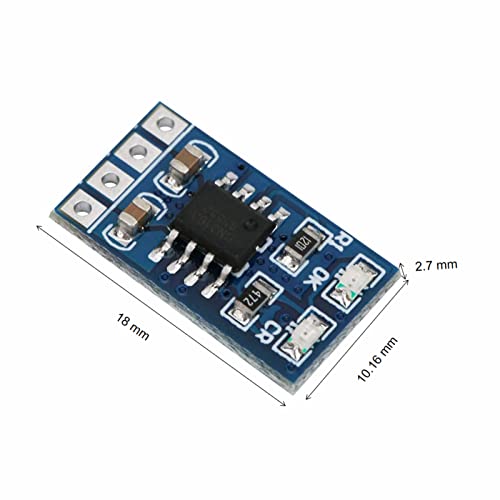
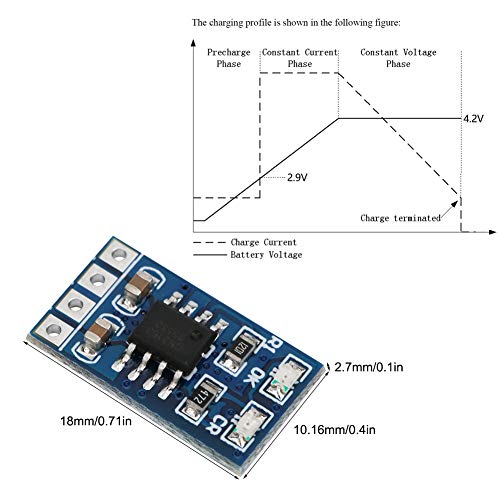
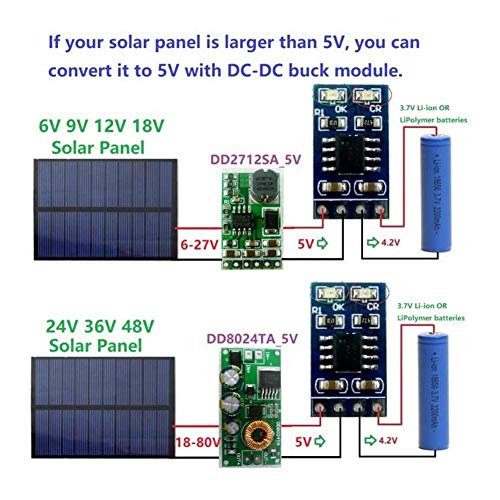
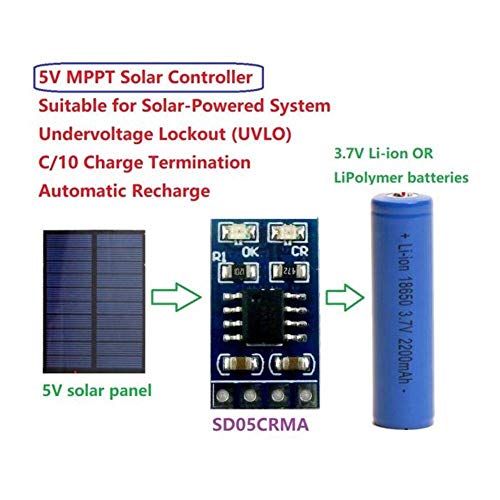
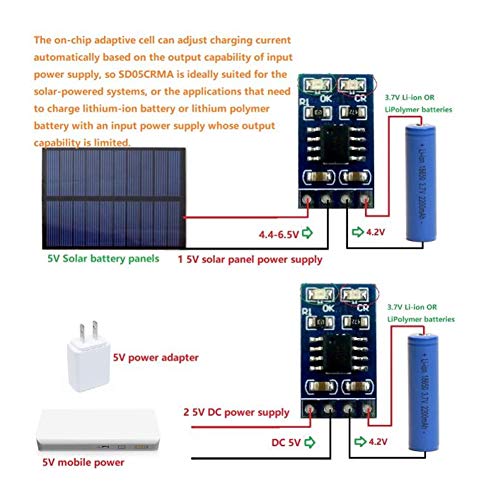
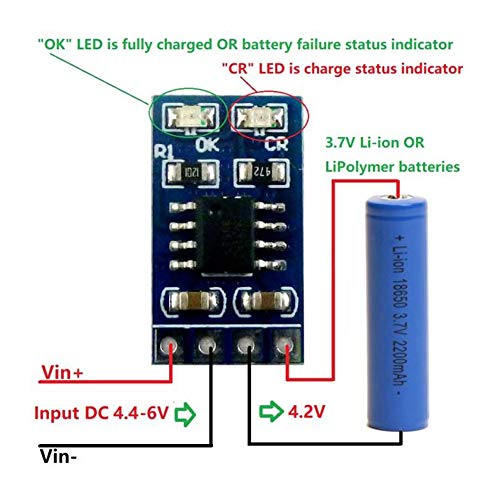
The Fafeicy Solar Module LiPo Li-ion Battery Charger is a compact MPPT solar controller designed for single-cell lithium batteries. It supports a 4.4-6.5V solar input and delivers a stable 4.2V charging output with up to 1A current, adjustable via resistor. Featuring thermal regulation, automatic sleep mode, and overcharge protection, it optimizes solar energy harvesting for reliable, safe, and efficient battery charging in small-scale solar-powered electronics and IoT applications.


| ASIN | B08DY28BXW |
| Best Sellers Rank | #79,441 in Patio, Lawn & Garden ( See Top 100 in Patio, Lawn & Garden ) #88 in Renewable Energy Controllers |
| Date First Available | July 30, 2020 |
| Item Weight | 0.071 ounces |
| Item model number | Fafeicyoma4zn8c3y-12 |
| Manufacturer | Fafeicy |
| Operating Temperature | 20 Degrees Celsius |
R**S
Great Controller of charging Li-ion Battery from PV Module
I have a rain gauge measuring unit that is powered by two AA batteries that require periodic replacement throughout the year, and the batteries invariably go dead at a most inconvenient time. Thus, my engineering project was to replace the two AA batteries with a solar battery supply powered by a little 60 mA photovoltaic (PV) module. The rain gauge's power demand is quite modest: 3 volts and around 1600 mA-hr total current draw for the year. My engineering concept uses a single 60 ma 5V PV module to charge a model 14500 Li-ion battery with a nominal capacity of 800 mAh and voltage of 3.7 volts. This 14500 battery is the same size as a conventional 1.5 volt AA battery so it fits easily into the rain gauge's battery compartment and leaves space where the second AA battery was for needed charge electronics. To get the 3.0 volts needed by the rain gauge unit I add a series diode to drop the voltage 0.7 volts from 3.7 (the battery voltage) to the 3.0 volts desired by the rain gauge. The PV engineering challenge is thus to connect my small 60 ma PV module to the 14500 battery in a manner that efficiently uses the current generated by the small panel, and prevents overcharging of the 14500 Li-ion battery. Li-ion batteries, unlike other rechargeable batteries like Ni-Cd and Ni-Mh, are very sensitive to overcharging and don't tolerate long-term trickle charging. This has resulted in specialized integrated-circuit charge regulators, such as the CN3163, which is what is used in the Fafeicy controller. These have been specifically designed for use in charging single-cell Li-ion batteries at a fixed current until a maximum charge voltage of 4.2 volts is reached, then they rapidly turn off all charging current to prevent overcharging. The question is: can the Fafeicy controller be easily used in conjunction with a tiny 60 mA 5V PV module to charge a 14500 Li-ion battery? The short answer is Yes. In contrast to a 5-volt USB power supply, which supplies its current at a fixed 5.0 volts, a solar panel puts out a highly-variable, but limited current (proportional to the solar illumination level) with a current-voltage relationship defined by its IV curve. To efficiently use the output of the solar panel the applied load must operate near the panel's Maximum Power Point (MP) on its IV curve, which is a point near the knee of the IV curve. Fortunately, a fairly useful means of achieving operation at the array's maximum power operating point is to use a constant-voltage load (such as that provided by a charging battery), where the constant voltage is modestly well matched to the array's max power voltage. A constant-voltage load works well because the voltage of the maximum power point does not vary greatly with illumination level. To confirm the capability of my little 60 mA PV module, I set up a test in bright midday sun on a crystal clear day with the module perfectly normal to the sun. I then used a resister bank to switch thru the load points on the IV-curve as noted in the attached figure. The module has a nice square I-V curve with a max power point at around 4.5 volts, good for Li-ion battery charging. My measured Imp of around 50 mA is in pretty good agreement with the module's 60 mA rating. For my location, solar web sites give around 2100 peak solar hours per year for a south facing fixed panel at 40 degree tilt. Thus, under ideal conditions, the tiny 5V 60 mA module should be able to provide around 2100 x 50 ma = 105,000 mAh charge per year, actually way way more than the rain gauge needs. Next, I tested the ability of the Fafeicy's charge regulating CN3163 IC to work with my tiny PV module to charge my Li-ion battery. Short answer: the CN3163 (which is optimized for PV power sources) quickly stabilized at a fixed operating voltage of 4.30 volts and drew full available current near the max power point. The attached graph displays the battery charge current measured for my application with the CN3163 during a period where I rotated the array from full sun to skylight-only and then to total darkness over a period of around 6 minutes. The charge current reduced smoothly as the module illumination was reduced, then the reverse current during dark periods was limited to around 20 micro-amps...a totally negligible loss. In a test for charge termination at full charge, I brought the battery up to near full charge to see how the CN3163 regulated the charge as full charge was reached. What the CN3163 did was slowly ramp down the 50 mA charge current from the PV module over a period hours as the Li-ion battery voltage reached 4.2 volts...thus preventing overcharging (see attached plot). Final Design The attached system diagram illustrates my final design using the small 5-volt 60 ma PV module connected directly to a 14500 Li-ion battery via the small Fafeicy charge controller board. No additional components were required beyond the series diode (e.g. 1N4001) used to reduce the battery's 3.7 volts down to 3.0 volts to accommodate the 3.0-volt input voltage desired by the rain gauge. All components (battery and CN3163 board) easily fit in the battery compartment of the rain gauge, while the tiny solar panel was mounted close-by with a good view of the sun. I mounted the little PV module using double-back tape to an aluminum substrate that serves as a heatsink to keep the module as cool as possible and tilts the module up at the sun. Controller board worked Great! Highly recommended!
Y**E
Great for solar mesh nodes
Bought for a solar meshtastic node. Works very well with my 5w solar panel. Even with little sun and just ambient light it charges the battery to 4.18v. Highly recommend if you don't need low voltage cut off.
R**E
highly effiicent solar charging module
These are fantastic solar charging controllers, it improved the charging efficiency with my solar pannel like 300% I bought a bunch more to add to all my solar projects with 18650 batteries. I highly recommend it.
K**E
Amazing Little Gem
I've tried a number of different solar chargers with mixed results and none were very efficient, that is until this little gem. I've tested it in my same build as the others, 4 small solar panels that track the sun via arduino and two servos to charge two 18650 cells that power all the above and a meshtastic transceiver from RAKwireless. At sun up is reporting ~75-80% bat level and in one hour it's charged to 100%. None of the other charges I've tried could even come close to this.
P**B
Fonctionnement satisfaisant entre petit panneau PV et batterie + ESP8266. A passé un hiver dehors dans boitier étanche.
C**.
Works well
R**D
kleines einwandfreies funktionierendes Modul
G**D
comme sur les photos de bonne qualité le prix est très intéressant après montage les essais sont concluants emballage parfait reçu avant la date prévue merci à toutes vos équipes
C**E
Le module est franchement très petit et difficile à travailler . les résistances étant très proches des soudures ... je ne vous fais pas un dessin ^^
Trustpilot
1 week ago
2 weeks ago