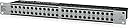
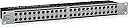
🎚️ Master your audio matrix with the PX3000 — where pro studios find their flow!
The Behringer Ultrapatch Pro PX3000 is a 48-point balanced patchbay featuring versatile 3-mode switching per channel (Normalled, Half-normalled, Parallel, Open) for ultimate routing flexibility. Designed with rugged construction and premium TRS jacks, it delivers ultra-low resistance connections that preserve audio fidelity. Ideal for professional studios and broadcast environments, it streamlines cable management while ensuring reliable, noise-free signal paths.
| ASIN | B000CZ0RII |
| Best Sellers Rank | #37,775 in Musical Instruments ( See Top 100 in Musical Instruments ) #331 in PA Systems #12,112 in Music Recording Equipment |
| Brand Name | Behringer |
| Cable Type | TRS |
| Color | Slvr/Blk |
| Compatible Devices | Personal Computer |
| Compatible Phone Models | No Compatible Phone Models |
| Connectivity Technology | TRS, TS, XLR, MIDI |
| Connector Gender | Male-to-Male |
| Connector Type | Trs |
| Customer Package Type | Standard Packaging |
| Customer Reviews | 4.6 4.6 out of 5 stars (396) |
| Included Components | Px3000 48 Pt Trs Patchbay With Selectable Normal |
| Indoor Outdoor Usage | Indoor |
| Item Type Name | PA System |
| Item Weight | 3.9 Pounds |
| Manufacturer | Behringer |
| Model | PX3000 |
| Model Name | PX3000 |
| Number of Items | 1 |
| Recommended Uses For Product | Audio Networking |
| UPC | 736211577443 |
| Warranty Description | Products are covered by behringer manufacturer's warranty within one year of the original date of purchase from an authorized behringer dealer. If your behringer product is still under warranty, you must obtain a return authorization (ra) number from behringer before sending your product to an authorized service center for warranty service. |
M**G
Behringer Patch bay rocks
Like many others I dismissed the Behringer patchbay because it was tooooo cheap, how could it possibly be anygood? A BIT OF HISTORY: Back in the 90's I bought some of the Neutrik TRS patchbays, back then they worked pretty well but over the years the newer versions of the Neutriks have different jacks in them that are difficult to plug in and the normal connections have gotten flakey. Besides the jacks getting cheaper and cheaper in the Neutrik units the metal work has changed from year to year, now the face plate is held on with two little screws that barely engage the metal and if you lose one the whole thing becomes a flimsy mess. So I looked for a replacement and almost passed on the Behringer units again because of the low low price. I'm an electrical design engineer by trade and build a lot of my own gadgets. There are 96 1/4" TRS jacks on one of these patchbays, $50/96= just $.52-cents per jack (not including metal work, packaging or labor), how could they possibly be any good? Then I found a review online from someone who had been using the Behringer units for years without problems. He stated that the key to using them was to support the cables so they don't put a strain on the jacks. Recently we were putting a broadcast studio together and needed some patch capability so we decided to try one of the Behringer units. It was sort of a joke at first, everyone expected these units to be crap. Instead, we found a product that works fantastic, is super easy to configure (due to the 3-pos switches) and the jacks are like buttered toast, no more fighting to get the cable in or out. TRS plugs glide in and out smoothly, easily and most important of all, reliably! I measured the impedance from input to output of one channel (passing thru the normal connection path) using a Fluke DVM and found less than one-ohm of series resistance, this speaks pretty well for the normalled connection not degrading your audio sonically. On some old "mil spec" patchbays I've measured as much as 10 ohms thru the normal path, that's what happens when the contacts get dirty. On one of our Neutirks that was going flakey I measured 39 ohms in series, that's enough to seriously upset the CMRR of a balanced line which can be a big source of noise. We now have four of the PX3000 installed and no issues with a single connection. I've used them in all three modes (normalled, unnormalled and half normalled) and they are in use every day. We don't do a ton of patching on them (the normal connections run our studio) but when we need to insert something or do a quick reroute these tools get the job done reliably. Each channel of the PX3000 is built on its own little circuit board (I had to look inside) which slides into the metal frame. You never have to access these little boards to configure the patchbay (like on Neutrik, DBX, and others) but the little boards do have a very tiny amount of give in the chassis, this is what makes it feel a bit "unsolid" to some folks. It's not a flaw, it's just the way they are built and so far it has not affected my installation one bit. Several of my Neutrik patchbays act the same way (channel boards moving slightly when you insert or remove a cable). I'm very happy with these and ordering a few more before they raise the price. REVIEW UPDATE: MARCH 2013 We're up to eight of these in our broadcast rig with zero problems, just ordered our 9th one. I make most of my cables myself using Canare and Mogami wire with Switchcraft plugs and have zero noise problems. I always clean my plugs with Deoxit prior to plugging them in for long use. I've know many people who just assume their connectors are clean, most have oil on them from manufacturing that can cause interference and distortion. Good music to everyone!
T**R
I love this Behringer patch Bay system in my custom sound surround sound Tower
Yes this patch Bay system by Behringer Ultrapatch Pro 48 channels 28 lines in or out if you can figure it for right and left channels and you can change the direction of the channels if you wanted four pass through you have switches on the top of it to make it half in half but I prefer straight through I got this for my custom surround sound Tower for my surround sound system and now I can connect anything up to it without going into the cabinet I have my preamp connected up to the patch Bay and also the EQ out connected up to the patch Bay so we can go to the surround sound and I have all the other effects machines connected up to the EQ along with the preamp so I can get all the effects to go with the surround sound to make the sound customized now I can connect my CD decks up to the tower to the patch Bay that goes to the preamp connected up to and the cool thing about this setup I have a patch Bay in my CD decks with the mixer and everything and the CD decks and mixer patch Bay can be connected to this patch Bay so it's a win-win no matter what simple and easy take the quarter inch jack wires and plug them into the patch bay pass away the patch bay and both of them are barangers the same unit the ultrapatch Pro I definitely recommend this patch bay not too expensive very affordable and very durable for whatever you use it for for Studio customizing a DJ setup or even customizing a surround sound custom sound Tower setup like what I'm doing this past day is unique and I bought another one because I like it so much so yeah this would do the job for you go order one yourself I'm out of here later
L**L
Lifesaver!
In my studio, I have mic/instrument inputs in my walls that run behind my desk. My interface inputs are on the back of the interface so this device, in normal mode, connects my lines on the back without me doing anything on the front. It seems to be solid and looks great in the rack. I will be buying more of these.
A**.
Cheap and easy to modify, rear jacks are especially tight, which is good!
I'll let the other reviews describe the functionality. No surprises there. The rear jacks are tighter than I would have liked at first, but that's grown on me to be a good thing! It keeps those mostly-permanent cords from pulling out while you're shuffling things around. Just be aware that fragile cords and connectors may not like the rear jacks. The front ones feel about right for regular use. I modified 6 adjacent channels to be half-normalled *horizontally*, instead of vertically as usual, so I could arrange things in a way that makes a little bit more sense to me: - Remove all the screws - allen/hex on the front, then phillips on top - and take 6 circuit boards out. These are going to be 3 stereo pairs, half-normalled to mono horizontally. - For 3 of them, drill a small hole in the middle of the big ground plane, so as not to disrupt anything, and away from the jacks and switch of course. - Feed two small wires through that hole, and solder them to the front jack of the same board, and its neighbor on the other side of the hole. (see note below) All of this plugs into the same mixing console, so I don't need to connect the grounds here - the console already does that - but depending on what you're doing, you might need to add a third wire for that too. - Reassemble. - Remember to keep the switches centered for all 6 of those channels. (no connection, as far as it's concerned, so it doesn't interfere with the one you just added) Note: Pay close attention to which pins you're soldering to! This defines the normalling function in the first place, and its direction: - For half-normalling, you want the direct contacts of one, and the switch contacts of the other. - For full-normalling, you want the switch contacts of both. For orientation, the traces from front to back connect to the direct contacts. The other pins of the front jacks are the switch contacts. The rear jacks don't have switches.
M**D
Rapport qualité prix imbattable pour ce Patchbay TRS. Ça fonctionne impeccable et cela semble solide. Après plusieurs mois d’usage sans ménagement : RAS. Les connexions sont impeccables. Le seul reproche possible : les switchs de sélection du mode sur le dessus qui deviennent inaccessible une fois le patch installé dans un rack. Ceci mis à part c’est un excellent produit vendu à petit prix.
D**T
good product
R**Y
Ich hatte bereits viele Patchbays, aber diese günstigen Behringer Dinger sind inzwischen meine erste Wahl. Wo man bei anderen Herstellern die Module umdrehen muss um zu normalisieren, stehen hier Schalter (auch für die anderen Modi) zur Verfügung. Beim Normalisieren wird der "normale" Audioweg geschaffen. Wobei z.B. hinten-unten der Synthesizer ankommt und das Signal direkt nach hinten-oben durchgereicht wird, ohne das man ein Kabel braucht. Dort schließt man das Kabel zum Mischpult an. Erst beim Einstecken von Vorne wird der Pfad unterbrochen. Ich habe inzwischen sämtliche Aus- und Eingänge in meinem Homestudio auf zwei dieser Patchbays verteilt und brauche im Normalbetrieb kein einziges Kabel einzustecken. Allerdings kann ich nun jederzeit mit nur zwei Kabeln z.B. eine Parallelkompression oder Sidechaining realisieren. Das Einstellen der Modi per Schalter ist besonders dann unbezahlbar, wenn die Teile bereits verkabelt und im Rack verbaut sind. Die Behringer ziehst Du ein paar Zentimeter raus und legst den Schalter um. Andere Patchbays musst Du vorher halb ausbauen, das Modul abschrauben und die Kabel abziehen. Wirklich ein Alptraum. Inzwischen hatte ich über 20 Jahre locker 10 dieser Teile (die Mehrzahl gingen bei Studioauflösungen "verloren") und nie ist eine Buchse ausgefallen! Und selbst wenn; Die Dinger sind so günstig, dass man sich ohne Probleme eine auf Vorrat hinlegen kann.
B**N
I wasn't expecting this patch bay to be great quality, but I was pleasantly surprised by the robust solid. The fact that it's switchable, normal, half-normal and through at this price is a fantastic feature. No taking apart and flipping modules to choose between normal and half only, like my old Teac and Dbx units. Certainly makes life easier in the studio and happy with my purchase.
Y**U
Denemedim. Ama alabildiğine mekanik bişi bişi çalışmada icabına tamirine bakarız. Kaliteli bir görüntüsü var. Özellikleri de gayet iyi. Behringer markasına atıp tutmak kolay ama güzel urunleri de var.
Trustpilot
1 month ago
2 weeks ago