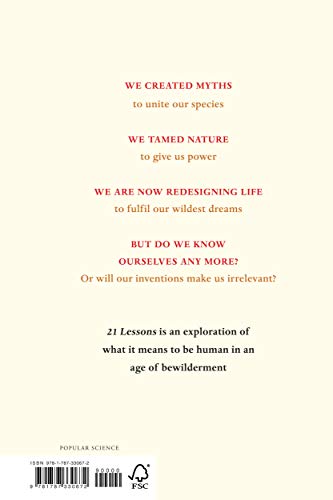


Buy 21 Lessons for the 21st Century: Yuval Noah Harari 1 by Harari, Yuval Noah (ISBN: 9781787330672) from desertcart's Book Store. Everyday low prices and free delivery on eligible orders. Review: A compulsive read for all who are interested in the future - This is another remarkable book from the author of Sapiens and Homo Deus. But the reader need not know either of them to appreciate these 21 Lessons. Harari takes a very long view of the history of mankind and the driving forces that shape the world as we know it. Given the pent-up forces for change (especially infotech and biotech) that make bewilderment a normal state of mind, he attempts to offer our children (and us) some ways of preparing for our collective futures. Recognizing and exploding many of the narratives that have allowed the human ape to dominate the planet, he suggests that our children’s education should be characterized by greater humility, respect for the “other” and for the biosphere that we are rapidly destroying. Skills will become obsolete in a decade and therefore in need of constant renewal. The ability to adapt to whatever the world needs will therefore become the vital learning required by the whole of humanity. But “what should we wish to become?” remains the unanswerable question. Identity and philosophy therefore become vital subjects. While the progress of science enables mankind to design and create modified forms of humans, our ethical and philosophical understanding has not kept up the pace of change offered by the sciences. Science fiction allows us to imagine plausible futures, but we should be wary of taking any of them literally, says Harari. But the reality is that any future we will face by 2050 or 2100 is likely to be a future that in 2018 seems like science fiction. This book should be mandatory reading for everybody involved in education and in preparing for the future. That means all of us! Harari’s grasp of historic reality and his wide fields of knowledge are here presented in a manner accessible to us all. As a primer to change management, there can be no better text book. I happen to agree with 99% of his views. But even when I am not convinced, I am driven to consider carefully why not. It is therefore a compulsive read! Review: Society, AI, biotechnology, ideology, nationality, religion, identity, truth and myth - The topics in the subject heading, a partial list, constitute chapters of the five parts comprising the book. The treatment is comprehensive and cohesive and illuminates the society we live in while contemplating its evolution in the near future. On the eve of the Second World War there were globally three main ideologies: liberal democracy, fascism, and communism. At the end of the war and the collapse of fascism there remained only two, liberal democracy and communism. And with the fall of communism in 1989 there remained only one, liberal democracy. By the early 1990s, thinkers and politicians alike hailed 'the end of History', confidently asserting that all the big political and economic questions of the past had been settled and that the refurbished liberal package of democracy, human rights, free markets, and government welfare services remained the only game in town. This package seemed destined to spread around the whole world, overcome all obstacles, erase all national borders, and turn humankind into one free global community. But suddenly with the financial crisis of 2008 and the ensuing widespread skepticism on financial markets, globalization and liberal capitalism - the world is left without ideology. Liberalism is losing credibility as the twin revolutions of information technology and biotechnology might soon push billions of humans out of the job market and undermine both liberty and equality. Big Data algorithms might create digital dictatorships in which all power is concentrated in the hands of a tiny elite while most people suffer not from exploitation, but from something far worse - irrelevance. And as a result precipitating social, economic and political crises. The above is just one theme of the poly thematic book. Of the remaining, I found particularly interesting the chapters on education and meaning. In the light of the enormous speed of change, many pedagogical experts argue that schools should switch to teaching 'the four Cs' - critical thinking, communication, collaboration and creativity. - Most important of all will be the ability to deal with change, to learn new things, and to preserve your mental balance in unfamiliar situations. When we look for the meaning of life, we want a story that will explain what reality is all about and what is my particular role in the cosmic drama. This role defines who I am, and gives meaning to all my experiences and choices. The stories that provide us with meaning and identity ( religion,nationality) are all fictional but humans need to believe in them. If you want to know the ultimate truth of life, rites and rituals are a huge obstacle. But if you are interested - e.g. Confucius - in social stability and harmony, truth is often a liability, whereas rites and rituals are among your best allies. What is then the aim of my life? To create meaning by feeling, by thinking, by desiring and by investing. Anything that limits the human liberty to feel, to think, to desire and to invest, limits the meaning of the universe. Hence liberty from such limitations is the supreme ideal.












| Best Sellers Rank | 332,701 in Books ( See Top 100 in Books ) 394 in History References 408 in Reference Material for Young Adults 529 in History of Civilisation & Culture |
| Customer reviews | 4.6 4.6 out of 5 stars (1,269) |
| Dimensions | 14.4 x 3.4 x 22.2 cm |
| Edition | 1st |
| ISBN-10 | 1787330672 |
| ISBN-13 | 978-1787330672 |
| Item weight | 564 g |
| Language | English |
| Print length | 368 pages |
| Publication date | 30 Aug. 2018 |
| Publisher | Jonathan Cape |
M**S
A compulsive read for all who are interested in the future
This is another remarkable book from the author of Sapiens and Homo Deus. But the reader need not know either of them to appreciate these 21 Lessons. Harari takes a very long view of the history of mankind and the driving forces that shape the world as we know it. Given the pent-up forces for change (especially infotech and biotech) that make bewilderment a normal state of mind, he attempts to offer our children (and us) some ways of preparing for our collective futures. Recognizing and exploding many of the narratives that have allowed the human ape to dominate the planet, he suggests that our children’s education should be characterized by greater humility, respect for the “other” and for the biosphere that we are rapidly destroying. Skills will become obsolete in a decade and therefore in need of constant renewal. The ability to adapt to whatever the world needs will therefore become the vital learning required by the whole of humanity. But “what should we wish to become?” remains the unanswerable question. Identity and philosophy therefore become vital subjects. While the progress of science enables mankind to design and create modified forms of humans, our ethical and philosophical understanding has not kept up the pace of change offered by the sciences. Science fiction allows us to imagine plausible futures, but we should be wary of taking any of them literally, says Harari. But the reality is that any future we will face by 2050 or 2100 is likely to be a future that in 2018 seems like science fiction. This book should be mandatory reading for everybody involved in education and in preparing for the future. That means all of us! Harari’s grasp of historic reality and his wide fields of knowledge are here presented in a manner accessible to us all. As a primer to change management, there can be no better text book. I happen to agree with 99% of his views. But even when I am not convinced, I am driven to consider carefully why not. It is therefore a compulsive read!
S**T
Society, AI, biotechnology, ideology, nationality, religion, identity, truth and myth
The topics in the subject heading, a partial list, constitute chapters of the five parts comprising the book. The treatment is comprehensive and cohesive and illuminates the society we live in while contemplating its evolution in the near future. On the eve of the Second World War there were globally three main ideologies: liberal democracy, fascism, and communism. At the end of the war and the collapse of fascism there remained only two, liberal democracy and communism. And with the fall of communism in 1989 there remained only one, liberal democracy. By the early 1990s, thinkers and politicians alike hailed 'the end of History', confidently asserting that all the big political and economic questions of the past had been settled and that the refurbished liberal package of democracy, human rights, free markets, and government welfare services remained the only game in town. This package seemed destined to spread around the whole world, overcome all obstacles, erase all national borders, and turn humankind into one free global community. But suddenly with the financial crisis of 2008 and the ensuing widespread skepticism on financial markets, globalization and liberal capitalism - the world is left without ideology. Liberalism is losing credibility as the twin revolutions of information technology and biotechnology might soon push billions of humans out of the job market and undermine both liberty and equality. Big Data algorithms might create digital dictatorships in which all power is concentrated in the hands of a tiny elite while most people suffer not from exploitation, but from something far worse - irrelevance. And as a result precipitating social, economic and political crises. The above is just one theme of the poly thematic book. Of the remaining, I found particularly interesting the chapters on education and meaning. In the light of the enormous speed of change, many pedagogical experts argue that schools should switch to teaching 'the four Cs' - critical thinking, communication, collaboration and creativity. - Most important of all will be the ability to deal with change, to learn new things, and to preserve your mental balance in unfamiliar situations. When we look for the meaning of life, we want a story that will explain what reality is all about and what is my particular role in the cosmic drama. This role defines who I am, and gives meaning to all my experiences and choices. The stories that provide us with meaning and identity ( religion,nationality) are all fictional but humans need to believe in them. If you want to know the ultimate truth of life, rites and rituals are a huge obstacle. But if you are interested - e.g. Confucius - in social stability and harmony, truth is often a liability, whereas rites and rituals are among your best allies. What is then the aim of my life? To create meaning by feeling, by thinking, by desiring and by investing. Anything that limits the human liberty to feel, to think, to desire and to invest, limits the meaning of the universe. Hence liberty from such limitations is the supreme ideal.
T**A
Amazing!
Amazing book
C**W
Thought provoking
Having read this book, I'm not sure that I have learnt the 21 lessons that were promised in the title. The book however is certainly thought-provoking and debates many of the questions I have asked myself about the future. The main theme is that the pace of change is much faster than at any other time in human history, and that by 2050 (a date often quoted by the author) life on Earth will look significantly different. Yuval Noah Harari speculates that biotechnology, information technology and 'Big Data algorithms' will reshape the world for Homo sapiens (humans) over the coming decades to the point that the species will cease to exist in its current form by the beginning of the 22nd century. The author debates in detail the role that artificial intelligence and these algorithms will have and how they will influence and possibly even control large aspects of our lives as time goes on. The book begins with a lot of detail about how collection and analysis of huge amounts of data and advances in technology will allow us to even re-engineer our bodies, and in particular our brains, to allow artificial intelligence to know what we are thinking in order for it to make better decisions for us. It goes on to speculate that robots could make huge numbers of people redundant and irrelevant, forcing people to change careers at an increasingly regular rate. There is then a lot of discussion about religion, in particular the author's own Jewish religion, and how fiction has played and continues to play a crucial role in life. I enjoyed the book but if you are looking for life lessons to follow, then it probably isn't the book for you. If you want a glimpse into the (possible) future of the human race and a summary of how we got to the point we are at now, then this is something for you. It is certainly a very well-written book.
C**N
To begin with, I have to say that I am a big admirer of the author and that I also read his first two books (Sapiens and Homo Deus) with great delight. So my view might be a bit biased. This said, I find his new book even more insightful than the two previous ones. The author presents his arguments for the various highly relevant topics (as always) very carefully. The last chapters on the "meaning of life" are not particularly easy to read, especially from an emotional perspective, but are maybe the most important ones. I found the chapter on meditation as closing of the book very encouraging. I cannot recommend this book enough, especially to people who are willing to put aside their own prejudices and to critically examine their own perspective to the various important topics of life.
B**Y
This book is a fascinating read for those interested in an unbiased pursuit of Truth. Truth as they say is based on observation and evidence rather than on mere faith. Yet, the most intelligent species, relies more on stories than on verifiable facts, and are the only species on earth that can weave stories. Be it Fascism, Communism or Liberalism, the great political stories; or those derived from religion and culture, all of them have their share of fiction. Yet stories are all around (accepted as true), and act as the glue to unite people on a common theme. People forget facts but not a well woven story. Our allegiance to stories and beliefs assumes that our nation or religion or culture is central to the planet, the best and the most important of all. Hence, our civilization is trapped in several such disparate compartments and is at war with itself. It is sad to see that the species that has abundance of Intelligence is bankrupt in Consciousness. We are staring at the threats of nuclear war, terrorism, and global warming. We see acute human suffering despite the enormous wealth and technological progress. The book begins with the challenges the world might face if AI and Bioengineering converge. In the past, human inequality on an economic scale was a result of highly skewed distribution of wealth. In the future, economic Inequality might seem to be a better choice, since most humans would be made Irrelevant by those who control data and information. There could be for the first time, genetic superiority of those who can manipulate their DNA, live longer and even have substantial enhancement of their cerebral power by coupling their brains with super computers in real time. Morality means ‘reduced suffering’ and not just ‘following divine commands’ argues the author. The ability to understand human suffering and to end it comes with compassion. Commitment to truth and compassion result in the concept of Equality of all human beings. It is not possible to find Truth without Freedom to think, investigate and experiment. It takes Courage to question the status-quo and admit our ignorance and venture into the unknown. ‘Questions you cannot answer are better for you than answers that you cannot question’. With this framework, Secular people take Responsibility for creating a better world, than leaving it to any unknown higher power. Politicians of all hues understand the power of stories and their voter psychology. They operate systematically in four stages, as explained in this book. 1. Downsize the issue, create a big Villain vs the rest of us 2. Focus on a touching story that arouses emotions and melts our hearts 3. Weave a conspiracy theory or a big scam that threatens the culture or nation. 4. The white knight in shining armor, a leader or a dogma or belief, finally arrives to redeem us… and he rules till the cycle turns against him. I appreciate the author’s Courage for an unbiased and vocal analysis of several political, cultural, religious, and historical perspectives. This is a genuine pursuit of Truth with an open mind. Finally, there is convergence of knowledge that emerges from the vastness and depth of this study. This is where the book takes an unexpected but remarkably interesting and insightful turn. The Truth is that the cause of all our tensions and misery in life are a creation of our MIND. Life is not a Story. It has meaning. The last two chapters of this book (Meaning and Meditation) are the culmination of the understating of this Wisdom. This is the lesson humanity should learn for eternity. Touches our heart, mind, and soul in search of the eternal Truth.
D**A
perfecto, solo hubieron problemas con la informacion sobre la entrega. El libro esta completo y cuidado.
A**U
A must-have if you are constantly questioning about issues we are all facing in the 21st century, and issues we might face in the future. Excellent sum up, and at the same time goes deeper into some important subjects (religion, big data, artificial intelligence). Some ideas are debatable in the book, but how not to be controversial talking about religion for instance. It is good that the author use such a "free speech" approach.
D**R
Product was dirty and already used. Not new at all, very disappointed. The book itself is very interesting though. Yuval Harari is a great author. The seller is straight dishonest though.
Trustpilot
1 month ago
2 days ago