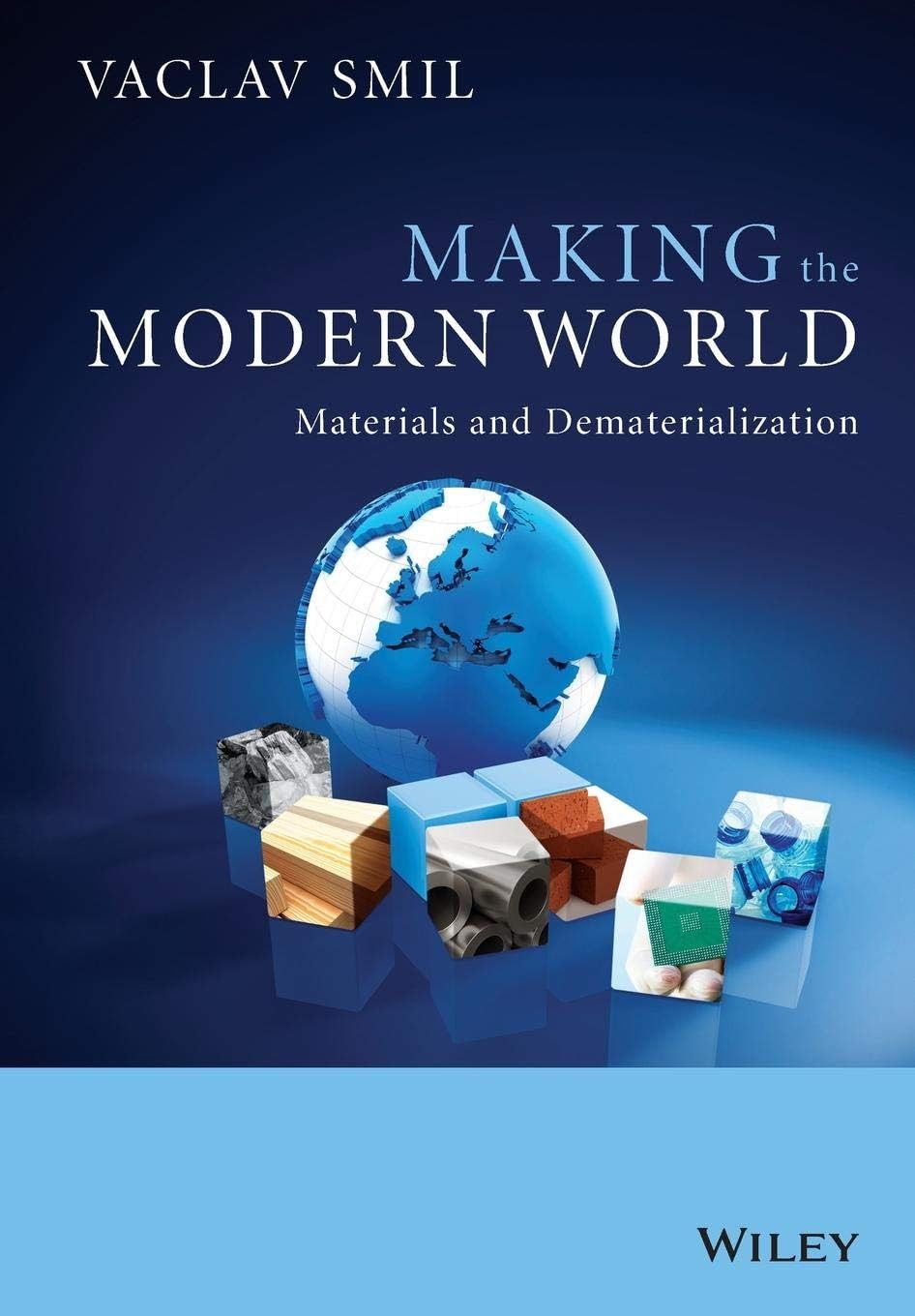
Making the Modern World: Materials and Dematerialization
Product ID: 6946443
desertcart.com: Making the Modern World: Materials and Dematerialization: 9781119942535: Smil, Vaclav: Books Review: What do we do when we run out of Smil? - Smil looks at economies their cities, machines, high-ways, farms, vehicles, airplanes and he finds music in statistics. Tonages, gallons, watts, Joules, Newtons and populations. He must compose the score of this music in his head. Musical though made of numbers not numerical, instinctive not contrived. This latest of Smil’s brilliant books repeats statistical music we are familiar with from earlier studies but this work is more extreme, Smil breaks into a dance celebrating his fond dream of de-materialization. In earlier books such as the recent “Should we Eat Meat” Smil has made clear his distaste for greed and extravagance. We humans, especially Americans indulge ourselves. We needn’t eat steak at every meal, drive there ton SUV’s. His statistic crowded studies should be effective because he employs “science” and skirts tiresome scolding’s we have become immune to. De-materialization brings on excitement. The music of statistics isn’t enough to accompany man’s great accomplishments. De-materialization promises technical ecstasy. Lighter and lighter aluminum beer cans. 85 grams for the first, now only 12.75 grams. More and more powerful yet lighter internal combustion engines. Jets and rockets so powerful they may overshoot outer space. The facts are assembled and referenced in studies that make your head spin as Smil accelerates intricate numerical observations. Sadly the de-materialization dance ends in a somber switch as Smil accepts defeat switching from ever lighter beer cans, jet engines and computers to what we strangle and clog our roads with, huge heavy cars. Smil carefully documents their ungainly mass as dependent on the price of oil, like a biologist charting the size of pigeons and the acorn crop they feed on. This part of the story leaves Smil crestfallen. This disappointment after what can be done by de-materialization. In a later chapter Smil disagrees with our perennial mongers of shortages. “We are soon to run out of …..” our real dilemma is more complicated for our end will not come from exhaustion. We can mine scrap, dig deeper, invent substitutes. We suffer self inflicted damage; struggle to make ourselves fat and unhappy. Reading his rebuttals to those predicting exhausting oil, gas, phosphate, copper etc. I found another worry; running out of Vaclav Smil. Born in 1948 how many more years of wisdom can we expect? This book is not perfect, Smil is a carrier of a modern sickness, the over use of initials. This leaves the reader out in a wilderness; what does this mean? How can the author be proud of switching to code when he could remain with well understood English? Review: Good book - Book that mensures the amount of materials that humankind utilizes during many years. And trace de future of dematerialization and utilization of many materials with the necessity in living in a more susteinable World.
| Best Sellers Rank | #482,902 in Books ( See Top 100 in Books ) #80 in Materials Science (Books) #332 in Environmental Economics (Books) #713 in Environmental Science (Books) |
| Customer Reviews | 4.4 4.4 out of 5 stars (116) |
| Dimensions | 6.6 x 0.6 x 9.4 inches |
| Edition | 1st |
| ISBN-10 | 1119942535 |
| ISBN-13 | 978-1119942535 |
| Item Weight | 15.2 ounces |
| Language | English |
| Print length | 256 pages |
| Publication date | December 16, 2013 |
| Publisher | Wiley |
S**R
What do we do when we run out of Smil?
Smil looks at economies their cities, machines, high-ways, farms, vehicles, airplanes and he finds music in statistics. Tonages, gallons, watts, Joules, Newtons and populations. He must compose the score of this music in his head. Musical though made of numbers not numerical, instinctive not contrived. This latest of Smil’s brilliant books repeats statistical music we are familiar with from earlier studies but this work is more extreme, Smil breaks into a dance celebrating his fond dream of de-materialization. In earlier books such as the recent “Should we Eat Meat” Smil has made clear his distaste for greed and extravagance. We humans, especially Americans indulge ourselves. We needn’t eat steak at every meal, drive there ton SUV’s. His statistic crowded studies should be effective because he employs “science” and skirts tiresome scolding’s we have become immune to. De-materialization brings on excitement. The music of statistics isn’t enough to accompany man’s great accomplishments. De-materialization promises technical ecstasy. Lighter and lighter aluminum beer cans. 85 grams for the first, now only 12.75 grams. More and more powerful yet lighter internal combustion engines. Jets and rockets so powerful they may overshoot outer space. The facts are assembled and referenced in studies that make your head spin as Smil accelerates intricate numerical observations. Sadly the de-materialization dance ends in a somber switch as Smil accepts defeat switching from ever lighter beer cans, jet engines and computers to what we strangle and clog our roads with, huge heavy cars. Smil carefully documents their ungainly mass as dependent on the price of oil, like a biologist charting the size of pigeons and the acorn crop they feed on. This part of the story leaves Smil crestfallen. This disappointment after what can be done by de-materialization. In a later chapter Smil disagrees with our perennial mongers of shortages. “We are soon to run out of …..” our real dilemma is more complicated for our end will not come from exhaustion. We can mine scrap, dig deeper, invent substitutes. We suffer self inflicted damage; struggle to make ourselves fat and unhappy. Reading his rebuttals to those predicting exhausting oil, gas, phosphate, copper etc. I found another worry; running out of Vaclav Smil. Born in 1948 how many more years of wisdom can we expect? This book is not perfect, Smil is a carrier of a modern sickness, the over use of initials. This leaves the reader out in a wilderness; what does this mean? How can the author be proud of switching to code when he could remain with well understood English?
E**O
Good book
Book that mensures the amount of materials that humankind utilizes during many years. And trace de future of dematerialization and utilization of many materials with the necessity in living in a more susteinable World.
J**L
Recommendation for you, thinkers
Excellent, as we are used to read from Václav Smil: critical reference book to fathom context of issues and to return to genuine sciene that cannot be bended by political discussions! Exciting and disturbing reading for all real thinkers!
K**R
A "Must Read"
Excellent. There are not other words for describing it. The author is not an allarmist nor a nihilist, and surely tries to keep a balanced view, but what he describes in the book should be a matter of concern of all of us.
D**E
Good reading.
Extremely detailed analysis.. Good reading..
R**S
Palatable numbers
Tons of statistics brilliantly compiled and discussed. The information/page rate is out of normal. You end up entertaining yourself learning how civilization has been using materials. Amusing that this book is a good example of efficient use of words/numbers.
B**N
Dense with knowledge
I gave 5 stars because Smil is extraordinarily meticulous and thorough with research. A mass of data is presented to supplement rational and important arguments and discussion.
O**A
Great read!
Textbooky but interesting!
D**E
The debate around climate change is full of way more noise than information. It seems that the less a person knows about the actual real world science behind how the modern world works, the more likely they are to be screaming nonsense. Mr. Smil is a welcome change. The writing is clear. His research is thorough. His conclusions are unbiased. If you are looking for a non-ideological approach to the science behind climate change, read Smil. This book is specifically on the energy cost of the materials that make up our civilization. Unsurprisingly, steel and cement production consumes an immense amount of energy and produces an immense amount of carbon. He provides the raw numbers on which he bases his conclusions. If you want to be informed about climate change, his books are a good place to start.
P**K
I love it!
J**F
Great book
A**J
Hard to get through the marass of numbers in the first half of the book but rewarding analysis after that.
M**S
Okay
Trustpilot
1 week ago
2 months ago