


⚡ Micro Powerhouse: Precision Motion in the Palm of Your Hand
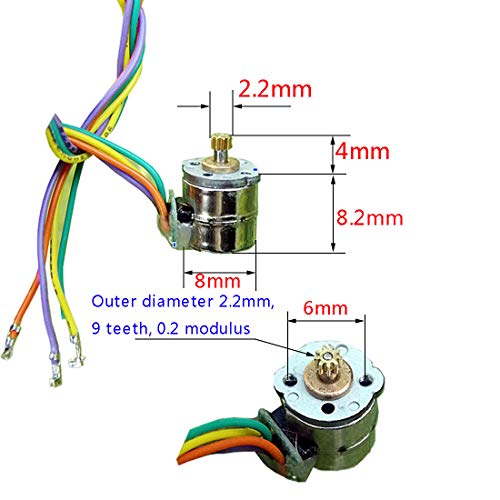
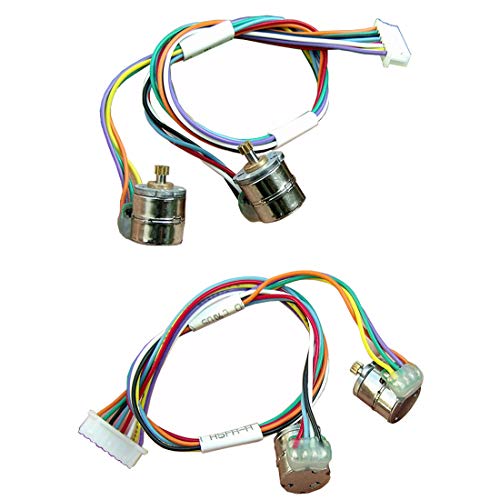
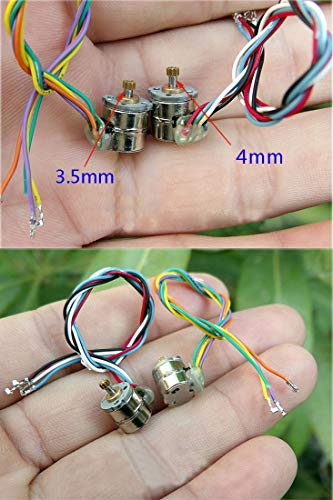
The Abovehill 10 Pairs 8mm Micro Stepper Motor set delivers precision 2-phase, 4-wire stepper motors optimized for digital cameras, autofocus, and compact appliance applications. Operating efficiently at 5-6V and 0.12A current, these motors feature dual shaft lengths (4mm & 3.5mm) and durable copper gears, ensuring versatile, reliable performance. Perfect for professionals seeking compact, energy-efficient motion control solutions with easy integration.
| ASIN | B08346RFVZ |
| Batteries Included | No |
| Batteries Required? | No |
| Customer Reviews | 4.4 4.4 out of 5 stars (40) |
| Date First Available | May 9, 2022 |
| Item Dimensions LxWxH | 12 x 8 x 8 mm |
| Item Weight | 57.7 g |
| Manufacturer | abovehill |
| Material | Copper |
| Product Dimensions | 1.22 x 0.79 x 0.79 cm; 57.83 g |
| Speed | 2000 RPM |
| Voltage | 6 Volts |
G**G
For some reason the listing doesn't provide any details about what part these are. They are, specifically, PM08-2 stepper motors. So from that, its pretty easy to find spec sheet with coil polarity, current, and all the dimensional information. These are typically used for autofocus and/or zoom mechanisms in lenses, so they're a very common stepper motor. So far all the ones I've tested in the pack worked. They're easy to drive, generally with a dedicated stepper controller, although you can kind of drive them directly from a microcontroller, but you've got a pretty good chance of cooking it. These, and their controller, aren't going to get hot at the very low current they run at, but it more than most microcontrollers can handle. Driving them with TMC2209 drivers works like a charm, if pretty substantial overkill. They are 18 degree steppers, so they're 20 steps per rotation on a 9 tooth gear. That's a half tooth per step, so the microstepping of a modern dedicated controller may be useful depending on what you're using it for. The brass (or copper, some PM08s are copper gears) is 2mm in diameter pressed on, and I kind of doubt you can remove it without destroying the stepper. Its a 0.2 modulus, which are unfortunately fairly pricey gears and very small even for resin printing, so interfacing with these isn't especially easy if its not simply being used as a replacement.
J**.
While this motor ended up being a little too small for my usecase, I was pleasantly surprised to find that it could be driven from an Arduino's raw PWM outputs. (Just barely; the current draw is at the edge of frying the output pins). I used this code to drive it at a constant speed with the DFRobot "Beetle" Arduino: ``` void setup() { pinMode(3 , OUTPUT); pinMode(11, OUTPUT); pinMode(9 , OUTPUT); pinMode(10, OUTPUT); } void loop() { float floatTime = float(millis()); float A = (sin((floatTime * 0.03) )) * 255; float B = (sin((floatTime * 0.03) + 1.5708)) * 255; analogWrite(3, max(0, A)); analogWrite(11, max(0,-A)); analogWrite(9, max(0, B)); analogWrite(10, max(0,-B)); } ``` However driving it raw is a little noisy; putting a SilentStepStick (TMC2208) in-between got rid of the noise and ~doubled the effective torque, but the pot needs to be adjusted to keep it from getting hot. Also, the way the steppers are packed two-per-piece on a single connector isn't very convenient... Make sure to pay attention to the description's pinout order; here's the mapping I used for the StepStick's pinout to the description to the wire colors: 2B = "A-" = Black or Yellow 2A = "A+" = Blue or Purple 1A = "B+" = Red or Orange 1B = "B-" = White or Green
J**.
The product arrived in a timely fashion, exactly as described; however, other than one line written on the outside of the package describing the contents, there was no information included on this product; no suggestions on how to run it; and no links online for more information about it. Why has including instructions on a product ordered online become something companies feel no obligation to do anymore?
Trustpilot
2 months ago
2 days ago