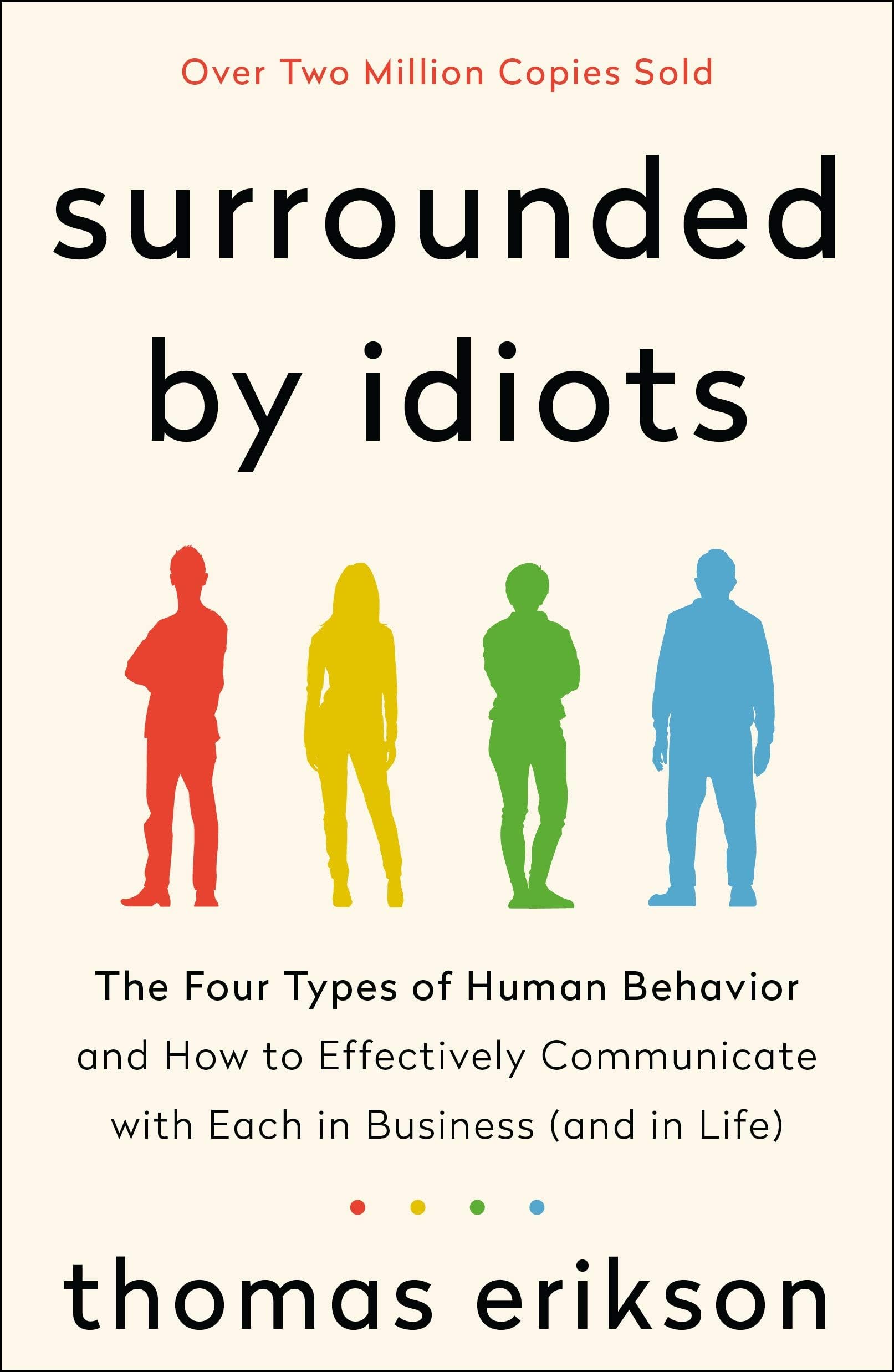
Surrounded by Idiots: The Four Types of Human Behavior and How to Effectively Communicate with Each in Business (and in Life)
Product ID: 778333645
Desertcart purchases this item on your behalf and handles shipping, customs, and support to Philippines.
Do you ever think you’re the only one making any sense? Or tried to reason with your partner with disastrous results? Do long, rambling answers drive you crazy? Or does your colleague’s abrasive manner rub you the wrong way? You are not alone. After a disastrous meeting with a highly successful entrepreneur, who was genuinely convinced he was ‘surrounded by idiots’, communication expert and bestselling author, Thomas Erikson dedicated himself to understanding how people function and why we often struggle to connect with certain types of people. Surrounded by Idiots is an international phenomenon, selling over 1.5 million copies worldwide. It offers a simple, yet ground-breaking method for assessing the personalities of people we communicate with – in and out of the office – based on four personality types (Red, Blue, Green and Yellow), and provides insights into how we can adjust the way we speak and share information. Erikson will help you understand yourself better, hone communication and social skills, handle conflict with confidence, improve dynamics with your boss and team, and get the best out of the people you deal with and manage. He also shares simple tricks on body language, improving written communication, advice on when to back away or when to push on, and when to speak up or shut up. Packed with ‘aha!’ and ‘oh no!’ moments, Surrounded by Idiots will help you understand and communicate with those around you, even people you currently think are beyond all comprehension. And with a bit of luck you can also be confident that the idiot out there isn’t you! Review: What personality type are you? - Fantastic book! Highly recommend for any leader/psychologist or anyone interested in human behaviour. It’s easy to read and has plenty of pictorial diagrams to help the reader to understand too. It’s engaging from beginning to end. There’s an audio version too. Review: Good read - Entertaining, easy read to introduce the subject. Good thing that it is broken down into simplistic and provocative language, keeps you reading even when tired and it makes it very memorable being easy and repetitive. Also, I suspect a purposeful choice to go in order of red, yellow, green and then blue, a blue probably has more patience than a red to keep reading on. I am red, I might have stopped reading if not for the entertaining first red chapter considering that yes the use of he/him instead of they for example is a bit annoying. Luckily, details like this can be blinded out ;)
| Best Sellers Rank | 1,131,917 in Books ( See Top 100 in Books ) 416 in Language Communication Reference 1,874 in Higher Education of Biological Sciences 3,914 in Popular Psychology |
| Customer Reviews | 4.4 out of 5 stars 6,307 Reviews |
M**K
What personality type are you?
Fantastic book! Highly recommend for any leader/psychologist or anyone interested in human behaviour. It’s easy to read and has plenty of pictorial diagrams to help the reader to understand too. It’s engaging from beginning to end. There’s an audio version too.
S**Y
Good read
Entertaining, easy read to introduce the subject. Good thing that it is broken down into simplistic and provocative language, keeps you reading even when tired and it makes it very memorable being easy and repetitive. Also, I suspect a purposeful choice to go in order of red, yellow, green and then blue, a blue probably has more patience than a red to keep reading on. I am red, I might have stopped reading if not for the entertaining first red chapter considering that yes the use of he/him instead of they for example is a bit annoying. Luckily, details like this can be blinded out ;)
P**.
Pseudopsychological Guff.
I bought this hoping for some real psychological insight into people. Instead I got pseudopsychological guff. It is oversimplified condescending pseudopsychology, aimed at the clueless corporate HR crowd. Of use only as toilet paper or in a recycling bin.
H**A
A Corporate Idea, Not a Behavioural Model
This book is an ok read. There are some things worth taking from it, but as a whole it has to be taken with a pinch of salt. The theory does not seem to have much basis in scientific research. For a model of human behaviour, and for being touted by the author/creator as a highly accurate one, I would have expected more reference to studies he lead showing how evidence supports his theory. He does refer to the psychologists who actually created the original system, but has changed it profoundly without giving reasons. He also ignores criticisms except to state that criticisms exist. Bizarrely, he adds a section about the Aztecs and Hippocrates as powerful and ancient people with fascinating ideas that he has borrowed from. The way he writes suggests that he thinks this is a good thing. Sure, medics still take the Hippocratic Oath, but they otherwise seem quite enthusiastic about using the most recent and robust information to hand to inform their practice. Much the same seems to be the case for psychology. Just because something is old doesn’t means it’s the best or even good, and I’m surprised he takes this attitude. Effectively, you have to take his word on most things, and on the rare occasions when evidence is produced it is blatantly selected only because it supports what he’s saying right then, and not because it was good quality. I appreciate that as a popular book he probably didn’t want it to be dry, as many (most) very academic pieces are. But equally, I have read a good few other popular psychology and science books that did manage to be engaging, easy to understand, but also rigorous in their inclusion and treatment of evidence (Oliver James’s work and Ben Goldacre’s “Bad Science” being two such examples). If taken in a narrow context, like doing a project at work, there are aspects that can be useful, and he does give decent information about how to handle people and their different approaches, as well as yourself. So the person who is focused on ensuring their work is always thorough and correct may not be interested in a chat about what happened at the weekend. The person who wants everyone to get along may be stressed by a confrontation. And if people are annoyed with you, it may be that you’ve overlooked an awful lot of what was crucial in getting a job done. The author says that people are often just different from you, but that doesn’t make them wrong. He says that variety in people’s approaches is necessary for anything to be achieved. And he says that we are best when we learn to accept others and their differences. All these statements are admirable and clear-sighted. But as you read on it seems like he doesn’t always agree with his own approach. Some personality types are treated with more sensitivity and generosity than others. Perhaps he did this to prove a point about how he falls into his own behavioural system (presumably as mainly red), but when you’ve put your thoughts into the written word to be published, I expect you to be able to look at what you’ve said and work hard to address imbalances. Especially when your theory is supposed to help make people more self-aware. Overall, the book gave me some insight as to how different people approach work, and how I might work with them. It also drew attention to the downsides of my own way of working and how that might mean other people perceive me, and how I can deal with that. All that was quite useful, and that’s why I give two stars and not one. But this was a book written with a corporate mind, not a scientific one, or even an especially sensitive one. So I would be cautious about trying to apply it more widely. I would have given three stars if the author had treated all his subjects more generously, and if there was an indication that the book was based on more robust evidence than it appears to be. Four stars if he was more honest about its shortcomings.
P**E
Trite. Poorly written.
Poorly written. Pushing his company's personality testing service. Is it DISC or DISA ? He can't settle on one, the DISA abbreviation changes several times throughout. No basis for it at all. . Terrible writing style. Verbose, unstructured. No way to figure out which type you are. Relies on a colour classification novelty, which soon wears thin. Everyone has elements of all four classifications. Some people don't get on. You need all sorts of people in your company or team. Trite.
K**1
‘Eye-roll’ sums it up best
Disengaged as soon as the author said he’d decided to use ‘he’ and ‘his’ for all examples, no need at all. Author comes across as arrogant, found it both dull and irritating to read
C**O
Easy to read
I prefer hard covers to those of paper as they are easier to store in my library yet in this case I was not sure if I would keep this book. I am now happy I made this decision as I will definitely hold on to it. Interesting view of people’s traits and a helpful reading to strengthen our communication capacities.
D**E
Arrivato in buone condizioni
Libro arrivato in perfette condizioni, non l'ho ancora letto ma ne ho sentito parlare positivamente.
A**P
A Literary Review for Graduate Study
This book describes four behavior types by sorting them into colors: red, blue, green and yellow. People that are sorted into these behavior types typically exhibit the same characteristics. For example, the book claims that green individuals are typically laid back and sometimes struggle to make decisions. Since teachers need to be able to understand and manage behavior, this book can be a foundation for how we interpret different social situations with students. While Erikson does point out that we should not use this classification method on children, it does give us some background knowledge on students and what drives behavior (e.g. environment). There are many aspects of the book that I enjoyed. The book begins with a description of how and why he and his father began classifying behavior in this way. They used what is called the DISC method to establish these four behavior types. He explains that most people are a combination of two or three behavior types; very few people are just one type. Erikson describes the basis of behavior – what causes us to behave in the way that we do. He then moves on to provide an overview of the system, listing characteristics of each color in a diagram provided on page thirteen. After this introduction, he dives into how we can recognize each behavior type, how each behavior type deals with stress, which behavior types are best suited to work together, how to give feedback to each behavior type and so on. In chapter nineteen, Erikson provides examples of how people who have been sorted into the different behavior types react to different questions about their behavior and the book. Each of these people who were interviewed have read the book and are able to explain how they feel about the portrayal of individuals who belong to the group they do – most of them seem almost annoyed. For example, Hakan seems annoyed that the interviewer points out what he says is contradictory. The book ends with an interactive quiz, which is perhaps one of my favorite parts. It allows the reader to self-assess and determine what they took from this book and how they (now) understand the different behavior types. While there are not many things that I would change about the book, there are some pieces that could help provide some clarity for the reader. I loved how each behavior was talked about in detail; however, there were some parts where I really had to stop and think about what behavior was being talked about and reflect on what was said about that “color” chapters beforehand. This was likely due to the fact that it would spend the course of four chapters talking about each behavior type individually in relation to one concept or situation. It may have been better for the author to adjust this so that each situation was talked about for a single behavior type. For example, perhaps chapters four through nine could have talked about just green behavior, describing the different situations, scenarios and ideas that are discussed for that behavior throughout the book. This was not a huge issue since there were a variety of visuals, but it may be difficult for some readers who lack reading comprehension skills or have problems organizing information in their minds.
S**P
Finished this book in 2 days 💯
I’m not a pro reader, but I can binge read books that are really good - Simple, fun, and teach you something you can immediately apply. Surrounded by idiots caught my attention from the first few pages. It is one of those books that make you wonder how different society would be if everyone read it once. After I finished this book, I made a list of all the closest people I interact with (family, friends, coworkers, lovers) and tried to identify their “colors”. My perception of these people went from being “aggressive” or a “pushover” to “Red” and “Green”. It subconsciously became second nature to me to quickly identify what colors someone I am talking to falls under and so naturally you start understanding why people are the way they are and how YOU can adapt to them better to make the most out of that interaction/relationship. One area in which I found this information to be quite amusing and helpful to analyze is in the context of romantic relationships. I started seeing the “true colors” of my past partners and inherently saw why the relationships were either great, or not, and where they went wrong and how knowing this information now and applying the knowledge in the next relationship will be drastically life changing. I realized why as a Yellow, Red with hints of Blue I was having problems with someone that was Red and Blue - My “yellow side” clashed with their “blue side” while actually complementing their “red side”. Our common "redness" led us to fall for each other as we both like someone with the same qualities, but also played a role in weakness as it brought some subconscious competitiveness that is not good in a romantic partnership, especially if one or both partners aren’t emotionally mature enough to see things for what they are instead of falling prey to the supposed societal norms and perceptions that are unfortunately being reinforced in everyday social media content. It’s truly remarkable once you realize how humans self sabotage and this book definitely helps you realize that. I can also now see the downfall of my past relationship with a mostly Green person. My Red side could not only not tolerate being with a Green person, but it made my redness go into overdrive and into survival model (instinctual human behavior) which ultimately caused the imbalance that led to a breakup. In my personal view, It’s important to not see this as a lesson of « I can’t entertain a prospect with a color that challenges mine » as 1) though challenging, it is actually *goals* to be with someone that has some opposing qualities so both partners can adopt traits that can help them become a more upgraded and newer version of themselves that will open new doors in life. Remember, a partner should ultimately make you grow, not just make you feel comfortable. As a yellow, you want and need to become more blue, and as a blue you would most definitely benefit from being more yellow; in fact, it’s exactly those lack of yellow traits that have you somewhat stuck in your life and same goes for the yellow person - they both represent the characteristics that are needed to take their lives to the next level! and 2) because you come to understand that unless yo are both 100% one color, everyone (~85% of the population) will have a mix of colors and that you will have to learn to adapt to each other. I think couples needs to read this book more than anybody! In summary this book is a 9.5/10. Fun, simple, and impactful. Must read!
大**ゆ
Communication master
I bought this couple months ago because I am simply interested in understanding people through communication. It was well written.
P**M
Received an old second hand copy
The book I received was far from new, completely faded by the sun, corners broken and pen markings all over. Total scam !!
Trustpilot
1 week ago
3 weeks ago