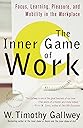
The Inner Game of Work: Focus, Learning, Pleasure, and Mobility in the Workplace
Product ID: 87952237
Desertcart purchases this item on your behalf and handles shipping, customs, and support to Philippines.
Do you think it's possible to truly enjoy your job? No matter what it is or where you are? Timothy Gallwey does, and in this groundbreaking book he tells you how to overcome the inner obstacles that sabotage your efforts to be your best on the job. Timothy Gallwey burst upon the scene twenty years ago with his revolutionary approach to excellence in sports. His bestselling books The Inner Game of Tennis and The Inner Game of Golf , with over one million copies in print, changed the way we think about learning and coaching. But the Inner Game that Gallwey discovered on the tennis court is about more than learning a better backhand; it is about learning how to learn, a critical skill that, in this case, separates the productive, satisfied employee from the rest of the pack. For the past twenty years Gallwey has taken his Inner Game expertise to many of America's top companies, including AT&T, Coca-Cola, Apple, and IBM, to teach their managers and employees how to gain better access to their own internal resources. What inner obstacles is Gallwey talking about? Fear of failure, resistance to change, procrastination, stagnation, doubt, and boredom, to name a few. Gallwey shows you how to tap into your natural potential for learning, performance, and enjoyment so that any job, no matter how long you've been doing it or how little you think there is to learn about it, can become an opportunity to sharpen skills, increase pleasure, and heighten awareness. And if your work environment has been turned on its ear by Internet technology, reorganization, and rapidly accelerating change, this book offers a way to steer a confident course while navigating your way toward personal and professional goals. The Inner Game of Work teaches you the difference between a rote performance and a rewarding one. It teaches you how to stop working in the conformity mode and start working in the mobility mode. It shows how having a great coach can make as much difference in the boardroom as on the basketball court-- and Gallwey teaches you how to find that coach and, equally important, how to become one. The Inner Game of Work challenges you to reexamine your fundamental motivations for going to work in the morning and your definitions of work once you're there. It will ask you to reassess the way you make changes and teach you to look at work in a radically new way. "Ever since The Inner Game of Tennis , I've been fascinated and have personally benefitted by the incredibly empowering insights flowing out of Gallwey's self-oneself-two analysis. This latest book applies this liberating analogy to work inspiring all of us to relax and trust our true self." --Stephen R. Covey, author of 7 Habits of Highly Effective People


| Asin | 0375758178 |
| Dimensions | 13.13 x 1.45 x 20.22 cm |
| Edition | Reprint |
| Isbn 10 | 9780375758171 |
| Isbn 13 | 978-0375758171 |
| Item Weight | 227 g |
| Language | English |
| Part Of Series | The Inner Game |
| Print Length | 256 pages |
| Publication Date | 11 Sept. 2001 |
| Publisher | Random House Trade |
User
A must read.
Very easy to read and full of insight, it deserves being one of the 'classics' in coaching literature. A must.
User
Read this first!
This is an extremely influential book. It is the source of the successful work of so many people who have gone on to refine and publish their methods for coaching and consulting in the workplace.It is easily understood and practiced, which is the whole point, really.It offers opportunity for development for anyone today, not just those engaged in change processes.It makes so much sense that you will be drawn into using the practices without knowing it.
User
Four Stars
Great book
User
A great coaching book
This is the first Tim Gallwey book I have read and can thoroughly recommend it. Tim started his career in formal education and then found a new way of learning, that formal education missed. Working as a coach and raising awareness of the coachee, he found that learning was enabled from their own experiences and so was more relevant for the learner. There is lots of great coaching insights in this book.
User
An Excellent Read
All managers should consider this as essential reading when considering how to build effective teams that combine productivity with a good sense of the team and individuallity.
User
Cut to the chase - go directly to Chapter 9
I know it's a best seller, and millions of people can't be wrong, but for me, this book is based on a very thin premise – that of a negative voice. This is expounded in the first 8 chapters – skip directly to Chapter 9 would be my recommendation. And unfortunately, thats almost the last chapter. Here things do start to get useful as we move into types of coaching conversations - for awareness; for choice and for trust. Great questions for my coaching toolbox.
User
Five Stars
Great book
User
Simple but profound insights about learning
In 1976 the author Timothy Gallwey, gained a remarkable insight when trying to coach tennis. He pondered whether he was aiding or preventing the learning experience. This revolutionary thought process was provoked when he discovered that by asking the learner to focus on the ball & not the shot - by stating out aloud what the ball was doing - immediately improved the person's ability to play the ball.In fact he found that the generally accepted method of providing advice as a coach on how to improve the shot was having the converse effect viz preventing the shot from being played correctly. This insight calls into question the role of the coach in the learning process.From this profound insight arose the concepts of Self 1 & Self 2 where Self 2 was the non judgmental & intuitive part of oneself whereas Self 1 was the judgmental part which was invoked or provoked by traditional methods.Typical training invoked the Self 1 which hindered the learning process. Evolving from this is the concept that in most situations the person had the innate ability to perform the task themselves. To prevent the Self 1 from automatically kicking-in, the role of the coach would instead focus on invoking Self 2.Gallwey then expands this concept & demonstrates into applicability in the world of work. His first assignment involves the improvement in the tedious job of call centre operator.Gallwey discusses how one can maximize one's enjoyment of even mundane tasks. By enjoying a task one is in a "state of flow" or "in the zone".Other concepts are also introduced viz STOP when "renewal" is required. This relates to STEP BACK, THINK, ORGANISE YOUR THOUGHTS & then PROCEED. This is also a powerful concept to employ when floundering under pressure.However what resulted in a score of a meager 3 is the attempt to philosophize. Maybe it's Mr. Gallwey's attempt to shed light on the application of these concepts, but instead I found them tedious & repetitive.The concept of Self 1 & 2 undoubted has wide applicability & will no doubt gain greater acceptance with quality of work life issues on the ascendancy in the Western world. This is useful book for the collection as one needs to "dip in" every now & then. Overall there are some powerful & appropriate concepts which can be learnt but it could have been covered in half the number of pages.
User
Buchbewertung aus Sicht eines Coaches und Trainers
Dieses Buch geht von der zentralen These aus, dass jeder Mensch ein Ich-1 (Self 1) (dass unablässig bewertet - lobt und kritisiert) und ein Ich-2 (Self 2) (das für schöpferische Kreativität und die Einzigartigkeit jedes Menschen steht) in sich hat.Im weiteren Verlaufe des Buches arbeitet Gallwey heraus, welche Aspekte für die größtmögliche Befreiung des Ich-2 zu berücksichtigen sind (Awareness - Bewusstseinsmachung, Choice - Wahl und Vermeidung des Tunnelblicks sowie Trust - auf das Ich-2 vertrauen).Die Verknüpfungen der Aussagen im Buch zum Coaching sind vielfältig. So arbeitet Gallwey sehr gut den Unterschied zwischen Lehren (teaching) und Coaching heraus. Auch belegt er an vielen Beispielen, dass ein nicht-bewertendes Hinterfragen im Coachingprozess oft schon eine sehr heilende Wirkung auf den Coachee haben kann.Im vorletzten Kapitel erläutert Gallwey eine Methode, die in Veränderungsprozessen gut eingesetzt werden kann: den Wechsel der eigenen Perspektive in die Person gegenüber (Transposing). Auch aufgeführt werden in jenem Kapitel einige hilfreiche Fragen, die in den Veränderungsphasen Bewusstwerdung (awareness), Auswahl von Wegen und Methoden (choice) und Vertrauensbildung (trust) sehr gut eingesetzt werden können.Für alle Leser, die sich strategisch mit dem eigenen Arbeitsleben (und dem der Mitmenschen) beschäftigen möchten, kann dieses Buch ein echter Gewinn sein!
User
Great read for those seeking career progression
Highly recommended book for those looking to grow their professional status
User
Reflects Author's Evolving Thoughts On The Inner Game Of Work (And Everything Else)
I admit have not read the author's classic, The Inner Game of Tennis.Instead, I chose to order TIGOW because I thought the groundbreaking concepts in TIGOT would not only be repeated in the former but that the former would reflect the author's evolving understanding of inner games. After all, many years had gone by since the publication of the later.Having completed TIGOW, I have no reason to believe that I was wrong.Anyway, TIGOW is excellent. Reading it will almost certainly help your inner game.I have nothing to add to what other people have said about the book.Except that the story the author relates concerning the class he took as a Havard undergrad featuring then professor B.F. Skinner demonstrating the power of operant conditioning on a pigeon subject has stayed with me. That story alone might be worth the price of the book for those who understand much of its chilling and not-so-chilling implications.Get the book.
User
Inner Game
It's a pretty deep analysis human interactions in work environment! Beyond that the author goes deep in mental strategies which can take us toward excellence!!!
User
Excelente
Un gran libro de Tim Gallwey, te explica claramente los conceptos de "inner game" aplicable a negocios, pero sobre todo a como crecer uno mismo.
Trustpilot
2 weeks ago
4 days ago