

Desert Online General Trading LLC
Dubai, United Arab Emirates
Desert Online General Trading LLC
Dubai, United Arab Emirates
Full description not available
J**N
Open the lid; it's a good trashy read...
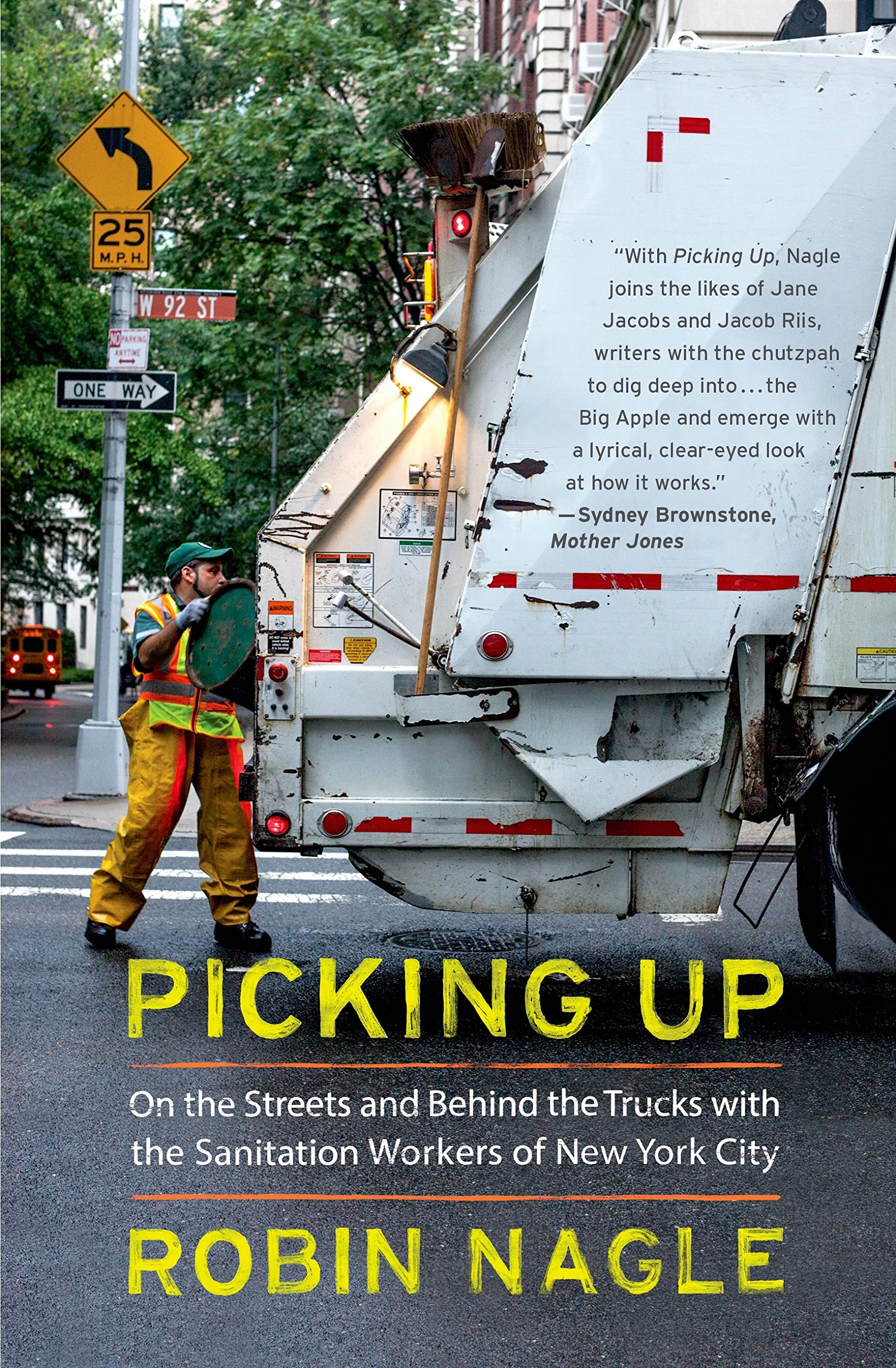
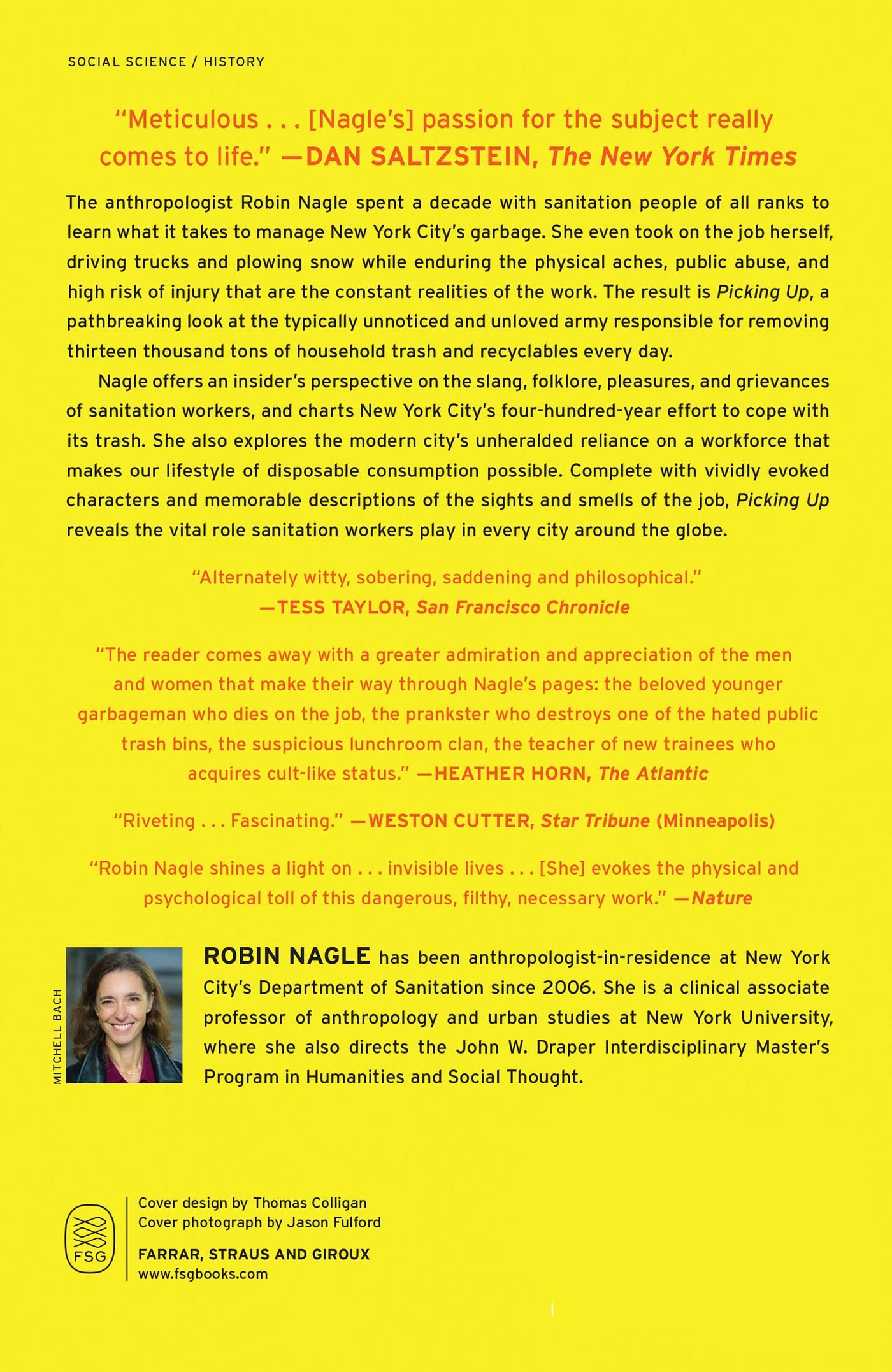
It's difficult for anyone to imagine a good book about trash... call it refuse, rubbish or garbage, whatever you might like. However, sometimes one can be quite surprised, even as a New Yorker.Author Robin Nagle's Picking Up is about the DSNY, the City of New York's Department of Sanitation, and it's an interesting and sometimes fascinating book. As the subtitle "On the Streets and Behind the Trucks with the Sanitation Workers of New York City" suggests, this one takes you down to the road level where the trash bags, garbage cans and dumpsters exist, waiting their scheduled pickup.Ms. Nagle teaches anthropology at New York University, and has been anthropologist-in-residence at the DSNY since 2006. After reading this book, it isn't hard to be a bit more grateful of the efforts of the men and women who clean up after us, regardless of where you live. These unsung heroes are essential to us, unless you're one of those who has to take your own trash to a municipal dump or some such suburban facility.As one reads the pages of this work, it becomes amazing to realize that Manhattan Island itself has historically been extended into both the Hudson and East Rivers by building on its own trash. The author does an excellent job of covering the role of the long history of sanitation and its workers in the Borough of New York, going from such topics as 17th-centuryNew Amsterdam's ban on scavenging pigs to Street Commissioner George E. Waring Jr.'s spotless White Wings cleaning crews at the turn of the 20th century. The author also looks at the command breakdown that tarnished the reputation of the DSNY after the 2010 blizzard.She reveals that the DSNY has its own fascinating jargon: "getting banged" is undergoing corrective disciplinary measures and "disco rice" refers to maggots. The term "mongo" refers to objects salvaged by sanitation workers from the trash, and can be used as either a noun or as a verb. In addition, sanitation workers should be referred to as "san men" and not as "garbage men."We are reminded that sanitation workers have a higher on-the-job death rate than any other uniformed department in the city, firefighters and police officers and firefighters included. They have one of the 10 deadliest jobs in America, due to traffic accidents and exposure to toxic waste, yet their responsibilities are not at all as respected, much less admired. She quotes a sanitation worker: "You can go your whole life without ever having to call a cop. And you can also go your whole life without ever calling a fireman. But you need a sanitation worker every single day."Ms. Nagle's book is not just to make us more aware of sanitation workers. She reminds us that they are New York's Most Essential. She writes: "Sanitation is the most important uniformed force on the street."Picking Up is the result not just of Ms. Nagle's years researching the New York Department of Sanitation, but of a deeply-rooted preoccupation with trash that dates back to her own childhood. She has taken a topic that many of us would pass on, thinking that it would be boring or perhaps even disgusting, but instead we find a book that reads like a novel. Open it and you'll find (and pardon the pun) that it's a good trashy read.5/10/2013
S**N
Who Knew??
As a child, I remember watching a "Sesame Street" segment about garbage disposal. It began with a banana peel being tossed in a garbage chute, and ended with a barge chugging out of a harbor with a sing-songy jingle reciting, "Goodbye, garbage!" I was always troubled by that segment - notwithstanding the obviously absurd implication that garbage dumped in the ocean ceases to exist, I also felt that there must be more - a LOT more - to the story. Years later, I sometimes observed rumbling garbage trucks and wondered about their mission and the people who carried it out.Enter Dr. Robin Nagle, anthropologist, professor, and sanitation worker. "Picking Up" is a moving, gritty, and sometimes laugh-out-loud-funny meditation on sanitation in the modern world. Nagle considers sanitation workers the single most important uniformed force in New York City, and after recovering from the audacity of such an idea, I had to acknowledge its plausibility. Her descriptions of New York BEFORE modern sanitation opened my eyes to blessings I never realized I had. I used to think of the City as grimy, even dirty, but compared to the ankle-deep filth and rampant disease of earlier times, I now recognize its astonishing cleanliness.This is one of the most literate books I have ever read. Nagle tips her hat to at least half-a-dozen literary works, from Dante's "Inferno" to Douglas Adams's "Hitchhiker's Guide to the Galaxy". That, the exhaustive end notes, and the occasional word that sent me to a dictionary ("peristaltic"??), engendered a deep respect for the author's scholarship. I am relatively well-read, with an above-average education, but Nagle's prose led me to intellectual depths I never even knew were there.I felt that "Picking Up" is about so much more than just garbage and sanitation workers. This is a book linked to universal human experience, through the basic life functions essential to one of today's most vibrant and challenging urban centers.
S**E
Flawed, but very interesting
I very much enjoyed this inside look at the operations of the Sanitation Dept of NY (DSNY) written by an anthropologist who embedded herself in the Dept. by both observing the day to day operations and apparently hiring on as a DSNY employee. However, this brings up a major problem I had with the book. From reading the text, the impression I had was that after first getting permission to travel with some of the crews, she decided to actually become an employee. It was only when I got to "A Note About the Author" at the end did I learn that since 2006 she has been the "anthropologist-in-residence of the DSNY." This was not brought up in the text. She does discuss an early meeting with DSNY management to get permission to ride along with crews, but even that sets out no limits placed on her. The later chapters when she is applying for a job going through training and working were very interesting, but made no mention of whether this is with the prior approval of upper management and the degree to which she and management selected her assignments and how much her fellow employees knew about her status. In my mind this makes her observations suspect, or at least sugar coated. The best part of the book are the stories about individual workers and their interaction with the public and management. There is a portion of the book devoted to some selected historic events relating to trash in NY since colonial times, This doesn't really add much to understanding the current situation, and I found myself skimming them. The other major weakness is the lack of any definitive summing up or conclusions from all the observation. The last chapter discusses benevolent societies associated with DSNY. The Postlude just echoes her oft repeated message that somebody has to pick up the trash and it is a tough under-appreciated job.
Trustpilot
5 days ago
2 months ago