Desert Online General Trading LLC
Dubai, United Arab Emirates
Desert Online General Trading LLC
Dubai, United Arab Emirates

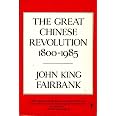
The Great Chinese Revolution 1800-1985
A**L
A rewarding delightful experience
I read history to understand my short time in a finite place, the United States in the first part of the 21st century. Just I do not have to take any test, pass any course or earn any degrees, John King Fairbanks when he wrote this late in life didn't have to face any peer review committee or publishers approval. He writes this book as a gift to share his life time of scholarship to those who are just interested in what forces forms our way of life, using China as both a particular story and an example of universals.He lays out the vastness of the challenge of the book in the beginning, saying China isn't just a country; in variety and vastness it would be compared to all of "Christiandom" that is Europe, Western Asia and North an South America. He frankly shares the limits of what is known, describing the Taiping Revolution, a heterodox Christian ideology that became a horde led by a man who claimed to be the brother of Jesus, that ravaged the land for a decade loss of life in the millions. All records of this event that was occurring during our own civil war had been destroyed by the dynastic rulers who saw it as an embarrassment, only to be recreated laboriously by later historian. While he tells of the history, he recounts the historiography, the project of recovering records that can allow the stories to be accurately told.What makes this book unique is the way Fairbank steps aside to describe the difficulties of explaining various elements. So we learn a bit about Chinese Characters and how they were revised to make them more accessible to the masses who had been almost all illiterate. We also learn more about those Scholar-Officials that had been equated to our own civil service. It was so much more, as Fairbank described it was a combination of a full college professor and member of congress. They became a class, almost a separate ethnic group who dressed, talked and looked differrent, with not only delegated authority but as interpreter of classic Confucian values. And when Fairbank takes a crack at describing that which takes a lifetime to understand, he prefaces it with saying how pale the explanation is to the full understanding.So, for this novice, I came away learning a bit about China, but also the privilege of with spending time with this good natured scholar who loved his subject and seemed to get a real pleasure out of sharing what he spent his lifetime to understand.
Y**G
The best book on China I ever read
"The Great Chinese Revolution" is a great book, no match among the books on China I have read in that the author, the greatest Sinologist, John King Fairbank really wrote in the way a surgeon operated with a scapel, dissecting Chinese culture so thoroughly and the observation so piercing that I couldn't help clapping with my hands many times while reading it. He uprooted all the grave problems with Chinese culture in terms of politics and shed light on them in such an enlightening way that conquered me totally.
T**R
The Great Chinese Revolution 1800-1985
This book by John Fairbank King is a very interesting book on China. As someone who has taken Asian Studies courses in college, I used this book to aid in the writing of an article for future publication. However, if you long to learn about China, you need to read this book.
J**D
Great Revolution
He covers a tremendous transitional period for modern China which is vital for understanding China. I thought it was very good in covering a difficult and complicated era but I think his perspective on the Nationalists vs the Communists was misguided somewhat. The Nationalists unfortunately paved the way during a very turbulent period of Chinese history which resulted in great progress but created an impression that they were going to be more corrupt and unsuccessful than the Communists in creating a better future for the people. Chairman Mao was very astute in selecting the poor and ignorant peasants to do his bidding as any smart demagogue would do.
K**6
Five Stars
A great and brisk history of China by one of the great China scholars of all time
C**L
Americans who read a book like this stand to gain a lot
The author, now deceased, wrote this wonderful book after his retirement from Harvard, having taught the history of China there for over forty years. Although he authored a large number of scholarly works on that country, like other retired scholars, he now aimed this book at non-scholars and so his text is lightened at times in a way that made me smile several times. For instance, he makes occasional statements summarizing preceding information in a whimsical but telling manner in an effort to help laymen Americans like me understand the Chinese way of doing things. My impression is that Professor King assembled his lecture notes on modern China and fashioned them into this very readable and important book.His main effort is to explain how the Chinese people were pressed forward, by an array of leaders, all in succession, out of a pre-modern, feudal and internally focused imperial system, and into 20th century. The author naturally pays a lot of attention to politics and government and so I enjoyed his discussion of the difficult initiatives made by Chinese leaders in the early 1900s, including Sun Yat-sen, in favor of a western-oriented, republican form of government. The author gives due attention to the often times shameful interventionism of Europeans and Americans eager to make a fortune there in the late 1800s and otherwise impress their values on the Chinese.The turmoil associated with the trials and errors associated in the search for a viable more up to date form of governing, pressed by enormous international forces, including world wars, encourages the rise of Mao Tse-tung. He takes the needs and aspirations of the little people from the vast back lands into account as well as their ancient communal values and thereby fashions a soviet-styled government that later morphs into Chinese socialism led by him single-handedly. Although he helps create a single dominant party to help govern the country, Mao is unable to rise above the egocentrism of a dictator and plunges the people of China into government programs that meet disastrous and practically genocidal ends in the 1970s.With the passing on of Mao Tse-tung in 1976 and the arrival of his successors, including Deng Hsiao-p’ing, China lurches forward, in a steady and costly manner, to become a power house in the 21st century. Americans who read a book like this stand to gain a lot of appreciation about how the Chinese people got to where they are today.
D**S
Fairbank is amazing
Great book in great shape.
Trustpilot
1 month ago
1 week ago
3 days ago
3 weeks ago